
Zero-Click Search in 2026: What Businesses Need to Do
Someone types a question into Google. A years ago that meant looking at a list of blue links and choosing one to open. In 2026 it often means something the answer shows up. In a snippet a box, a local listing or a short summary made by an AI. And the person moves on without opening any website.
This is zero-click search. It is no longer a small thing. Research from SparkToro using Similarweb data found that 68% of Google searches in the U.S. In early 2026 ended without any click up from about 60% in 2024. That is a change, in just two years and it is happening as AI-powered search experiences grow fast. Google said at I/O 2026 that its AI Mode had already reached 1 billion monthly users with the number of questions asked doubling every quarter.
None of this means search is going away. It does not mean your website is not important. It means the work of appearing in search has gotten bigger. This guide explains what zero-click search really is, why 2026 is the year it needs your focus and. Importantly. Exactly what your business needs to do about it.
What Is Zero-Click Search?
Zero‑click search occurs when a person finds the answer they need directly on the search results page. Through a featured snippet, knowledge panel, local pack or AI‑generated summary. Without clicking into any website. Zero‑click search does not mean the search failed; zero‑click search means the answer has moved onto the results page itself.
For example if someone searches “what is a domain name ” Google shows a definition at the top of the page. The searcher receives the answer closes the tab and moves on. From Google’s perspective that is a search. From a business’s perspective that is an impression that did not convert into a visit. Unless that business’s content was the source of the answer.
Zero‑click search results exist because search engines have become better, at understanding intent not just matching keywords. When a question has one factual answer there is often no need to send someone to a full page to find it.
How Does Zero-Click Search Work?
User Query → Search Engines Understanding of Intent → SERP Feature or Direct Answer → User Gets Information → Click Becomes Optional
The exact experience that the user sees depends on factors: the type of query the device of the user the location of the user the platform such as Google Search, Google AI Mode, Bing or an AI assistant and even the time of day for things like local business hours. The search engine must interpret the query. A “what is” question behaves differently from a “best plumber near me” search, which behaves very differently again from a complex multi-part research question typed into an AI chat interface.
This point is worth repeating because it is easy to oversimplify: not every query produces a zero-click result and not every SERP feature behaves, in the same way. Some searches still send plenty of traffic. Transactional comparison-heavy or highly specific queries.
Types of Zero-Click Search Results
Featured Snippets
Featured Snippets are answers that come straight from a webpage. They can be a paragraph, a list or a table. They appear at the very top of the search results. The page that supplied the answer is shown with a link yet many people do not click through the link.
Knowledge Panels
Knowledge Panels are information boxes that usually sit on the side of desktop results. They give a summary of facts about a business, a person, a place or an organization. The data in these panels often comes from data and trusted sources.
Local Packs / Local Results
Local Packs or Local Results help people who search for “near me” or other location‑based queries. Google shows a map with business names, ratings, hours and directions. A user can call, get directions or check hours without opening the website.
People Also Ask (PAA)
People Also Ask sections are question‑and‑answer boxes that answer related questions right inside the results page.
Definitions and Direct Answers
Definitions and Direct Answers give factual responses to queries such as “what is SEO” or “what is a backlink.” These answers are short and to the point.
Calculator, Conversion and Utility Results
Calculator, Conversion and Utility Results include things, like currency conversion, unit conversion, simple math and other quick tools. The search engine provides the answer instantly.
AI‑Powered Search Experiences
AI‑Powered Search Experiences include AI Overviews and conversational AI search modes. They combine information from sources into a single narrative answer sometimes with citations sometimes without a click‑worthy link at all.
Why Is Zero-Click Search Important in 2026?
A few converging trends make this the year businesses cannot ignore.
AI Overviews are showing up on more queries.
Similarwebs 2026 analysis found AI Overviews now appear on than one in five Google searches and that number is still climbing.
AI-native search interfaces are growing quickly.
Googles AI Mode had over 1 billion users by mid-2026 and usage keeps growing each quarter.
Search behavior is becoming more conversational.
People are asking questions more often expecting a clear answer instead of a list of links.
Local, mobile and voice search all want answers.
A person asking “is this store open now” wants a fact, not a webpage.
The strategic shift for businesses is simple to say although it needs work to do: stop treating every search as a race, for a click and start treating it as a chance to build visibility, authority and trust. Some of which gives results right away and some of which pays off later.
Zero-Click Search: Threat or Opportunity?
Potential Challenges
- Content that is about explaining what X is might get less clicks even if it appears high in search results.
- More companies are fighting for space in the search results pages through features like snippets, panels and people also ask boxes.
- Certain types of website traffic have gone down because the answers are now right on the page.
- For searches how well a brand is known is more important, than just how many clicks it gets.
Potential Opportunities
- Being the cited or featured source in a snippet or AI answer builds credibility without a click.
- Local businesses can capture calls, direction requests and visits directly from packs.
- Users who click after seeing a summary tend to be along, in their decision. Often more qualified.
- Strong entity and brand presence compounds: the consistently you show up the more people search for your brand by name later.
It would be wrong to say that every business loses traffic because of zero-click search. The truth is, the effect changes a lot depending on the industry the kind of search query and how well a business has organized its content and signals.. It’s also wrong to pretend this shift doesn’t matter. The businesses that start adjusting are going to be in a stronger spot, than those who wait.
How Zero-Click Search Affects SEO
Lorem ipsum dolor sit amet, consectetur adipiscing elit. Ut elit tellus, luctus nec ullamcorper mattis, pulvinar dapibus leo.
SEO vs AEO vs GEO for Zero-Click Search
These three disciplines overlap heavily. Are not the same thing.
SEO (Search Engine Optimization) makes a website and content easier for search engines to find, understand and rank in results.
AEO (Answer Engine Optimization) shapes content so it can be pulled out as an answer. Think of definitions clear question-and-answer formatting and content arranged for easy extraction.
GEO (Generative Engine Optimization) shapes content and brand information generative AI systems can understand, retrieve and possibly reference or mention a business when they create an answer.
Think of it this way: SEO gets a business found. AEO gets a business quoted. GEO gets a business understood and referenced by AI. A strong 2026 strategy treats SEO, AEO and GEO, as connected layers of the goal—visibility wherever a customer is looking.
How to Optimize for Zero-Click Search
This is the part that matters most. Here are nine practical strategies.
Strategy 1: Target Question-Based Searches
Build content around the questions your customers ask, such as “what ” “how ” “why ” “when,” and “which is better.” Pull these questions from sales calls, support tickets and reviews. Use them as your starting list.
Strategy 2: Give Direct Answers First
Begin each section with a 40 to 60 word answer before adding more detail. Do not force readers or AI systems to read paragraphs to find the main point.
Strategy 3: Use Clear Content Structure
Use H2 and H3 headings bullet points numbered steps, tables and FAQs. This clear structure helps both readers and machines to parse and extract information.
Strategy 4: Build Topic Authority
than writing isolated blog posts create topic clusters: a comprehensive pillar page that links to supporting articles that dive deeper into subtopics. This shows depth of expertise not a focus, on keywords.
Pillar Page → Supporting Content → Links → Topical Authority
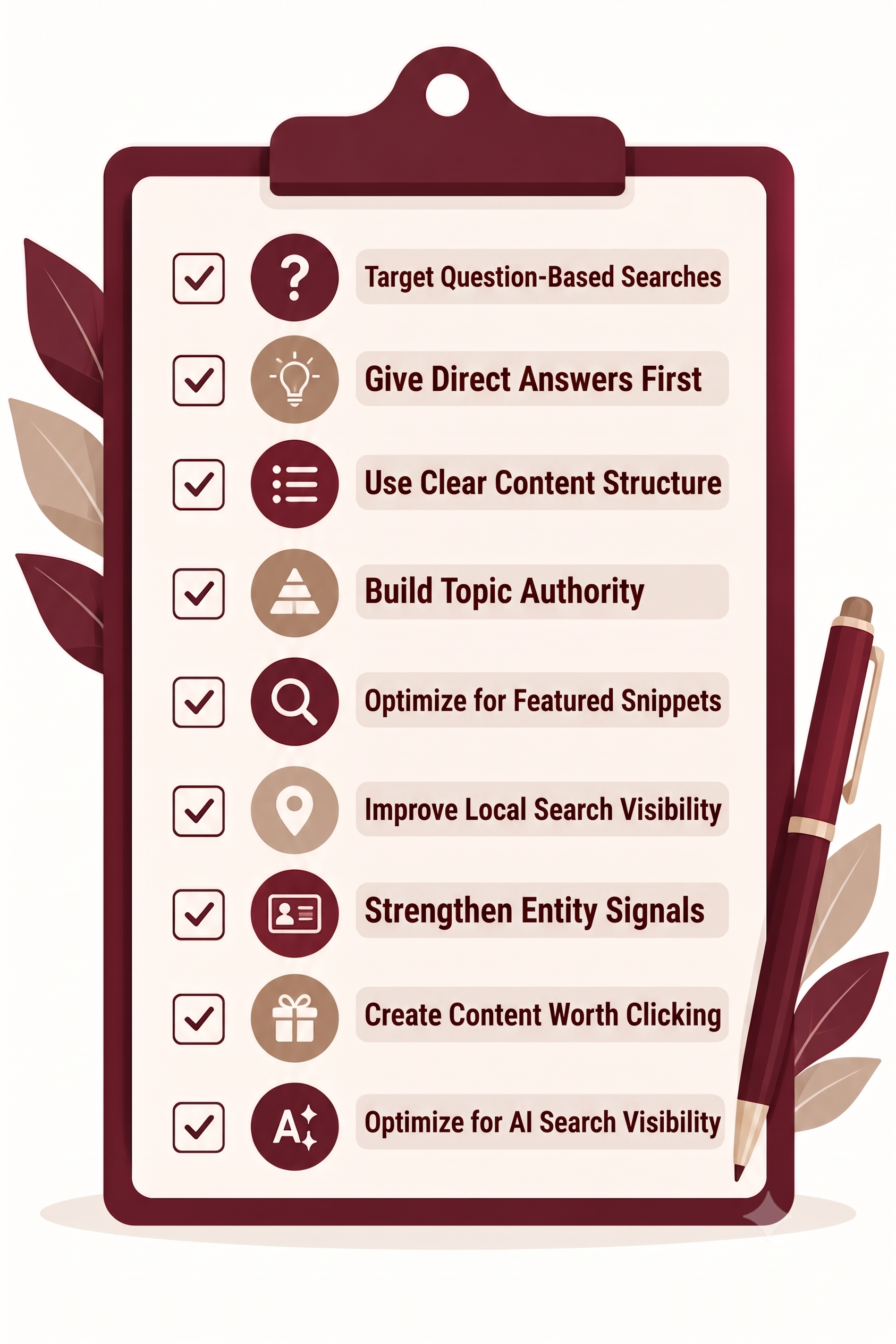
Strategy 5: I suggest you format the extractable parts of your content as concise definitions, numbered steps, short lists or simple tables. There is no guaranteed way to win a snippet. Clear formatting meaningfully improves your odds.
Strategy 6: Keep your business name, address, description and key facts consistent online. Maintain a clear About page author credentials and structured data (schema markup) where relevant, so search engines and AI systems can confidently identify who you are.
Strategy 7: For local businesses keep your Google Business Profile complete and accurate.. Respond to reviews. Publish relevant content. Make sure your name, address and phone number match, across every listing.
Strategy 8: Create content worth clicking. This might be the most important strategy. I advise you not to optimize for the quick answer but to give people a reason to go deeper. Original research, guides, calculators, templates, comparison tools and case studies are not easily replicated by a snippet or an AI summary.
Strategy 9: Optimize for AI search visibility. Help AI systems understand and trust your content through factual writing, strong topical coverage, consistent entity information, credible external references and visible author expertise. There is no way to guarantee inclusion in an AI-generated answer. These fundamentals improve your chances.
How to Write Content for Zero-Click and Click-Through
The goal is not to avoid answering questions it is to answer them well and still give people a reason to explore further.
A useful framework:
Answer → Context → Evidence → Deeper Value → Call to Action
Answer the question in the few sentences. Provide Context that shows your expertise. Back it up, with Evidence or examples. Then give something an answer cannot— a tool, a deeper guide or a personalized recommendation—followed by a natural next step.
Zero-Click Search for Different Types of Businesses
- Local Businesses: Local Businesses should make sure their Google Business Profile is complete improve pack visibility and add content that speaks to your exact location.
- E-commerce Businesses: E-commerce Businesses ought to focus on product FAQs, comparison content and structured data to show results such as pricing, reviews and availability.
- SaaS Companies: SaaS Companies should build comparison pages create integration guides and write feature definitions that answer buyer research questions directly.
- Service Businesses: Service Businesses should publish process explanations provide pricing transparency content and offer location- or niche- FAQs.
- Startups: Startups should concentrate on a number of high-authority, comprehensive pillar pages instead of spreading thin across many shallow posts.
- Indian Small Businesses: Indian Small Businesses should combine Google Business Profile optimization with regional-language or bilingual FAQ content where relevant to your audience.
- Content Websites: Content Websites should invest heavily in research and data because this is what earns citations, in AI‑generated answers.
- Personal Brands: Personal Brands should emphasize author bios, credentials and consistent entity information to build the trust signals that AI systems and readers both look for.
How to Measure Zero-Click SEO Success
Clicks by themselves no longer show the value of your presence in search results.
Traditional SEO Metrics: impressions organic clicks, click-through rate rankings organic conversions.
Visibility Metrics: appearances in SERP features, impression share, visibility in packs volume of branded queries.
Business Metrics: leads, phone calls, form submissions, purchases, sign-ups, revenue conversions that get help from sources.
Brand Metrics: searches that include your brand, direct traffic, people who come back mentions of your brand.
Be realistic here: some visibility happens without a click. For example being in an AI Overview, without anyone clicking.. That is really hard to measure with current tools. There isn’t one score that shows how much zero-click visibility you have. The honest way to understand your performance is to look at several of these metrics instead of hoping one report has all the answers.
Zero-Click Search Best Practices for 2026
- I understand the search intent and write for it.
- I answer questions directly and early.
- I build authority through content clusters.
- I use scannable structure.
- I optimize for relevant SERP features.
- I strengthen presence and listings.
- I improve entity clarity and consistency.
- I create original content.
- I. Reference credible sources.
- I keep business information accurate
- I apply SEO, AEO and GEO together.
- I track visibility metrics alongside conversions.
- I update content on a schedule.
- I keep expertise and editorial review in the loop.
Zero-Click Search and Content Strategy
Consider content as a guide for the stages of the customer journey:
Discovery Content (answers simple questions) → Authority Content (shows deeper expertise) → Decision Content (helps customers compare options) → Conversion Content (encourages action)
Zero-click visibility can.. Should. Exist at every stage not only at the top of the funnel. A comparison page that is pulled into an AI answer during the decision stage is just as valuable, as a definition that appears at the discovery stage.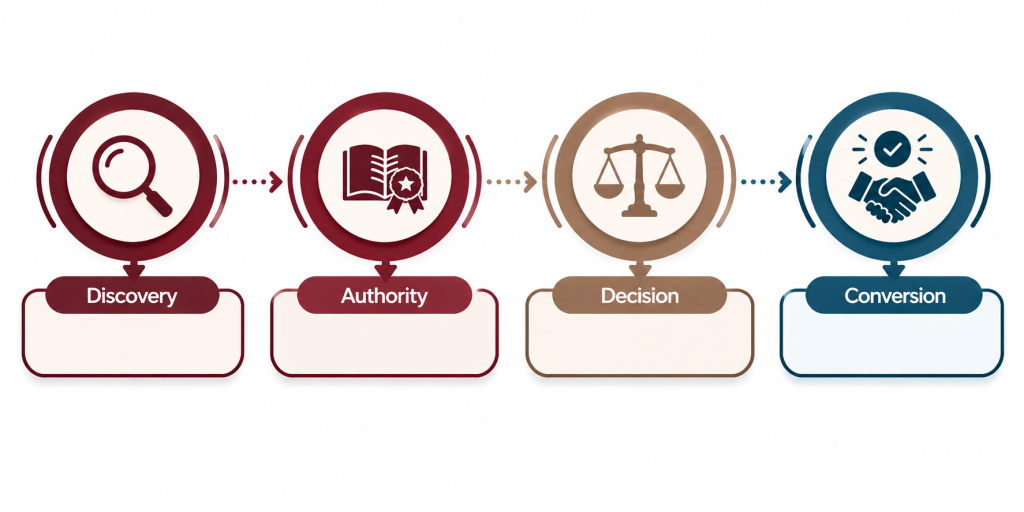
The Future of Zero-Click Search
Based on trends a few developments are worth watching. Framed here as emerging possibilities, not guaranteed outcomes:
- AI‑powered conversational search interfaces will likely keep growing becoming better at understanding and answering questions.
- Multimodal search that blends text, voice and image will expand, letting people ask for information in many ways at once.
- Voice assistants will be used more often for quick, local and factual queries, especially when hands are busy.
- Search results and AI answers will feel more personalized matching each user’s unique interests and habits.
- Search journeys will spread across platforms and AI assistants not just one single search engine.
- Clear entity information and authoritative sourcing will become more important as AI systems improve at pointing to reliable references.
None of this is guaranteed to unfold in a way or timeline. But the direction of travel is consistent, across the sources tracking it.
Practical 30-Day Zero-Click SEO Action Plan
Week 1. Audit: Look at your search rankings. See which of your target queries already show up with SERP features. Write down the questions your customers are asking. Check that your local business listing is accurate and up to date. Take stock of all the content you already have.
Week 2. Optimize: Rewrite your answers so they start with the direct answer. Improve your heading structure to make content easier to scan. Add FAQ sections to your pages. Make your internal linking stronger. Go through your business information and fix any errors or inconsistencies across the web.
Week 3. Create: Publish content that answers questions directly. Build cluster articles that support your topics. Make comparison pages when needed. Add content that is relevant, to your area if it makes sense.
Week 4. Measure: Check how times your pages appear in search (impressions) how many people click, what your click-through rate is, your rankings how often you show in SERP features how many leads you get, how many conversions happen and how much branded search volume you have. Use all this data to decide what to focus on next.
F.A.Q.
A zero-click search is a query where the user finds their answer directly on the search results page — through a snippet, panel, or AI summary — without visiting any website.
I answer questions directly and early to help people find what they need. I use formatting because it makes information easy to read. I strengthen entity and local signals so that the content feels relevant and trustworthy. I create content that gives people a reason to click deeper because people want real value.
Featured snippets are a format that creates zero-click outcomes. Featured snippets answer the query at the top of the results page.
Small businesses need to focus on making sure their local search results are correct. They should create content that gives answers to questions customers often ask. Also they must keep their business details the same everywhere on the web.
Combine SEO, AEO and GEO by answering questions. Structure content in an easy-, to-follow way. Strengthen entity signals and local relevance. Create content that invites readers to stay longer and explore more.