
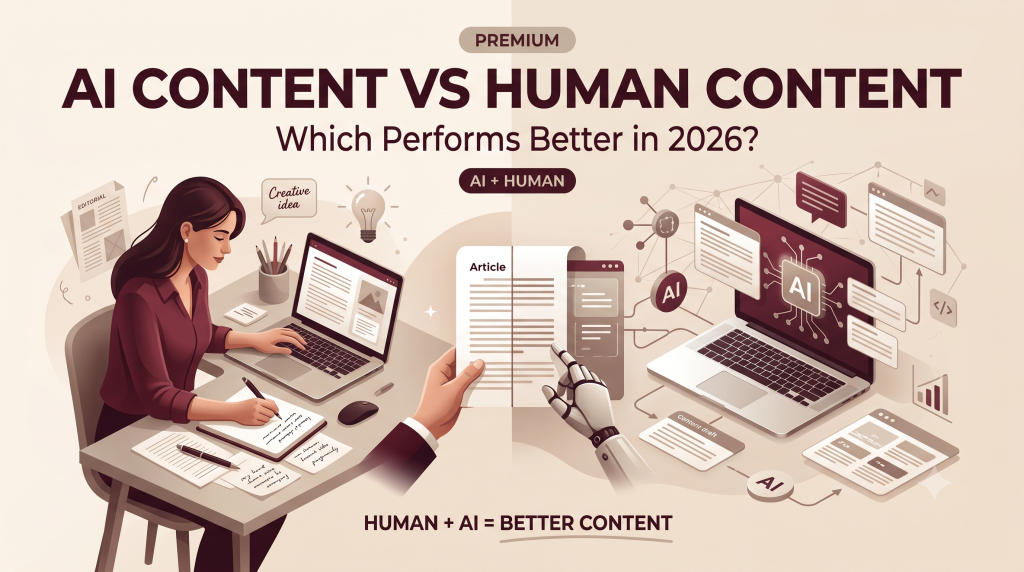
AI Content vs Human Content: Which Performs Better?
AI Content vs Human Content: Which Performs Better? Introduction Two years ago many businesses were still unsure if content written by AI could actually work. Today AI tools are part of every content process. Helping with outlines drafting first versions creating product descriptions and answering customer questions before a person even starts writing. This change has led to a question for anyone who publishes online: should you use AI-generated content, human writers or a mix of both? The real answer isn’t about choosing one over the other. AI content and human content don’t compete in the way. Their strengths depend on what you care about. Like search rankings trust from readers how much people engage or whether they turn into sales. A post that ranks high might not lead to conversions. A written article might never be found by anyone. This article looks at where each method works and where it struggles. It also shares what the data and official rules say about quality and rankings. By the end you’ll have a way to decide what fits your strategy. And why the choice is usually not “either AI or humans ” but something in, between. What Is AI-Generated Content? AI-generated content is text or other types of media created by a machine learning system. This usually involves a language model like the ones used by ChatGPT, Gemini or Claude. The system follows a prompt that a person writes. These models are trained on amounts of text and they learn how language works. This helps them create writing that makes sense and is related to the topic they are given. It can be done quickly. In life AI content means different things to different people. At one end someone might type an instruction and then share the result without changing anything. At the end a writer might use AI to help start a piece of writing. Then they check the facts change the words and organize the content in a way. This difference is more important than many people think. It affects the quality how correct the content. How well it works. People use AI-generated content in ways today. Some examples are: Drafts and outlines for blog posts Descriptions for products when many are needed Captions for social media Copy for email marketing versions of ad text for testing Briefs for writers to use Answers to frequently asked questions Meta descriptions and titles for SEO For companies that need to create a lot of content like online stores, with thousands of products AI is no longer something new. It has become a part of the work that needs to be done. What Is Human-Written Content? Human writing is the result of an effort to communicate. Human writing comes from thought, human work and human feelings. While software writes by guessing what words are most likely a human writer starts a page with something that machines do not have. A human writer has a point of view that comes from life experiences. When an experienced marketing strategist, software engineer or clinical doctor writes an article, a human writer does more than just repeat what the ten Google results say. A human writer uses years of trial and error customer talks, surprising project failures, private case studies and quiet cultural instincts. A human writer knows when a strange metaphor will help explain an idea or when a true admission of vulnerability will calm a doubtful buyer. Human writing has clear mental qualities: Lived practitioner experience: Real insights that come from hands‑on work from making executive decisions and from real field tests. Original investigative research: Doing surveys talking to industry experts and finding new data. Emotional. Empathy: Adjusting tone, pace and style to meet the fears and hopes of the reader. Narrative storytelling: Weaving stories and dramatic tension, into lessons or business talk. Nuanced critical reasoning: Arguing bold ideas that go against common opinion. AI Content vs Human Content: Key Differences:- AI CONTENT AI-generated content is made using intelligence tools that can quickly create articles, captions, product descriptions and other marketing materials. It is helpful when you need a lot of content and want to save time. However AI content can sometimes sound the same feel ordinary or miss the touch and emotional feelings that people have. It also needs a person to check the facts make sure it is original check the tone and ensure it fits the brand. HUMAN CONTENT Human-written content is created by people using their imagination and knowledge. It is based on experiences. Thinking carefully about things. Human writers can understand emotions. They can sense what people want to express. They also understand cultures and how to share a story. This helps them make content that feels real and easy to relate to. It usually makes people believe in the content more. Does Google Penalize AI-Generated Content? No Google does not penalise content simply because it was created using AI. Google’s long‑standing position, first set out in guidance published in 2023 and reaffirmed since is that Google evaluates content based on quality and helpfulness not on the production method. What Google does penalise is the misuse of automation including AI to mass‑produce content whose primary purpose’s to manipulate search rankings rather than to help users. This falls under Google’s spam policies about scaled content abuse. The distinction is really about intent and outcome, not the tool: Allowed: Using AI to help draft, outline or scale content that’s genuinely useful, accurate and reviewed for quality. Not allowed: Publishing volumes of thin, unoriginal or unreviewed AI output purely to capture search traffic. Google’s quality systems evaluate content against the E‑E‑A‑T framework. Experience, Expertise, Authoritativeness and Trustworthiness. Regardless of who or what wrote the draft. In practice that means a well‑researched fact‑checked useful article produced with AI assistance can perform just as well as an article written entirely by hand while an unedited generic AI dump published at scale is exactly the type of low‑value content that Google’s spam systems are