
Social Media Content Automation: Benefits and Limitations
If you run a business page on Instagram, LinkedIn and Facebook at the time you already know the problem: writing captions, resizing images checking comments and tracking performance takes hours every week. Many teams start looking into automation the moment they realize that manual posting isn’t sustainable at scale.
Automation can genuinely help here.. Its not a magic fix. Tools can schedule your posts. Track your numbers but they can’t build your brand voice read the room during a sensitive news cycle or have a real conversation, with a customer. Understanding where automation earns its keep and where it quietly causes damage is the skill.
This article walks through what social media content automation is, how it works, its genuine benefits and real limitations what to automate versus what to keep human and how to build a workflow that uses both well.
What Is Social Media Content Automation?
Social media content automation means using software to manage social media jobs. These jobs include scheduling posts publishing them and checking reports. Of doing each task by hand every time the software takes care of it all. This saves time. Makes things run smoother.
At its core automation replaces manual steps with rules and triggers. Of logging into five platforms every morning to post the same update a business can set up content in advance and let software publish it at the scheduled times.
Automation typically covers:
- Scheduling and publishing posts across multiple platforms
- Recycling. Repurposing existing content
- Auto‑responding to common simple messages
- Generating basic performance reports
- Sending reminders for content calendar deadlines
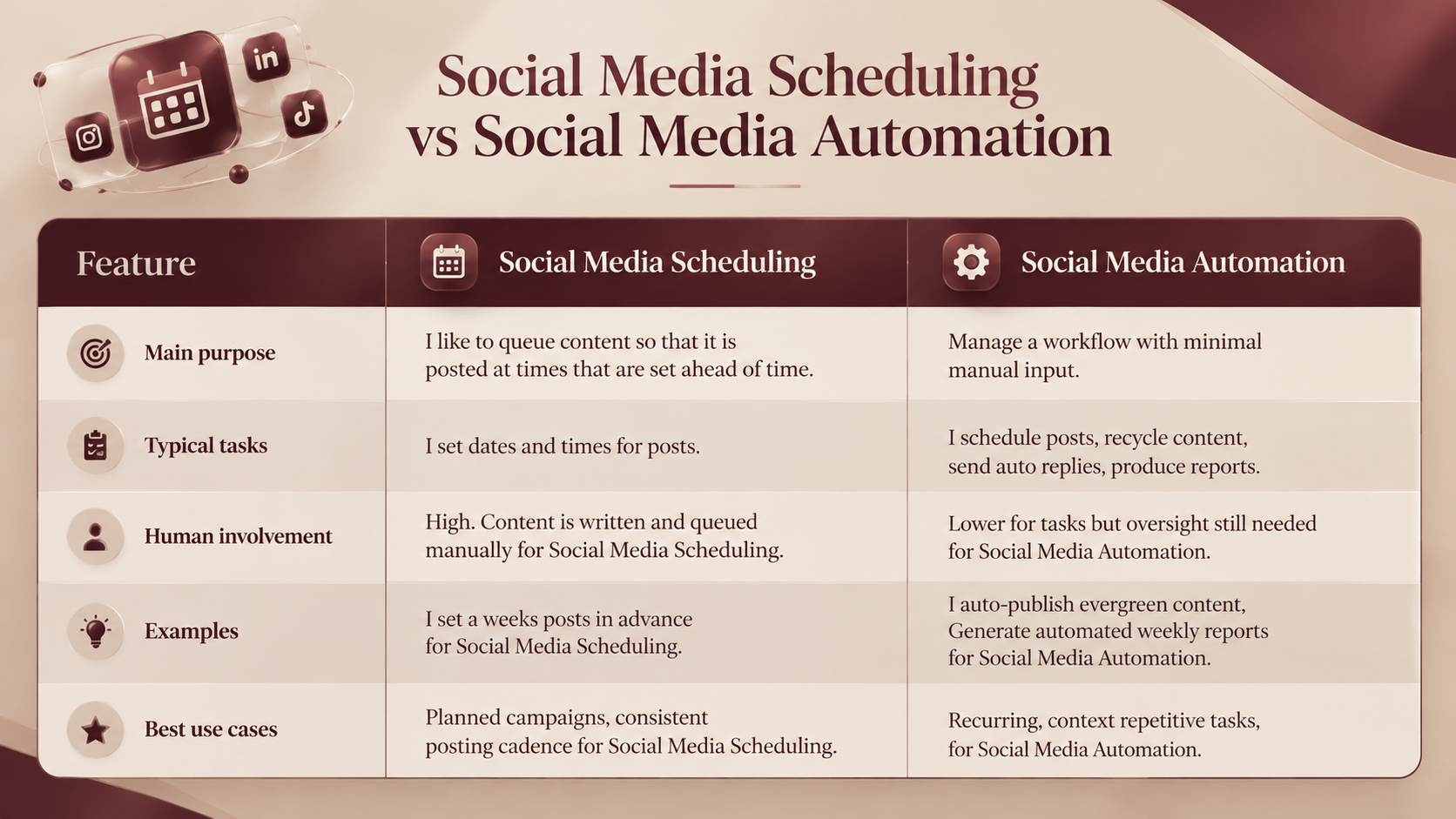
I find it useful to separate scheduling, from broader automation. Scheduling is just picking a time for a post to go live. Automation is a system—automation can include scheduling but also rules‑based responses, content recycling and reporting that runs without daily manual input.
Social Media Scheduling vs. Social Media Automation
Benefits of Social Media Content Automation
Saves Time
Posting to many platforms every day takes a lot of time. Using automation allows a team to create content at once each week or month and then let the system take care of publishing. A local business owner who used to spend an hour each day posting can often reduce that to a few hours each week.
Improves Posting Consistency
People like brands that’re always there. Automation makes sure posts go out even if someone is busy or away. This keeps the account active during times when the businesss not very busy.
Helps Maintain a Content Calendar
When content is planned ahead it is easier to see where there are spots plan around special days or new products and make sure the messages fit with the overall marketing plan instead of posting without thinking.
Reduces Work
Tasks like sharing the same promotion on five different platforms or changing the size of a picture for each one are boring but needed. Automation tools handle the formatting and sending so workers can focus on planning and creating ideas.
Supports Multi-Platform Publishing
One piece of content. Like a product announcement. Often needs to go to Instagram, Facebook, LinkedIn and X all at the same time. Automation tools send content to all these places from one screen, which saves a lot of repeated work.
Makes Campaign Planning Easier
For a product or a special sale automation lets the whole series of posts be made in advance and scheduled to go out on time. This way the campaign runs smoothly even if the team is busy with things during the launch week.
Helps Teams Collaborate
Many automation tools have shared calendars, approval steps and places to leave comments. This makes it easier for marketing, design and managers to work together without having to send lots of emails.
Improves Workflow Efficiency
Of seeing each post as something different automation makes social media management into a process that can be done over and over again. This includes writing, checking, setting a time sending and looking at results. This helps avoid confusion and missing steps.
Supports Performance Tracking
Automated reports collect information, like how many people saw the post how much they liked it and how many clicked on it. This data is gathered in one place on a basis so teams don’t have to go to each platform to get it.
Helps Businesses Scale Their Content Operations
As a company grows and needs to handle platforms more places or more campaigns automation makes it possible to keep up with the work without hiring more people just to do the same old tasks over and over.
Limitations of Social Media Content Automation
Risk of Losing Authenticity
Audiences can often tell when content feels mass-produced. If every post follows the template with no variation in tone followers may disengage. They sense that no real person is behind the account. That lack of authenticity can make the brand feel distant or even fake.
2. Automated Content Can Become
Recycling the same content across platforms without adjustment. Like using an Instagram caption verbatim on LinkedIn. Can feel out of place. Each platform has audience expectations and norms. What works on one may fall flat on another. Repetition without adaptation makes the content feel lazy.
3. Poor Timing During Events
A scheduled promotional post that goes live during a local emergency a tragic news event or a company crisis can look tone-deaf. Automation doesn’t know when the world has changed around it. It needs monitoring to pause queues when necessary. Missing this can damage trust and reputation quickly.
4. Automation Cannot Replace Genuine Community Management
Responding to comments resolving customer complaints and building rapport requires reading tone, context and intent. Automated replies handle the most basic predictable queries. Anything complex. Like a frustrated customer or a nuanced question. Often gets a response that feels robotic and unsympathetic.
5. Context Can Be Misunderstood
Auto-reply systems that rely on keyword matching can misinterpret sarcasm complaints disguised as compliments or nuanced questions. A comment like ” job you really nailed it” might be sarcastic. The system might reply with a thank-you missing the message. This can make the brand seem clueless or even insulting.
6. Over-Automation Can Damage Brand Voice
When too much of the content pipeline is automated end-to-end subtle brand personality begins to fade. Humor, regional references, in-jokes with a community. All these elements get flattened into safe messaging. The brand starts to sound like everyone
7. AI-Generated Content May Lack Originality
AI writing tools can produce drafts quickly.. Without human editing they often default to generic phrasing and predictable structures. The content may be clear. It lacks originality. It doesn’t stand out from competitors using the tools. It blends in of cutting through.
8. Platform-Specific Content May Be Neglected
Instagram favors storytelling. LinkedIn favors insight. X favors timely commentary. Automation that blasts content everywhere often underperforms on platforms it wasn’t tailored for. A long-form article on Instagram? Unlikely to get engagement. A photo-heavy post on LinkedIn? May seem out of place.
9. Automation Tools Can Create Technical or Publishing Issues
API changes, platform policy updates or tool glitches can cause posts, broken links or formatting errors. These problems may go unnoticed for hours or days without manual checks. A single broken link or a post that fails to publish can hurt credibility and reach.
10. Human Oversight Is Still Necessary
well-configured automation needs someone reviewing the queue checking analytics and staying alert to real-world events. Automation reduces labor.. It doesn’t eliminate the need, for judgment. A human touch is still essential to keep content respectful and real.
How Does Social Media Content Automation Work?

How AI Is Changing Social Media Content Automation
AI has grown the list of tasks that automation tools can help with beyond simple scheduling:
- Content ideation- AI suggests topics by looking at trending conversations or past performance
- Caption assistance- AI generates first‑draft captions that a human then edits
- Content repurposing- AI turns a blog post or video into multiple shorter formats
- Audience analysis- AI surfaces patterns, in engagement data that would take longer for a human to spot manually
- Trend research- AI summarizes what is currently being discussed in a given industry
- Personalization- AI adjusts messaging for different audience segments
- Scheduling recommendations- AI suggests posting times based on historical engagement
- Performance analysis- AI flags which content types are underperforming
- Social listening- AI tracks brand mentions and sentiment across platforms
- Workflow assistance- AI helps teams organize approvals and content pipelines
It is worth being cautious here: AI tools can support these tasks but AI cannot guarantee that AI understands your specific audience the way a person immersed in your community does and AI cannot promise higher engagement. Treat AI output as a draft or a data point, not a decision.
Social Media Automation Workflow
Strategy → Content Creation → Human Review → Scheduling → Publishing → Monitoring → Engagement → Analytics → Optimization
- I see that Strategy sets the path before anything is created.
- Content Creation makes the posts, with or without help from AI drafts.
- I rely on Human Review to check the tone, accuracy and timing.
- Scheduling queues the approved content.
- Publishing happens automatically at scheduled times.
- Monitoring tracks comments, mentions and real-world context so I stay informed.
- Engagement is where a person responds in a way, which feels personal.
- Analytics gathers performance data giving us insight.
- Optimization feeds insights back, into the round of strategy keeping us improving.
Best Practices for Social Media Content Automation
- I keep a human approval step before anything publishes.
- I customize content for each platform of copy-pasting.
- I maintain a recognizable brand voice.
- I avoid, over-posting just because scheduling makes it easy.
- I review scheduled content regularly not just when it is created.
- I monitor events and be ready to pause queued posts.
- I respond to comments personally than relying only on auto-replies.
- I use analytics to refine content not just to report numbers.
- I avoid publishing content across all platforms.
- I regularly audit automation workflows for rules or content.
- I keep an emergency pause control to the team at all times.
- I combine automation with timely creative content.
F.A.Q.
Using software to manage social media tasks such as scheduling, publishing and reporting helps avoid manual effort, for each post. Software streamlines workflow,. Software does not replace strategy or creativity.
AI can help with writing captions coming up with content ideas and using material in new ways.. People still need to review the work. They must check if the tone is right if the facts are correct and if it matches the brand style.
By tailoring content to each platform making sure a checks it before it goes live replying to comments, in a personal way and not using the same content everywhere.
A balanced one: an one automates repetitive low-risk tasks such, as scheduling and reporting while a balanced one keeps community engagement, brand voice and sensitive communication fully human-led.
Yes, for repetitive administrative tasks. It frees up time for administrative tasks so that we can focus on planned and creative work though it does not eliminate the need, for oversight.
Conclusion
Social media content automation is a productivity system. It does not replace strategy, creativity or genuine human connection. Automation works well for predictable tasks such, as scheduling posts creating reports or sending basic replies. Automation frees up time that would otherwise be spent on low-value tasks.
However automation has limits. Automation cannot understand context. Automation cannot read the room during a moment. Automation cannot build the trust that comes from a person engaging with a community over time.
The strongest approach combines strategy original content, smart automation, AI assistance and continuous optimization. Each element is used in the area where it’s strongest. The plan does not default to one or the other.
WORK WITH FUTURIXMEDIA
Ready to turn more visitors into customers?
Discover opportunities to improve your website experience, strengthen your messaging, and create a clearer path from visitor to customer.
CONTACT US →Digital Marketing & Growth