
AI Agents in Digital Marketing: The Future of Marketing Automation
Marketing has moved through a predictable series of shifts. First everything was manual. Every email sent by hand every report built from scratch. Then came marketing automation: rule‑based systems that could send an email after someone downloaded an ebook or move a lead to a stage after a form fill. After that AI‑assisted marketing arrived. Tools that could draft a blog post generate ad copy or summarize a report when a marketer asked.
Now in 2026 a lot of the conversation has shifted to AI agents and agentic workflows. Systems that depending on how they’re built and what permissions they are given can go a step further than generating a suggestion. They can plan a sequence of steps pull in relevant data use a connected tool take an action and check whether that action worked before deciding what to do next.
That does not mean marketing has suddenly become autonomous. What it means is that some of the multi‑step work marketers used to do by hand. Or manage through rigid automation rules. Can now be handled by a system that adapts a little more intelligently within limits a human sets.
This article explains what AI agents actually are, how they are different from the AI tools and automation you may already use where they realistically add value in marketing what the risks are and how a business can start using them responsibly. Without treating them as a replacement, for marketing strategy or human judgment.
What Are AI Agents?
An AI agent is a software system that receives a goal. Then the AI agent plans and carries out a series of steps. Often using tools or data. To work toward that goal. The AI agent evaluates results along the way. Adjusts the AI agent’s next action based on what the AI agent finds.
Unlike an AI tool that answers one prompt at a time an AI agent is built to handle a small workflow rather than a single response.
A simple way to picture it:
Goal → Understand → Plan → Use Tools → Take Action → Evaluate → Adjust
For example a marketing team might give an AI agent a goal such as: “Check which blog posts lost traffic this month and flag the top three for review.” The AI agent must understand the request plan how to retrieve the data use an analytics tool or connected dashboard evaluate the results and provide a summary. The AI agent may also flag the summary for a human to confirm before any changes to content are made.
It is important to note that the abilities of an AI agent differ widely. This depends on the system the tools the AI agent is linked to and the permissions the AI agent has. Not every AI agent on the market today can do all of this reliably. Many current implementations are narrower, than the word “AI agent” suggests.
What Is Agentic AI?
Agentic AI is the idea behind AI agents. Systems built with some level of independence to work toward goals not just give one answer to a question.
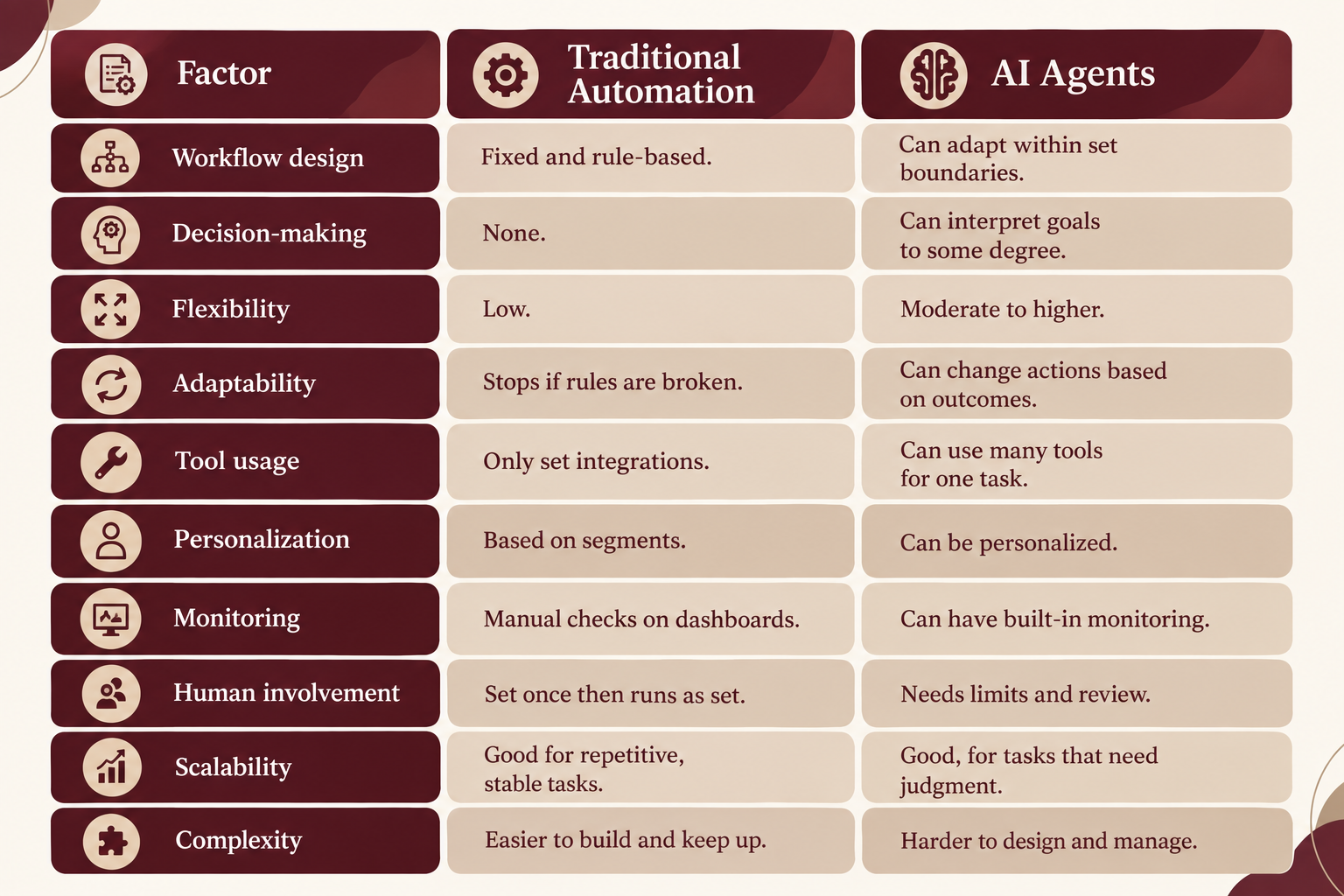
There are a few differences between agentic AI and generative AI or old-school automation.
- Generative AI, like a chatbot or a text generator usually works on one request at a time. It waits for a prompt before doing anything else. It won’t go off. Check a result or take a next step unless someone tells it to again.
- Agentic AI on the hand can plan a series of steps pick the right tool for each step and keep working toward a goal by doing multiple actions in a row. It doesn’t need to stop after one task.
- Traditional automation runs on fixed rules. It doesn’t. Adapt. If something unexpected happens, it. Fails because it wasn’t programmed to handle it.
Planning and the ability to use tools are what make agentic AI powerful. These features let the agent do multi-step work instead of just a single task. Permissions and human oversight are just as important. An agent that can actually do things. Like send an email update a customer record or change an advertising budget. Needs rules, about what it can and can’t do. It should not act on its own without someone watching or giving approval. Safety and control stay in the hands of people.
How Do AI Agents Work in Digital Marketing?
Here’s a practical breakdown of the workflow:
- Goal- The marketer defines an objective (e.g. “qualify inbound leads from the contact form”).
- Context- The agent receives data, instructions, brand guidelines and constraints.
- Planning- The agent determines the possible actions available to reach the goal.
- Tool Selection- The agent may use systems (CRM, email platform, analytics dashboard).
- Execution- The agent performs the actions it is permitted to take.
- Monitoring- The agent reviews the results of those actions.
- Optimization- If set up that way the agent may. Take a follow-, up action.
- Human Review- Important or high-impact actions should pass through a human approval step before anything customer-facing or budget-related happens.
I find that step easy to skip when a tool is marketed as “fully autonomous ” but it is the step that protects your brand, your data and your budget.
AI Agents in Digital Marketing: Key Use Cases
AI Agents for SEO
AI agents can help with keyword research search intent analysis, content gap analysis, competitor research, internal linking suggestions, content briefs, technical SEO monitoring, reporting and flagging pages that need updates. These tools make it easier to find the keywords understand what users really want and see where competitors are doing better. They also help keep websites running smoothly by checking for issues like broken links or slow load times. Still humans are needed to make decisions about content strategy to stay true to brand voice and to understand why rankings went up or down. Not just that they changed.
AI Agents for Content Marketing
AI agents assist with topic research, content planning creating content briefs writing drafts turning long-form content into shorter formats and tracking how well content performs. They save time and spark ideas.. Editorial review is still important. A human editor must check for accuracy originality and tone before anything goes live. The AI may draft fast. Only a person can ensure the message sounds like the brand and doesn’t contain errors.
AI Agents for Social Media Marketing
AI agents support content calendars come up with post ideas, write captions watch for trends turn one piece of content into formats, schedule posts and report on engagement and performance. They help teams stay consistent and reach audiences across platforms. However agents should never be set to auto-publish everything without approval. One off-tone or timed post can harm a brand’s reputation. Human oversight ensures every message is appropriate and on-brand.
AI Agents for Email Marketing
AI agents help segment email lists, plan campaigns, test subject lines personalize messages at scale run automated workflows based on triggers send follow-up emails, re-engage inactive subscribers and analyze results. This allows for targeted and timely communication. Still AI tools work best when guided by goals and human input. Final checks should happen before any emails go out.
AI Agents for Lead Generation
AI agents can qualify leads have conversations on websites gather information about a company or role run follow-up sequences, update CRM records score leads and book appointments. For example if someone fills out a “request a quote” form an agent might verify their details against qualification rules update the CRM send a tailored follow-up email and alert the sales team if the lead meets criteria.. The actual conversation with the lead. Especially closing deals. Should always be handled by a human.
AI Agents for Paid Advertising
AI agents can analyze campaign performance generate audience insights create ad variations suggest budget allocations monitor ads in time manage A/B testing and produce reports. This helps advertisers act faster and optimize campaigns efficiently.. Advertising decisions must stay within defined budgets and platform guidelines. An agent adjusting spend without sign-off could lead to big financial risks. Control always stays with the person in charge.
AI Agents for Customer Support
AI agents handle FAQs do lead qualification, route tickets to the right team pull customer info and escalate when needed. They speed up responses. Reduce wait times.. For complaints refund requests, emotionally charged situations or cases where the agent isn’t sure how to proceed a human must take over. Customers expect empathy and personalized care in moments. Things AI can’t fully deliver.
AI Agents for Personalization
AI agents can personalize website experiences, emails, product recommendations, offers and content journeys based on customer data. They make interactions feel more relevant and timely.. This must be done carefully. Companies should only use data customers have given consent to share. Transparency matters. People should know what data is used and why. Privacy and trust go hand in hand with personalization.
AI Agents for Marketing Analytics
AI agents assist with collecting data watching dashboards spotting anomalies like drops in traffic or conversions summarizing performance and making suggestions. They cut down on the time spent manually reviewing reports. This frees marketers to focus on strategy and insight.. Humans are still key, to interpreting results, understanding context and making final decisions based on patterns and gut feeling.
Benefits of AI Agents in Digital Marketing
- Greater efficiency- Doing research and writing reports takes less time letting marketers focus on more important tasks.
- Execution- Complicated processes that used to need many people or tools can now happen with less back and forth.
- Workflow automation- Linking steps that used to need people to pass things from one tool to another.
- Personalized customer experiences- Making content or offers fit each customer when doing it for a lot of people.
- Faster data analysis- Finding patterns in sets of data quicker than looking at everything by hand.
- Continuous monitoring- Checking how campaigns are doing or if there are problems on a website without someone needing to watch a screen all day.
- Scalability- Managing leads, emails or content requests without needing more people.
- Better workflow coordination- Bringing tools like CRM, email and analytics together into one process.
- Reduced repetitive work- Less time spent entering data adding tags or doing reports.
- Faster experimentation- Doing tests and looking at the results more quickly.
- Better response times- For things like first replies to leads or simple customer questions.
- More time for work- Letting marketers spend more time on ideas, creativity and planning campaigns.
- None of this guarantees a return on investment- The results depend a lot, on how good the data is, how well the process is set up and how well the system is managed.
AI Agents vs Traditional Marketing Automation
AI Agents vs Human Marketers
AI agents can help with:
- AI agents process data.
- AI agents handle tasks.
- AI agents monitor continuously.
- AI agents detect patterns.
- AI agents execute workflows.
- AI agents draft documents.
- AI agents personalize on a scale.
Human marketers remain essential for:
- Human marketers handle brand strategy.
- Human marketers bring creativity to the table.
- Human marketers choose positioning
- Human marketers show empathy, to customers.
- Human marketers use business judgment.
- Human marketers make decisions.
- Human marketers understand customers.
- Human marketers make high-level decisions.
- Human marketers generate ideas.
- Human marketers take accountability.
How AI Agents Can Change Marketing Teams
Roles are likely to change than go away. People will spend time on routine manual tasks and more time on:
- Strategic planning and guiding campaign direction
- Managing and checking AI workflows
- Writing clear instructions and setting limits for agents
- Understanding data instead of just gathering it
- AI governance. Making decisions about what agents can do
- Ensuring the quality of outputs generated by AI
- Running tests and analyzing what the results mean
- Working well with AI as a key skill
There isn’t solid proof that certain marketing jobs will disappear completely. What is clearer is that the kinds of tasks, within each role are shifting.
How to Implement AI Agents in Marketing
How to Use AI Agents in Marketing
- Figure out the business goal- Make sure to be clear about what it means to be successful.
- Find the work- Look for the tasks that take a lot of time but don’t need much creative thinking.
- Show the workflow- Write down how the task is done right now step by step.
- Pick the AI method- Choose if a simple tool, automation or an agent is the best fit for the task.
- Decide on the inputs and data- Make sure to know what information the agent needs and where it will come from.
- Set the permissions- Decide what the agent is allowed to do without getting permission first.
- Make approval steps- Add check points, for anything that deals with customers, money or the brand.
- Try it in a place. Run it on a small scale before using it everywhere.
- Watch how it works- Keep an eye on how accurate it is what errors happen and what results it gets.
- Keep improving and grow- Expand only after the process has been proven to work.
F.A.Q.
AI agents are software systems that understand a marketing goal design the steps to reach that goal use the tools or data that’re available and execute the actions that are allowed. AI agents should always stay within the limits set by a marketer. Seek approval before making major decisions.
Research can help with research, content drafting, lead qualification, campaign monitoring, reporting and routine workflow execution across SEO, content, social, email and ads. A clear plan, for each area helps make the work smoother.
Small businesses can start with a high-value workflow—such, as lead qualification FAQ handling or email follow-ups—instead of automating all of their marketing at once so small businesses can focus on the important workflow tasks first.
Track both marketing KPIs. Leads, conversions and ROAS. And agent-specific KPIs such, as task completion rate, error rate, human intervention rate and accuracy. Choose the KPIs based on the use case.
I see emerging possibilities that include multi‑agent systems, cross‑channel orchestration and advanced personalization. These emerging possibilities remain developing trends, than guaranteed outcomes.