
How to Create E-E-A-T-Friendly Content:
A business owner publishes 40 blog posts in six months. The blog posts are clean, keyword-focused and grammatically perfect. Traffic barely moves. A competitor with half the content but with named authors, real screenshots and honest “here’s what didn’t work” notes keeps getting the clicks the links and the mentions.
The difference is rarely word count. That is proof.
Publishing content is no longer enough because anyone can publish. AI tools have made content cheap and readers have become sharper at spotting pages that say a lot without showing anything. Search engines and AI answer systems face the problem: which source deserves to be believed?
That is where E‑E‑A‑T comes in. In this guide you will learn what it actually means (. What it does not) how each part shows up in real content and a 10‑step process you can apply to your next article. You will also get a before‑and‑after example a trust checklist and a 20‑point audit, for your existing pages.
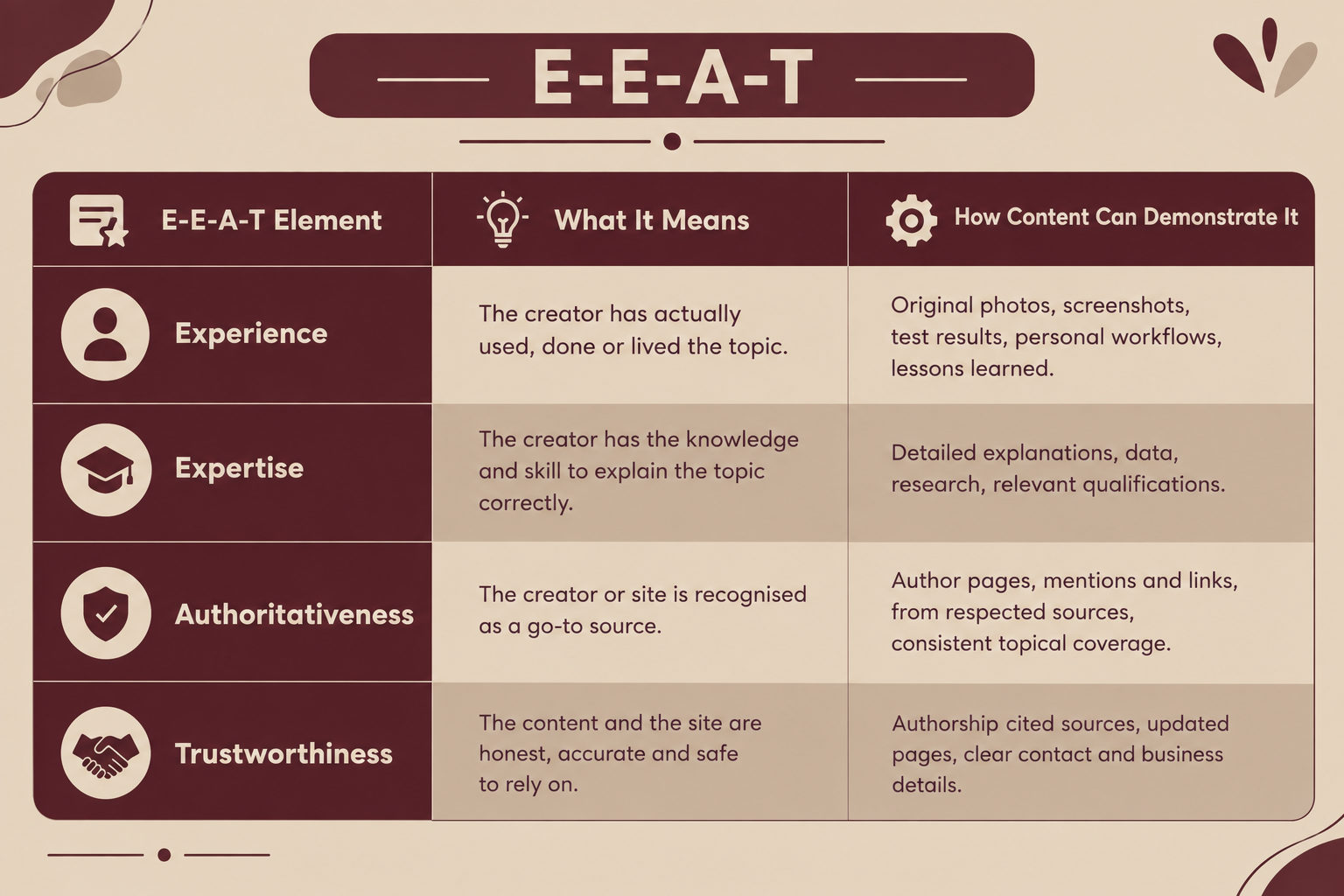
What Is E-E-A-T?
E-E-A-T stands for Experience, Expertise, Authoritativeness and Trustworthiness. It is a framework that Google uses in its Search Quality Rater Guidelines. This framework helps describe the qualities of content that’s reliable and helpful. In December 2022 Google added the E” for Experience to place more emphasis on real-world experience, in content creation.
Why E-E-A-T Matters for Modern SEO
Let us first clear up a myth. E-E-A-T is not a score or a direct ranking factor. Google has said that quality raters do not decide rankings. Their feedback helps Google evaluate whether its ranking systems produce results. Google’s systems use signals that taken together aim to surface helpful reliable, people‑first content.
So why care? Because the things E-E-A-T asks for are the things readers care about:
- content: Content that shows real experience tends to answer real questions better.
- User satisfaction: Readers who trust a page stay, read and act.
- Content credibility: Clear authorship and sources reduce doubt.
- Search visibility: Helpful credible pages earn links, mentions and repeat visits which’re the kind of signals that build visibility over time.
- AI search: AI answer systems need sources that’re specific, consistent and easy to verify.

Experience: Show That You Have Actually Done It
To show experience in content you need to prove you’ve done the work yourself—no vague claims, just proof. It’s not enough to say you researched something or followed advice. You have to show what you actually did what happened and how it changed things.
Take this example:
❌ “I researched this topic.” → “Many experts suggest improving page speed.”
This sounds generic. Anyone could write this in 10 minutes. It doesn’t show you did anything.
✅ “I actually tested this strategy. Here’s what happened.” → “We compressed hero images on a clients service page. Compared load time before and after using PageSpeed Insights. Here’s the screenshot.”
This is different. It shows you took action. You did the test. You collected data. You used tools. You’re sharing results from your work—not someone else’s.
Now here’s how to apply this across business types:
**Digital marketing**
of saying “We ran a Facebook ad campaign ” show it. Share your campaign setup—what audience you targeted the ad copy, the budget. Then explain what you changed in week two and why. Include a screenshot of the dashboard with client data hidden. This proves you managed the campaign not just read about it.
**SEO**
Don’t just say “We improved SEO for a blog post.” Tell the story. Document a content refresh: what sections you updated, the date you made the changes and then show data. Include a screenshot from Search Console showing how impressions and clicks moved before and after. If traffic grew say how much and when. This shows you did the work and saw the impact.
**E-commerce**
Show products in real use. Take photos of items being worn used or placed in a home. Then write about return reasons you’ve actually seen—like a jacket that runs small or a kitchen tool that’s hard to clean. List what you changed on the product page—like adding sizing details or clearer instructions. This proves you’ve worked with customers and made real improvements.
**SaaS**
Walk through the product. Use annotated screenshots to show where users get stuck. Point out steps—like a signup flow that requires too many emails. Include notes from your support team: “Customers keep asking about X.” Then explain what you changed and why. This shows you listened to users and acted on it.
**Local businesses**
Use photos from the job site—workers installing a roof cleaning a floor or serving a meal. Add local pricing context: “We charge $120 for a kitchen remodel, which’s 15% lower than the average in the area.” Share customer questions, from phone calls or WhatsApp messages: “They asked if we do weekend service.” Then explain how you added that option. This shows you’re on the ground solving problems.
The key is to show not tell. Use your experience, your own work, your own observations. That’s how you stand out. That’s how readers trust you.
Expertise: Prove You Understand the Topic
How do you show expertise? It starts with being accurate. Don’t just repeat what others say. Look beyond the surface. Give reasons for the advice. Explain the “why” behind every step. Use data from trustworthy sources.. Make sure the people giving the advice are actually qualified to speak on the subject.
Expertise isn’t about using words. It’s about taking something and making it clear. It’s about explaining an idea in a way that someone without a background in it can understand. That means clarity over cleverness.
Here are some ways to prove you know what you’re talking about:
– Be accurate: Double-check every fact, numbers and policy details. If you say a rule changed in 2021 back it up. If you mention a statistic, name where it comes from.
– Give explanations: Don’t copy the top three results on Google. Instead explain it like you would to a client who’s not an expert. Think about their confusion. Speak to it directly.
– Use solid research and data: Cite sources—official documents peer-reviewed studies government reports. Avoid secondhand summaries unless they’re from outlets.
– Include real examples: Show how the concept works in practice. A theory is only as good as its application. Tell a story. Walk through a case study.
– Get input from experts: Interview someone who actually does this work.. Ask them to review your content. Name them. Say what they looked at. This adds weight and trust.
– Share qualifications: Only bring up credentials when they matter. If you’re writing about Google Ads saying you’re certified makes sense. If you’re writing about taxes that certification doesn’t help unless its relevant.
– Break down processes: Give step-by-step guides. One thing at a time. This shows depth. A definition might tell you what crawl budget is. A process shows how to use it.
Now how do you write expert content without sounding too technical?
- Start by defining the term in simple language. For example: “Crawl budget is how pages Google is willing to visit on your site in a given period.” That’s it—clear and short.
- Use com parisons. Authority is like referrals: getting a recommendation from a person carries more weight than bragging about yourself.
- Lead with the outcome.Tell people what to do. Then explain why it works. For instance: “If you want rankings fix broken links. This helps Google find your content faster.”
- Cut jargon you wouldn’t say in conversation. If you’d never say “SEO optimization” to a client on a call don’t put it in your article. Replace it with words.
- Keep one idea per paragraph. This helps readers follow along. It also helps search engines understand what your content is about. No clutter. One point per section.
- Expertise isn’t, in the words. It’s in the care. It’s in the effort to get things right and make them understandable.
Trustworthiness: The Most Important Part
How can you make content trustworthy? You should be transparent about who wrote it and who runs the site. Back every claim with sources. Keep information current. Make it easy for readers to contact you.. Never mislead with headlines, pricing or promises.
Practical trust signals:
- Transparent authorship: real names, photos and bios.
- Sources: links to primary or authoritative references.
- Updated information: Trustworthy visible “last updated” dates, with updates behind them.
- Contact information: email, phone, address or a working contact form.
- About page: Trustworthy who you are what you do who is behind the site.
- Editorial policy: Trustworthy how you research, fact‑check and correct content.
- Business information: Trustworthy legal name, location, registration details where relevant.
- Secure website: Trustworthy HTTPS, across the site.
- Accurate claims: no exaggerated “guaranteed results”.
- Clear pricing: Trustworthy where state what things cost and what is included.
- Privacy information: Trustworthy a privacy policy.
- Corrections: Trustworthy a note when you fix something.
- No misleading headlines: Trustworthy the headline should deliver what the page promises.

How to Create E-E-A-T-Friendly Content: Step-by-Step Process
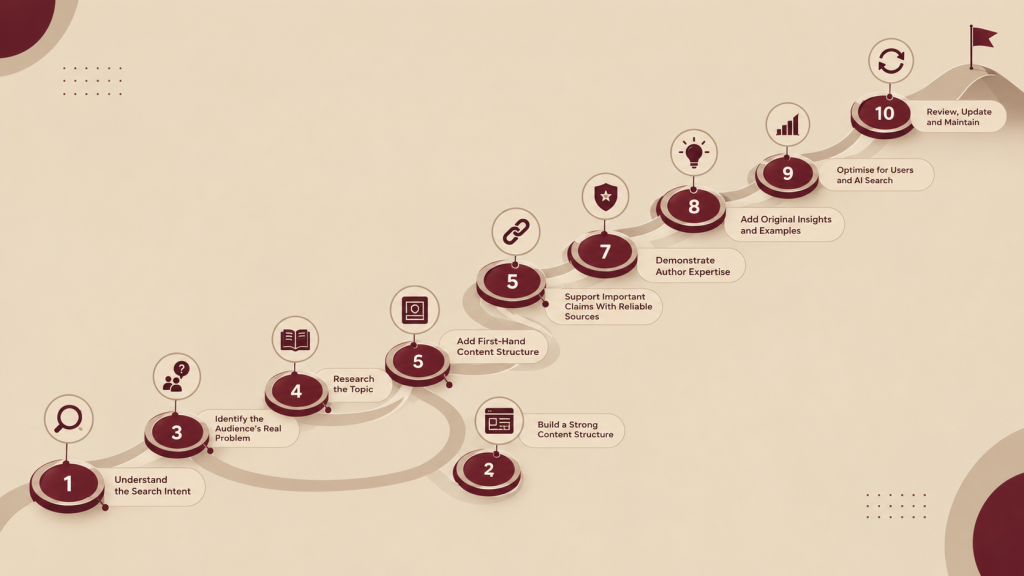
Here is a 10-step framework you can use for any article.
Step 1: Understand the Search Intent
- What to do: Look at what the top results offer. Decide whether the reader wants to learn, compare or buy.
- Why it matters: Content that misses intent can’t be helpful however credible it looks.
- Example: “E-E-A-T checklist” signals a reader who wants a list, not a history lesson.
- Tip: Write the readers goal in one sentence before drafting.
Step 2: Identify the Audiences Real Problem
- What to do: Collect questions from client calls sales chats, comments and Search Console queries.
- Why it matters: Real problems produce useful answers.
- Example: A café owner doesn’t want ” SEO theory”. They want to know why they’re not showing up on Maps.
- Quick tip: Keep a running “questions we hear” document.
Step 3: Research the Topic
- What to do: Start from sources (official docs, studies) then check industry experts.
- Why it matters: Good research prevents sounding mistakes.
- Example: For algorithm-related claims read Googles documentation before any commentary.
- Quick tip: Note the source for every number as you research not afterwards.
Step 4: Add First-Hand Experience
- What to do: Include your process, screenshots, data, failures and lessons.
- Why it matters: This is what competitors and generic AI output can’t copy.
- Example: “We moved the FAQ above the fold on a service page. Saw more enquiry form views.” (Only write this if its true with the data to prove it.)
- Tip: Add one “what we’d do differently” note per article.
Step 5: Build a Strong Content Structure
- What to do: Use headings, short paragraphs, direct answers, tables and lists.
- Why it matters: Structure helps readers scan. Helps search and AI systems extract answers.
- Example: A 40–60 word answer, under each major question heading, deeper detail.
- Tip: Each heading should promise one specific thing.
Step 6: Support Important Claims With Reliable Sources
- What to do: Link claims to reputable sources.
- Why it matters: Support Important Claims With Reliable Sources makes content verifiable a part of trust.
- Example: Link Googles documentation when explaining Googles stance on AI content.
- Tip: If verification is not possible soften the claim or remove it.
Step 7: Demonstrate Author Expertise
- What to do: Add a byline, bio, author page and where relevant, a reviewer.
- Why it matters: Readers want to know who is advising them.
- Example: Written by [Name] who manages paid and organic campaigns. Reviewed by [Name] SEO lead.
- Tip: Link the bio to a real author page with a work history.
Step 8: Add Insights and Examples
- What to do: Offer a framework, a comparison, a mini-audit or an observation that isn’t in other articles.
- Why it matters: Original value is the reason to cite you.
- Example: A Proof Ladder” (claim → example → evidence → source) for every important point.
- Quick tip: Ask: “What does this article say that the top five results don’t?”
Step 9: Optimise for Users and AI Search
- What to do: Use headings, concise answer blocks, consistent terminology and natural language. Add schema where it fits.
- Why it matters: Clear well‑structured content is easier for people and for AI systems to understand and summarise.
- Example: Define E‑E‑A‑T in the lines of the section not buried in paragraph six.
- Quick tip: Test whether each section still makes sense when quoted on its own.
Step 10: Review, Update and Maintain
- What to do: Re-check facts, links, screenshots and recommendations on a schedule.
- Why it matters: Outdated content quietly erodes trust.
- Example: Update a ” practices” post after a product or policy change and note what changed.
- Quick tip: Set a review reminder: quarterly, for fast‑changing topics yearly for ones.
F.A.Q.
E-E-A-T is a framework from Google’s Search Quality Rater Guidelines that helps judge content quality through Experience, Expertise, Authoritativeness and Trustworthiness. In SEO E-E-A-T guides you to create helpful content rather, than content that is built only for keywords.
It can if people bring their experiences check facts and accept responsibility. General AI content that hasn’t been checked usually misses those things.
Yes. Small businesses often have first‑hand experience. Small businesses talk directly with customers small businesses work on real projects and small businesses know local knowledge well. Showing that clearly can make the content more credible.
Its probably going to help because AI systems work best with accurate and well-sourced content. No one can promise citations but content that is credible and specific is much easier to understand and more trustworthy.
SEO is the picture thing—making sure your website shows up when people search online. E-E-A-T is a way to measure how good your content is. It helps you write better stuff that fits into that SEO plan.
Conclusion
E-E-A-T is not something you check off once. It is a habit: show who you are show what you have done show where your facts are from and keep everything up to date.
The best content does one thing. It makes it simple for a reader or an AI system to see why the information is trustworthy. That helps SEO it supports content that is ready to answer questions in AEO and it gives GEO something clear and real to work with.
Your next step is easy: choose your five important pages and run the 20-point audit mentioned above. Fix the parts first like a missing author, a claim, without proof or an old section. Small honest changes add up.
Ready to Build Content Your Audience and Search Engines Can Trust?
From SEO and content marketing to AEO and GEO strategies, Futurixmedia helps businesses build a stronger, more credible digital presence.
GET MORE INFORMATION →