
SEO Forecasting: How Businesses Can Plan Growth
Many companies spend money on SEO without understanding what they are actually purchasing. They say they want organic traffic yet they cannot specify how much traffic, when it will arrive or how much it will cost. SEO forecasting addresses this gap, by turning hope into a plan that relies on data.
SEO forecasting is not a crystal ball. Instead it draws on performance, search demand, keyword information, seasonal patterns and business assumptions to create realistic scenarios that show where organic traffic, leads and revenue might move.
What Is SEO Forecasting?
SEO forecasting is the process of estimating organic search performance. Such, as traffic, rankings, leads and revenue. Using historical data, keyword trends competitive analysis and planned SEO activities. SEO forecasting helps teams plan their SEO strategies.
It brings together different pieces of information:
- Historical organic performance
- Search demand and keyword trends
- Current keyword rankings
- Click-through rate (CTR) patterns
- Conversion rates
- Seasonality
- Competitive landscape
- Planned content and technical SEO work
- Business goals
Why SEO Forecasting Matters for Business Growth
A good forecast helps businesses:
- Set SEO goals instead of random targets
- Plan marketing budgets with more confidence
- Prioritize which keywords and pages to invest in
- Estimate potential ROI before committing resources
- Compare different growth scenarios side by side
- Align SEO activity, with actual business objectives
Example: A local HVAC company forecasts that ranking on page one for 15 high-intent local keywords could generate an additional 400 organic visits a month translating into roughly 20 extra service leads. That number helps them decide whether the SEO investment makes sense before they spend a rupee.
How Does SEO Forecasting Work?
- Gather SEO data- Traffic, rankings, conversions
- Spot keyword chances for SEO- Gaps, fresh topics competitor words
- Check search demand for SEO- How many people look, which way trends go
- Look at current SEO rankings- See where you are now
- Guess SEO ranking gains- Based on effort planned
- Project SEO organic traffic- Using click‑through curves
- Predict SEO conversions and leads- Using past conversion rates
- Adjust for SEO seasonality- Change, for known highs and lows
- Include competition and SERP shifts for SEO
- Create several SEO growth plans
- Watch real SEO performance
- Refresh the SEO forecast often
This is a cycle, not a single report.
SEO Forecasting Models
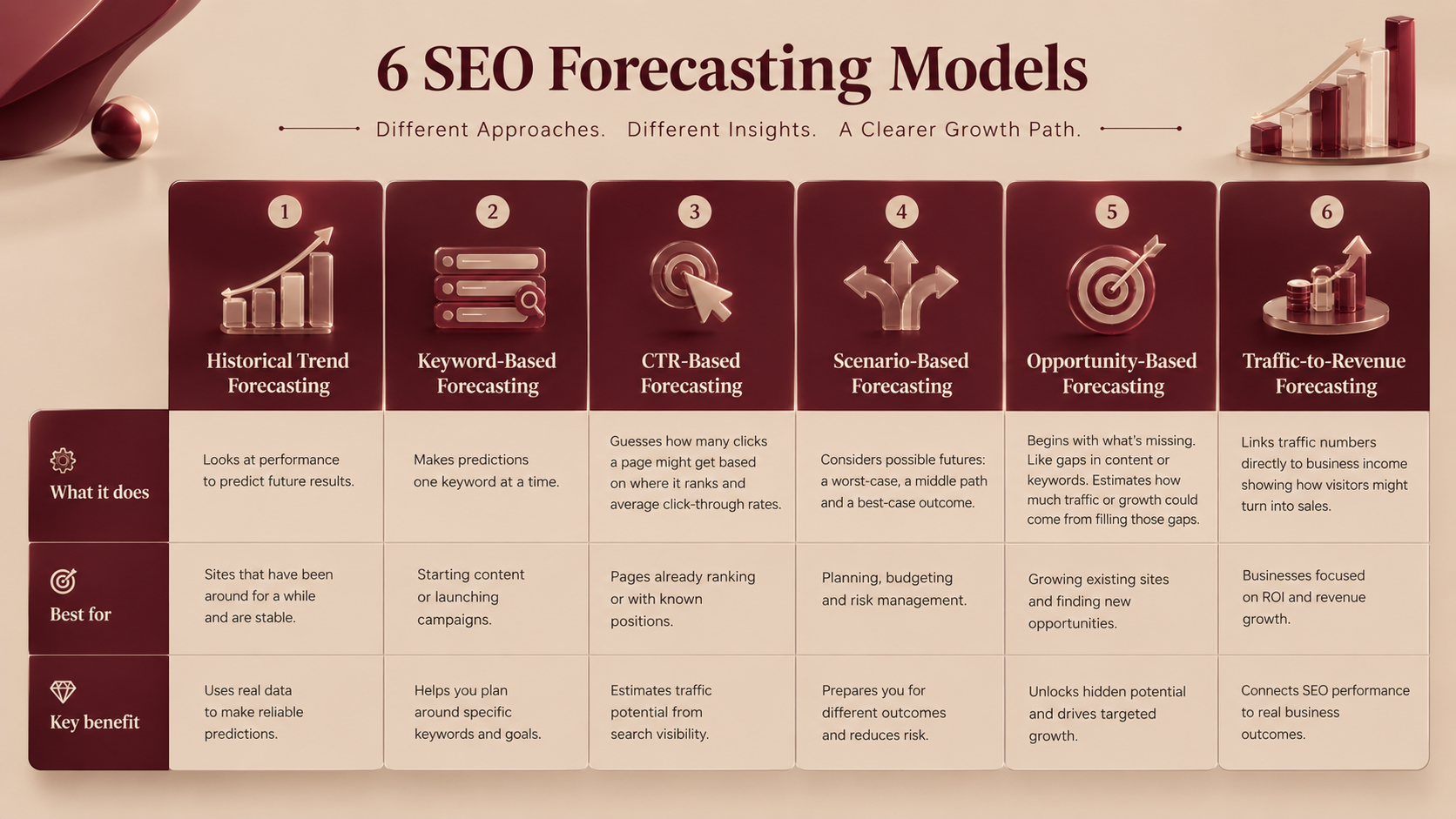
1. Historical Trend Forecasting- Looks at performance to predict future results; works well for sites that have been around for a while and are stable.
2. Keyword-Based Forecasting- Makes predictions one keyword at a time; great when starting content or launching campaigns.
3. CTR-Based Forecasting- Guesses how many clicks a page might get based on where it ranks and average click-through rates.
4. Scenario-Based Forecasting- Considers possible futures: a worst-case, a middle path and a best-case outcome.
5. Opportunity-Based Forecasting- Begins with what’s missing. Like gaps in content or keywords.. Estimates how much traffic or growth could come from filling those gaps.
6. Traffic-to-Revenue Forecasting- Links traffic numbers directly, to business income showing how visitors might turn into sales.
Each method has its limits. No single method can capture every factor that affects results. That’s why most agencies combine two or three of these methods to get a picture.
How to Forecast Organic Traffic
The main connection looks like this:
Search Demand → Rankings → Impressions → CTR → Clicks → Traffic → Conversions → Revenue
Basic calculation formulas:
- Estimated Organic Clicks = Search Impressions × Estimated CTR
- Estimated Leads = Organic Traffic × Conversion Rate
- Estimated Revenue = Leads × Lead-to-Customer Rate × Average Customer Value
These are estimates, not promises. Real results depend on how well things are done changes, in rules and whats happening in the market.
Common SEO Forecasting Mistakes
- I think treating forecasts as guarantees can be risky.
- I think ignoring seasonality can lead to plans.
- I think relying on search volume can miss deeper insights.
- I think ignoring search intent can hurt relevance.
- I think ignoring conversion rates can hide performance.
- I think overestimating ranking speed can set expectations.
- I think ignoring competitors can leave you blind, to market shifts.
- I think ignoring SERP feature changes can cost visibility.
- I think using quality historical data can mislead decisions.
- I think never updating the forecast can keep you stuck.
- I think ignoring business-level KPIs can disconnect strategy from results.
- I think focusing on traffic of revenue can misdirect priorities.
F.A.Q.
It helps businesses set goals, allocate budget and prioritize SEO work based on expected impact. This approach makes sure that every effort counts and that resources are used where they will make the difference.
By combining search demand expected rankings and CTR estimates, I project clicks. The combination of search demand expected rankings and CTR estimates helps me see how many clicks will happen in the future.
Google Search Console, Analytics, keyword tools, rank trackers and forecasting models. These are the tools that people use to keep track of their website performance. Google Search Console helps with website health and indexing. Analytics gives information about website traffic. Keyword tools help find the words to use. Rank trackers show how well a website is doing in search results. Forecasting models predict performance. All of these tools are important, for anyone who wants to improve their website.
Yes. These tools are useful, for trend analysis and pattern detection. Human validation is still required for trend analysis and pattern detection.
Yes. It helps small businesses focus their resources on the opportunities that will make the biggest difference.