
SEO vs AEO vs GEO: The Complete Guide for Businesses in 2026
Search doesn’t look like it did five years ago. It doesn’t work the way it worked when most small business owners first heard the word “SEO.” Today a customer might type a question into Google. They could get an AI-generated summary before they even see a blue link. Then they might open ChatGPT on their phone to ask a follow-up question. After all that do they land on a website. If they land at all.
That change is why three acronyms now appear in the conversation: SEO, AEO and GEO. Each one reflects a way people find information.. Each one needs a slightly different kind of content and optimization strategy.
This guide explains what SEO, AEO and GEO actually mean. It shows how they differ. It points out where they overlap. But most important it tells you what your business should actually do about them in 2026. There’s no hype. No promises that can’t be kept. Clear practical advice you can use right away.
What Is SEO?
SEO has existed for long as search engines have been around and SEO remains the base upon which every other part of this guide is built. When a person types a query such as ” accounting software for freelancers” or “plumber near me ” search engines crawl, index and rank billions of pages to find the ones that best fit that query.
SEO success depends on connected parts:
- Keywords and search intent- Use the words and phrases that your audience really types matched to the goal they have in mind (learn, compare or buy).
- On‑page SEO- Title tags, headings, meta descriptions, internal links and how the content is arranged all of which tell search engines what the page is about.
- Technical SEO. How fast the site loads, how well it works on phones how easy it is for search engines to crawl whether it uses secure connections and how clean the site structure is.
- Off‑page SEO- Links, from other trustworthy sites mentions of the brand and the overall authority of the domain.
- Content quality- Fresh well‑researched truly useful content that solves the person’s problem not just content that satisfies the algorithm.
- User experience- How easily visitors can move around the site and find exactly what they need after arriving.
If you keep all of these points straight a business will appear whenever its perfect customers are actively searching for what it offers.
What Is AEO?
Answer Engine Optimization, which I call AEO is the way I shape content so it can be pulled out and shown as a clear stand‑alone answer. AEO shows up in featured snippets People Also Ask boxes, voice assistants and other answer‑focused formats.
AEO appeared because how people search has shifted. People no longer just type phrases like “weather Mumbai.” Instead they ask questions such as “what is the weather going to be like in Mumbai this weekend?” Voice search made this shift faster because no one talks to a speaker in broken keyword fragments.
Search engines answered by creating features that give answers without needing a click:
- Featured snippets that show a short answer at the top of results
- People Also Ask boxes that let you expand related questions
- Voice search results that the assistant reads aloud
- Direct answer boxes that give facts, definitions and comparisons
AEO is about writing content so that these systems can easily pull out a clean accurate answer. That usually means:
- Using question‑based headings that mimic how people actually ask
- Answering the question in the one or two sentences then adding detail
- Adding FAQ sections numbered steps and short definitions
- Building content that can stand alone without the rest of the page
The main difference, from ordinary SEO is that SEO mainly aims to rank a page. AEO on the hand aims to win the specific spot where an answer is shown or spoken sometimes even without the user clicking at all.
What Is GEO?
Generative Engine Optimization or GEO is about making sure your content and brand are clear and easy for generative AI tools to understand. Tools like ChatGPT Google’s AI Overviews and Perplexity use this information to build answers summarize ideas or even quote sources when someone asks them a question.
More and more people are finding answers through AI conversations not by clicking through a list of search results. For example if someone asks an AI “what’s the best CRM for an agency ” the AI doesn’t show ten links. Instead it creates an answer sometimes pulling in and naming a few sources it used.
GEO focuses on key things:
- How generative AI systems discover and make sense of information about your brand or topic
- Whether AI tools actually mention or cite your content when they answer a question
- Brand and entity recognition. Does the AI know who you are and what you do and does it remember that consistently?
- Topical authority. Do you have deep meaningful coverage on a subject or just one thin page?
- Trust signals. Is your content clear, about who wrote it is it accurate and does it feel credible?
- Semantic and structured clarity. Is your content organized so the AI can easily see how ideas connect?
It’s important to be honest GEO is still a new field. How each AI platform picks sources is not always clear. It can change over time. Different tools also work in ways. So GEO helps make it more likely that your business will be understood and possibly cited by AI systems.. It doesn’t promise that any specific tool will mention your website.
SEO vs AEO vs GEO in Simple Terms
If the table above feels like a lot here’s the short version:
SEO → Helps search engines find and rank your content. Example: A bakery optimizes its website so it appears when someone in their city searches “custom birthday cakes near me.”
AEO → Helps answer engines understand and present your answers. Example: The same bakery adds an FAQ answering “how far in advance should I order a custom cake?” so it can appear as an answer or voice response.
GEO → Helps generative AI systems understand, trust and potentially reference your content or brand. Example: When someone asks ChatGPT “what should I look for in a custom cake bakery ” the bakerys documented, detailed and consistently described expertise increases the odds it gets mentioned or its content gets drawn on in the response.
Same business, three different doors, into being found.
How SEO, AEO and GEO Work Together
These are not three marketing departments. These are three layers built on the foundation of genuinely useful well-structured content.
Picture it like this:
SEO → Discoverability (can people and search engines find you all?)
AEO → Answerability (can your content answer the question being asked?)
GEO → AI Visibility (can AI systems understand and reference what you know?)
A single built page can serve all three purposes at once. Imagine a marketing agency that writes a page about the “best digital marketing agency for small businesses in India.”
For SEO the page looks for the keyword has a solid technical structure links internally to service pages and earns backlinks over time.
For AEO the page gives a direct answer near the top. “A good digital marketing agency for a small business in India typically offers X, Y and Z”. And adds an FAQ section that answers related questions like “how much does digital marketing cost for a small business in India?”
For GEO the page goes deeper than competitors: it explains the reasoning behind each recommendation cites credible sources shows clear expertise and stays consistent, with how the agency describes itself everywhere else online.
One page. Three layers of visibility. That is the goal.
Why SEO, AEO and GEO Matter for Businesses in 2026
Search behavior has really changed a lot. People still type words into Google. They also talk to voice assistants. Ask them full questions.. More and more they use AI chat tools to look up things they want to buy see what’s available and get help deciding before they even go to a companys website.
A reasons why this is important for companies right now:
- Zero-click searches happen a lot- Many questions are answered on the results page or inside an AI reply without people clicking on any website.
- Questions are like normal conversation- People ask detailed questions instead of just short words, which changes what it means to be “ranked” for something.
- Trust and clear writing are getting attention than just using a lot of keywords- Both answer. Ai systems like content that is easy to understand organized well and shows it is true.
- People are finding things on places- Customers look up the thing using a regular search engine, a voice assistant and an AI chatbot. Sometimes all three, on the same day.
None of this means SEO is no longer important. It means the idea of “being found” has become bigger and companies that only work on one part are missing out on chances to be seen in the parts.
Key Differences Between SEO, AEO and GEO
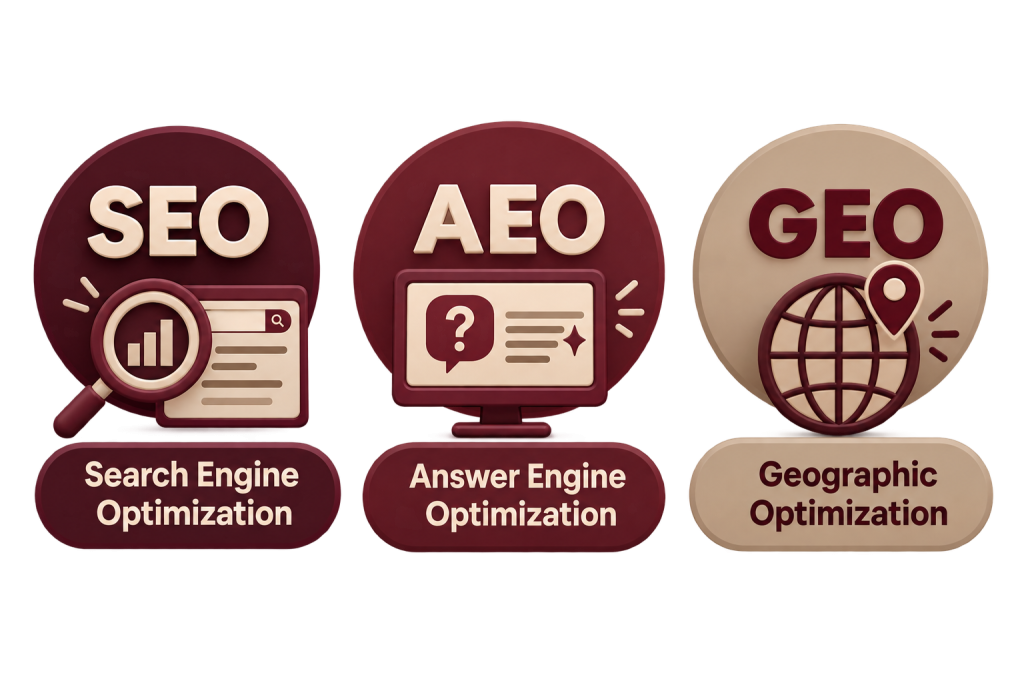
SEO
- search rankings
- organic visibility
- keyword relevance
- technical site health
- backlinks and domain authority
- long‑term website authority
AEO
- AEO gives answers to specific questions
- AEO uses featured snippets and PAA boxes
- AEO deals, with conversational and voice queries
- AEO creates FAQ‑style content
GEO
- GEO wants AI-generated answers to be easy to see.
- GEO wants an identity, for its brand.
- GEO wants deep knowledge and authority on its topics.
- GEO wants content that can be cited and that people trust.
- GEO wants to link ideas in a meaningful way.
How to Optimize Your Website for SEO, AEO and GEO
Step 1: Understand Search Intent
Every search query fits into one of four types: informational navigational, commercial or transactional. Informational means the user wants to learn something. Navigational means they are looking for a website. Commercial means they are comparing options. Transactional means they are ready to buy. Matching your content to the intent is the first and most important step for all three layers of optimization.
Step 2: Research Topics and Questions
Go beyond keywords. Look at the questions your customers ask. Check your emails review what comes up in sales calls and read through support tickets. These questions often reveal what people really want to know. They are more valuable for AEO than any keyword tool can provide. Use them to shape your content.
Step 3: Build Topic Clusters
Start with a pillar page that covers a broad core topic. Then create supporting articles on subtopics. Link all of these back to the pillar page. This structure shows search engines that you have knowledge in one area. It also gives AI systems a picture of your expertise and helps them understand your content better.
Step 4: Create Helpful Original Content
Original content built on experience wins every time. Generic copy-pasted content fails across all three optimization layers. Search engines are getting better at spotting templated writing. AI systems also prefer sources when answering questions. If your content isn’t unique it will be ignored. Focus on value, clarity and authenticity.
Step 5: Optimize for SEO
Make sure your content follows the basics. Use title tags that match the page topic. Write meta descriptions that encourage clicks. Structure your headings logically with H1, H2, H3 tags. Keep URLs readable. Link pages with strong internal links. Make sure your site loads fast. Ensure it works well on devices. Optimize images, for speed and clarity. These elements still. Help your content rank.
Step 6: Optimize for AEO
Use question based headings. Answer the question away then add more detail. Add FAQ sections, numbered lists and short quotable definitions that could stand on their own outside the page. AEO is the focus so AEO should appear clearly in every heading and every answer.
Step 7: Optimize for GEO
Establish entity information: who you are, what you do where you operate. Go on topics rather than skim many. Cite sources for factual claims. Show author expertise. Keep how you describe your business consistent across your website, listings and social profiles. GEO is the focus so GEO should appear clearly in every paragraph.
Step 8: Add Structured Data Where Appropriate
Schema markup—such as Article, Organization, LocalBusiness, Product or FAQPage schema where applicable—helps search engines and other systems parse your content more accurately. Structured Data helps machines understand your content correctly. It does not guarantee higher rankings or AI citations on its own. Structured Data should be mentioned clearly.
Step 9: Build Authority
Quality backlinks, digital PR, guest contributions from experts, visible author pages, genuine customer reviews and relationships, within your industry all compound over time to build the kind of authority that supports SEO, AEO and GEO simultaneously. Authority is the focus so Authority should appear clearly in every line.
Step 10: Measure and Improve
Track performance regularly look at what’s actually working and keep refining. None of these three disciplines is “. Forget.” Measure and Improve is the focus so Measure and Improve should appear clearly in every sentence.
How to Write Content That Works for SEO, AEO and GEO
- Start with the readers problem not with your product
- Answer the main question early do not bury it under a long introduction
- Add supporting context and nuance after the direct answer
- Use clear descriptive headings
- Include related questions that readers are likely to have
- Use concrete examples wherever they help understanding
- Add original insight or perspective not just recycled information
- Cite reliable verifiable sources for factual or statistical claims
- Demonstrate real expertise through detail and accuracy
- Keep information accurate and update it as things change
This framework is not complicated. It is closer to good writing discipline, than a technical trick. That is the point.
Example of SEO + AEO + GEO Optimization
Topic: What is Local SEO?
- SEO approach: Use the keyword SEO and related words naturally. Arrange the page with headings. Link to service pages inside the site such as Google Business Profile optimization. Over time build backlinks from industry sites that matter.
- AEO approach: Start with an answer: Local SEO is the process of making a businesss online presence better so that more customers find it from local searches. Then add an FAQ section. In it answer the questions How does local SEO work?. Why is local SEO important? with clear answers that stand alone.
- GEO approach: Go beyond a definition. Explain how the factors that rank local searches are connected. Cite sources such as official search engine documents. Show an realistic business example. Make sure the business name, location and services are described the way on this page and on all other pages.
All of this uses the topic but it is written so that it can rank can be taken as an answer and can be understood by an AI system. All, from one well‑built page.
Common Mistakes Businesses Make With SEO, AEO and GEO
- Focusing on keywords- Keywords still matter, but content built purely around them without addressing real intent performs poorly across all three layers.
- Writing for search engines- Content that reads like content was written for an algorithm rather than a human tends to underperform now more than ever.
- Ignoring user questions- Skipping the questions your customers ask is a missed AEO opportunity.
- Publishing AI‑generated content with no editing or expertise added- Thin templated output rarely demonstrates the depth GEO and modern SEO both reward.
- Publishing content- A 300‑word page rarely has enough substance to be extracted as an answer or cited by an AI system.
- Keyword stuffing- Repeating a phrase unnaturally hurts readability and offers no AEO or GEO benefit.
- Ignoring search intent- A page optimized for the intent (say, a product page, for an informational query) won’t perform, no matter how well‑written.
- Neglecting SEO- A slow, broken or unindexed site undermines every other effort.
- Not demonstrating expertise- Vague surface‑level content gives AI systems and search engines little reason to trust it.
How AI Is Changing SEO, AEO and GEO
AI is changing parts of how we search at the same time. Search habits are moving toward longer conversational questions. Content discovery is now happening through AI‑generated summaries of a long list of links. Even the way we ask questions is shifting, because people speak to AI in a style than they type into a search box.
On the content side AI tools are speeding up how we draft text and are flooding the market with content. Search engines and AI systems are working harder to separate useful articles from mass‑produced filler. Personalization is also growing, with search and AI results being shaped more by our interactions and context than, by a single fixed ranking.
None of this means the world is becoming chaotic. It means that the basics—clarity, accuracy, usefulness and trustworthiness—are becoming more important even as the ways we get information multiply.
Future of SEO, AEO and GEO Beyond 2026
Looking beyond 2026 a few directions seem likely to continue without treating any of this as certain:
- Conversational multi-turn search will probably keep growing as AI interfaces mature.
- Multimodal search, which combines text, voice, image and video will probably keep expanding.
- AI-generated answers will probably keep playing a role earlier in the customer journey.
- Trustworthy, accurate well-sourced information will probably matter more not less as AI-generated content becomes more common.
- Entity-based understanding, which shows how clearly a businesss identity, expertise and offerings are represented online will probably keep growing in importance.
- Personalized search experiences will probably keep individualizing what different users see for the same query.
- party data original research and demonstrated human expertise will probably keep remaining durable differentiators since they are difficult, for competitors or AI-generated content to replicate.
F.A.Q.
SEO is about getting higher rankings in regular search results. AEO is about giving answers to specific questions usually through featured snippets or voice search. GEO is, about helping artificial intelligence tools understand your content and maybe even reference it. These three areas deal with parts of how people look for information now.
Timelines differ depending on the industry. How competitive things are, but all three methods—SEO, AEO and GEO—usually require months of steady work. They don’t happen in a few days or weeks. SEO and AEO results tend to be easier to follow over time because you can see changes, in rankings, traffic and engagement clearly. GEO progress moves slower. Is often harder to measure with exact numbers.
None of them is inherently better. Each serves a purpose. SEO helps with rankings and traffic. AEO gets you direct-answer placements. GEO builds visibility for AI. Most businesses do better by investing in all three of picking just one.
Start with SEO basics like making sure the website is technically sound and has content that matches the keywords people are searching for. Then include AEO by using FAQs and answers that appear directly in search results. Finally grow GEO by creating content that is detailed backed by good sources and keeping the brand look the same everywhere on the web.
GEO is a new layer of visibility but it does not replace SEO. It shows how generative AI tools are changing the way people discover information. Still GEO relies on the core principles that SEO has always needed—crawlable, trustworthy and well-organized content. Without those basics GEO won’t work. The foundation stays the same even as the tools evolve.
Conclusion
SEO AEO and GEO are not three paths competing for your marketing money. They are layers of the same objective. Being seen, being helpful and being trusted wherever your customers are searching.
A solid digital marketing plan for 2026 starts with making sure you’re discoverable. Then make sure you can answer the questions people are asking. Finally build trust with AI systems by being clear, accurate and consistent. SEO opens the door. AEO delivers the answer at the right time. GEO helps generative AI tools recognize your content as reliable and worth citing.
If you haven’t already checked how your business stacks up across all three areas that’s the step to take. Begin with an audit of your website’s SEO performance. Check if your main pages actually answer customer questions. Look at how your business is described in online directories, reviews and other platforms. Then start building an approach. One well-crafted well-organized piece of content, at a time.