
Why Short-Form Video Is Still Dominating Social Media in 2026
You open Instagram to look at one notification. Forty minutes later you’re watching a person in Jaipur showing you how to fold a saree in than a minute then a bakery in Pune demonstrating how they make their famous brownie, then a person who started a business explaining how to file GST in just fifteen seconds. You didn’t plan any of this. That’s the power of short-form video. In 2026 it hasn’t gone away. If anything, its held on even tighter to how people find brands, products and other people.
Every year since Reels and Shorts became popular someone has said this type of video would get boring. It hasn’t. Peoples habits have just moved toward quick mobile-first videos and the platforms have kept adding the support. Like recommendation feeds, tools for creators and shopping features. That keeps this trend going. For companies short-form video is no longer something in a marketing plan. It’s often where a new customer first sees a brand.
This guide explains why short-form video continues to get attention in 2026, how it can be part of a real business plan and what makes the videos that actually lead to sales different, from the ones that just get a lot of views.
What Is Short-Form Video?
Short-form video generally refers to video content built to be watched quickly — usually anywhere from a few seconds to around two or three minutes — designed for vertical, mobile-first viewing on platforms like Instagram Reels, YouTube Shorts, TikTok, and Facebook Reels.
It’s not defined by a strict number of seconds. Platforms keep adjusting their formats, and what counts as “short” on YouTube Shorts can look different from what works on Instagram. What ties the format together isn’t duration alone — it’s intent. Short-form video is built to deliver one idea, one feeling, or one useful takeaway quickly, without asking for a long-term attention commitment upfront.
This is exactly why it works so well on mobile devices. People aren’t sitting down to “watch a video” the way they might with a film or a YouTube tutorial. They’re scrolling, waiting for a coffee order, standing in a queue, or unwinding before bed. Short-form video meets people in those in-between moments rather than asking them to set time aside.
Why Is Short-Form Video Still So Popular in 2026?

1. People Have Limited Attention
Viewers make a decision about whether a video is worth their next few seconds. There is no patience for a start or a logo animation before the main point is made. Short-form video pushes creators and brands to start with value or personality away which is exactly the skill that modern audiences appreciate.
2. Short Videos Are Easy to Consume
A video can fit into a lift ride a bathroom break or the two minutes between meetings. This “snackable” quality is a reason why the format continues to be popular. It does not ask for dedicated time it uses time that would otherwise be empty.
3. Social Platforms Prioritize Video Discovery
Most major platforms now focus a lot on recommendation-based feeds of showing content only to people who already follow the account. That means a good short video from a business can reach people who have never heard of the brand before. The exact rules for ranking are different on each platform and change often. Its better to see this as a general move toward feeds that focus, on discovery instead of a set formula to take advantage of.
4. Short-Form Video Encourages Higher Content Consumption
Short-form videos are quick to watch so people often scroll through several in one sitting. This means users spend time on the platform. For brands it means repeated exposure. Of depending on just one long video to make an impact they can show up multiple times across different short clips.
5. Short-Form Video Is Shareable
Short videos move easily from person to person. They get forwarded in WhatsApp chats reshared to Stories or sent in a message, with the note “you have to see this.” When someone shares a video they’re lending their trust to it. That kind of sharing reaches way beyond a brand’s existing followers. It builds credibility in ways that paid ads simply cannot match.
6. Creators Have Made Video Relatable
Creator-led content changed how video is made and seen. Now good videos don’t need high-end studios or perfect lighting. What works is people speaking directly to the camera sharing honest thoughts and connecting around specific passions. This shift makes video feel like a conversation, not a sales pitch. Audiences engage more when they feel like they’re part of a community of being sold to.
7. Artificial Intelligence Is Making Video Creation Easier
Artificial intelligence tools now help with thinking of ideas writing scripts making captions editing videos adding subtitles making voiceovers and using one video to create versions for different platforms. This has made it much easier for people to create videos. It is important to be clear though that artificial intelligence tools make the process faster. They do not automatically create content that people want to watch. The idea, the hook and the honesty still need a being behind them.
8. Videos Support Social Commerce
Short videos have become a real part of the shopping experience. From videos that show how something works to quick unboxings to comparison videos. It makes the distance between finding a product and deciding to buy it especially when combined with shopping tags inside the app or a clear link in the bio.
9. Short-Form Video Works Across Industries
few areas are left out of this style of video. It appears naturally in:
- Fashion- Tips on how to dress videos showing how clothes look new products
- Beauty- Teaching how to do something showing products before and after videos
- Food- How to make recipes behind the scenes in the kitchen highlights of the menu
- Education- Explanations, tips for exams building skills
- Fitness- Showing how to do exercises correcting form, stories of change
- Travel- Guides to places, hidden places, tips for packing
- Real estate- Walking through properties guides to areas tips for buyers
- Healthcare- Explaining myths, tips, for staying healthy introducing clinics
- E-commerce- Showing products, reviews, unboxings
- Technology- Explaining features, comparing products, quick reviews
- Professional services- Answering frequently asked questions, examples of work explaining what they do
- Local businesses- Daily deals, introducing staff thanking customers
Major Platforms for Short-Form Video in 2026
**Instagram Reels**
Reels stays a way for people to discover new content especially for brands that rely on eye‑catching visuals. Reels helps a brand grow by posting. Reels also works well when creators team up and Reels mixes nicely with product tags for sales. If a business already uses Instagram Reels is usually the way to begin.
**YouTube Shorts**
Shorts gains from being part of YouTube’s search and discovery system. This lets Shorts stay visible for a time than some other formats; a Short can be found weeks or even months after it is posted. Shorts is especially good for teaching, entertainment and reusing parts from YouTube videos.
**TikTok**
TikTok finds videos mainly through interest‑based suggestions, not just the follower list. TikTok’s creator community is large and moves quickly. Where TikTok fits into a business plan depends a lot on who the business wants to reach and whether TikTok is available in that area.
**Facebook Reels**
Facebook Reels usually reaches a often older or more local crowd than other short‑video sites. This makes Facebook Reels useful for businesses whose customersre already on Facebook, especially local and service‑based ones.
Platform relevance is not the same. Which platform matters most depends on the country the audience, the age group, the industry and what the business wants to do. A skincare brand aimed at Gen Z will choose different platforms than a B2B consultancy aimed at decision‑makers, in their 40s and 50s. The best approach is usually to focus on one or two platforms that match the audience instead of spreading effort across many.
Short-Form Video vs Long-Form Video
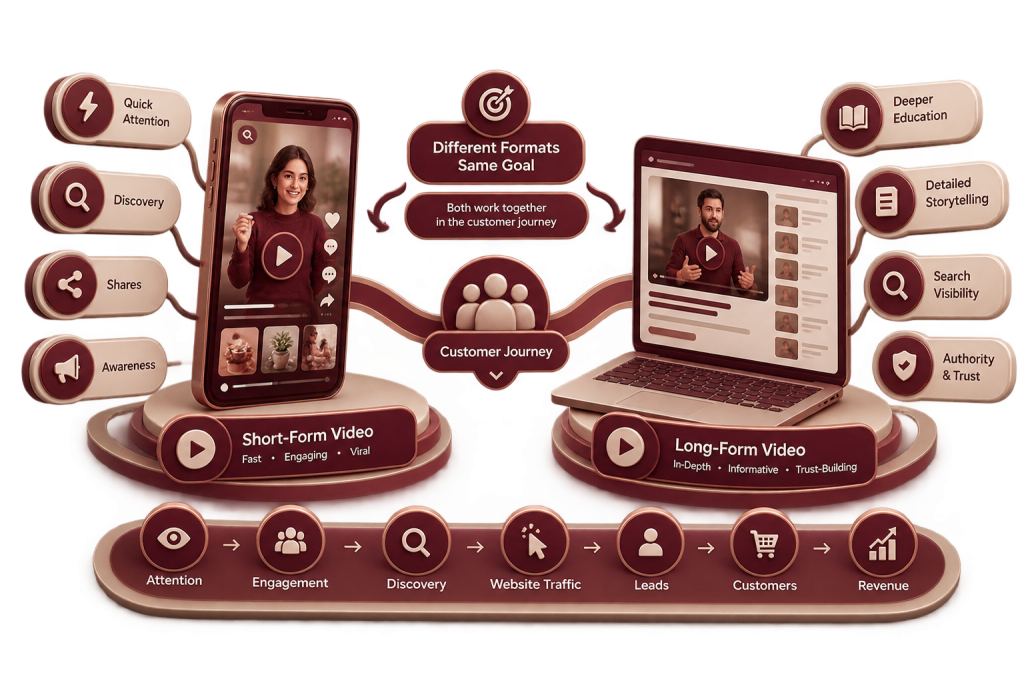
- Attention:- Short‑form videos win when people first see them; they are made to stop an eye. Long‑form content needs a larger time commitment. It can keep attention once it is earned.
- Depth:- Long‑form lets you give an explanation, a story and small details. Such as a product demo, a thorough tutorial or a customer story told entirely. Short‑form must squeeze an idea into its parts.
- Discovery:- Short‑form usually gains an advantage from recommendation feeds. Long‑form on YouTube gets a search advantage because people actively look for it.
- Production:- Short‑form usually needs time and less budget for each video, which supports a higher posting frequency. Long‑form normally demands planning, more editing and more resources, for each piece.
- Engagement:- Short videos make people react fast. They like, share and comment. Long videos usually create connections with a smaller group of people who really care.
- Education:- Short videos are good for advice and simple answers. Long videos are better, for teaching step by step or explaining things in detail.
- Brand awareness:- Short videos help introduce a brand to a lot of people quickly. Long videos help people get to know the brand and see it as an expert.
- Conversion:- Short videos usually start the conversation; long videos or a landing page usually finish the deal especially when the product needs thought.
- Repurposing:- Both types fit together well. A long video or podcast can be split into short parts and a short part that does well can show what people want more of in long form.
How Can Businesses Use Short-Form Video in 2026?
- Brand awareness- Always making videos that people can easily recognize helps a business stay in front of new people without needing to pay for ads all the time.
- Audience engagement- When people comment, share or copy a video they become part of a group that cares about the brand.
- Product discovery- A good video showing how a product works can make someone discover it even if they weren’t looking for it.
- Lead generation- Videos that end with a next step like sending a message clicking a link or filling out a form can turn viewers into people who ask questions.
- Website traffic- A link in a bio or a message on screen can take people from the platform to the business website.
- Community building- Making content that shows the personality of the brand gives followers a reason to keep watching not watch once.
- Proof- Videos with real customer reactions and reviews are more convincing for many people than written reviews.
- Customer education- Videos that explain things help reduce repeated support questions and make customers feel more confident.
- Product demonstrations- Watching a product being used in life often makes more sense than seeing it in a perfect studio setting.
- Behind the-scenes content- Showing how a product is made or how a team works helps people feel more connected and trust the brand more.
- Testimonials- A short honest video from a customer can be more powerful than a planned case study.
- Creator partnerships- Working with creators who already have fans helps introduce a brand in a more trusted way, than a normal ad.
- User-generated content (UGC)- Encouraging customers to make their videos about a product adds a real and honest feel that the brand can’t create on its own.
- Social commerce- Tags that let people buy and messages telling them to take action make it easier for people to go from “I saw this” to “I bought this.”
Types of Short-Form Videos That Work for Businesses
- Educational videos build authority around a topic that the business knows well.
- How‑to videos show a process step by step all in a few seconds.
- Quick tips give fast stand‑alone value that’s easy to save or to share.
- Product demonstrations show how something works or looks when it is used.
- Before‑and‑after videos prove results visually such as renovation, skincare or fitness.
- Customer testimonials build trust with a person’s experience.
- FAQs answer the questions customers ask often once and for all.
- Behind‑the‑scenes videos humanise the brand. Show the process.
- Day‑in‑the‑life videos give a relatable window into the business or founder.
- Myth vs fact videos correct common misconceptions in a niche.
- Trending‑format videos tap into an audio or format trend used only when they truly fit the brand.
- Storytelling videos build a connection around a larger brand narrative.
- UGC videos showcase customers using the product in their own words.
- Founder‑led videos put a face and voice to the business building trust quickly.
- Problem‑solution videos frame a pain point and show how the product solves it.
- Product comparison videos help undecided buyers choose with confidence.
- List‑style videos deliver quick tips or options in one format like “5 things to check before…”
- Industry insights demonstrate genuine expertise and keep the brand relevant to industry conversations.
- Case‑study snippets condense a success story into a digestible highlight.
- Offers and promotional videos give direct time‑bound calls, to action used sparingly so they do not overwhelm the feed.
What Makes a Short-Form Video Successful?
Strong Hook
The first few seconds decide whether someone will keep watching. Hook can be a statement, a visual surprise, a direct question or jumping straight into the most interesting part of the video. Hook does not need to be clickbait. Hook must promise something worth staying for and then Hook must deliver that promise.
Clear Message
One video should normally carry one idea. Trying to explain three things at once usually means none of those ideas land clearly.
Fast but Natural Pacing
Quick cuts and tight editing keep momentum. Pacing should still feel natural rather than frantic. The goal is to remove air not to make the video feel chaotic.
Captions and On-Screen Context
Many people watch with the sound off in public or shared spaces so Captions and on-screen text help the message land regardless of audio. Captions also support viewers who’re hard of hearing or who simply prefer reading along.
Storytelling
A structure works reliably: Hook → Problem → Value → Payoff → CTA. Open with something attention-grabbing name a problem deliver the useful part land the payoff then give a clear next step.
Authenticity
polished ad-like videos can sometimes feel less trustworthy than something shot on a phone with honest lighting and a real voice. That does not mean quality does not matter. It means audiences increasingly value realness over gloss.
Strong Visuals
Framing, movement, close-ups on the product and simple screen recordings all help communicate than words alone. Visual clarity often matters more than production budget.
Relevant CTA
A short specific call-to-action works better than an one. A few examples:
- Save this post
- Follow for
- Visit our website
- Send us a message
- Learn more
- Shop now
- Book a consultation

Not every video needs a hard sell. Sometimes the most effective CTA is simply “follow for more ” which builds an audience, for the next video.
How AI Is Changing Short-Form Video Marketing in 2026
AI has become a time-saver in the short-form video process. It can help with:
- Coming up with ideas and discussing topics
- Writing scripts and creating openings
- Looking at trends and formats
- Editing and making initial cuts
- Creating captions and subtitles automatically
- Adding voiceovers in different styles or languages
- Translating content for different languages
- Splitting one long video into many short clips
- Customizing messages for different groups of people
- Looking at performance data to see what is working
It is also important to know where AI is not good enough. Content that is completely made by AI can seem boring if it does not have a brand voice. Facts still need to be checked by humans. Using AI made pictures or sounds can also cause problems with copyright and originality that companies need to handle. Relying much on automation can take away the personality that made short videos successful in the first place. The companies that are getting the benefits, from AI in 2026 are using it to take care of the boring parts of making videos. Not to replace the human thinking, humor and truth that make a video worth watching.
How AEO Can Help Short-Form Video Content
Answer Engine Optimization is about making content around the questions people are already asking. The kind of questions people type into a search bar or ask a voice assistant. Applied to short-form video that means making videos around specific answerable questions such as:
- “How does SEO work?”
- “What is Google Ads?”
- “How can I get Instagram followers?”
- “How do I improve website conversions?”
- “What is content marketing?”
A video that starts by stating the question and then answers it directly tends to be more helpful. Both for the person watching and for any system trying to figure out what the content is, about. This kind of clarity also makes content easier to use in AI-generated answers even though no platform can promise that will happen.
How GEO Can Support Short-Form Video Visibility
Generative Engine Optimization is about creating content that’s easy for artificial intelligence systems to understand, summarize and use correctly. Not just content that is enjoyable for people to read. For short-form videos this means combining the video with information that is clear and correct such as:
- Clear topic information in text overlays and descriptions
- Facts that can be checked instead of general statements
- A brand image and way of speaking that stays the same on all platforms
- Words and phrases that are used the same way throughout a companys videos
- Websites that provide more details about what the video is about
- Information that is organized (like questions and answers) that match the main ideas of the video
- New ideas instead of common advice that everyone gives
- A clear sign of who made the video or which brand is responsible
- Messages that are the same, on every platform a business uses
It is important to be honest here: none of these things ensure that ChatGPT, Gemini, Googles AI tools or any other artificial intelligence system will mention a particular video. GEO helps make it more likely that content is understood correctly and used properly. It is not a way to get more people to see the content.
Common Short-Form Video Mistakes
- opening- Viewers scroll away before the point is made. Fix: rewrite the opening and test hooks until one grabs attention within the two seconds.
- Much information in one video- Trying to cover everything dilutes the message. Fix: split the content into a series instead of one overloaded video.
- Copying trends without relevance- A trending format that does not fit the brand can feel forced. Fix: use a trend only if it can genuinely serve the message.
- Promotion- Constant hard‑selling fatigues an audience quickly. Fix: balance material with educational and entertaining posts.
- Poor audio- Bad sound quality drives people away fast even with great visuals. Fix: invest in an external microphone; it matters more than a fancy camera.
- Poor lighting- Dark or unclear footage undermines credibility. Fix: film near light or use an affordable ring light.
- No captions- Viewers watching on mute miss the message entirely. Fix: add captions to every video, the short ones.
- No clear message- A video that tries to say everything ends up saying nothing. Fix: define a takeaway before filming.
- No CTA when appropriate- Viewers are left without a step. Fix: end with one specific action when the video calls for it.
- Inconsistent publishing- Sporadic posting makes it hard to build momentum. Fix: commit to a sustainable schedule.
- Ignoring analytics- Repeating what is not working wastes effort. Fix: review performance regularly. Adjust based on real data.
- Creating trend‑based content- A feed with no original ideas struggles to build a distinct identity. Fix: balance trends with brand‑specific content pillars.
- Using AI‑generated content without editing- Unedited AI output can feel generic or slightly off. Fix: always review, personalize and fact‑check AI‑assisted content before posting.
- Focusing on views- Vanity metrics do not pay the bills. Fix: track engagement, leads and conversions alongside reach.
- Not understanding the target audience- Content made for “everyone” tends to resonate with no one, in particular. Fix: build content around an audience’s real interests and problems.

F.A.Q.
It fits naturally into how people use their phones during the day. In moments between other things. Feeds that suggest content help it get to people who aren’t already following it.. Low costs to make content helped by AI tools make it easier, than ever for businesses and creators to keep putting out new stuff regularly.
It gives an effective way to show a brand to new people help them get to know the brand by seeing it again and again and get those who like it to go to a website send a direct message or make a purchase. All, without needing a lot of money for making videos or having a big group of followers.
Start with a hook in the first couple of seconds. Focus on one message. Add captions. Keep the pacing natural but tight. End with a specific call-to-action. Authentic direct-to-camera content often performs well as or better, than, highly polished production.
AI can help with coming up with ideas writing scripts, editing, creating captions adding subtitles making voiceovers translating and turning content into many short videos. It does the job when it is a tool that makes the work go faster not when it takes the place of a brands own voice and the decisions made by people.
Neither format is universally better. Each format serves its purpose. In my view the short‑form format is usually stronger for discovery and awareness. In my view the long‑form format is usually stronger, for depth, education and building trust. The effective strategies use both formats together.
Conclusion
Short‑form video has not remained popular by chance. It matches the way people use the internet. It rewards companies that’re honest instead of only polished. It also becomes simpler to make. It does not lose quality.. Getting attention was not the only aim. In 2026 the companies that get success with short‑form video are the ones that link that attention to a larger purpose. Awareness grows to recognition engagement grows to trust and trust grows to traffic leads and sales.
Creating a short‑form video presence that truly succeeds is not about following every trend or posting for the sake of posting. It is, about knowing the audience keeping a rhythm and viewing video as one piece of a wider digital marketing plan. It works together with [Internal Link: Social Media Marketing] [Internal Link: Content Marketing] and [Internal Link: SEO Services].
If your business is trying to decide where short‑form video belongs in its marketing picture that is exactly the kind of discussion worth having. No pressure. Just a clear next step when your business is ready.