
AI-Powered Marketing: Benefits, Challenges and Best Practices for Businesses in 2026
A few years ago, the idea of using data in marketing involved just checking a spreadsheet once a month; nowadays, companies are expected to understand their customers in real time, produce content faster than ever, and personalize each and every interaction—whether it’s a visit to a website or the subject line of an email. That change wasn’t the result of marketers suddenly becoming faster; it was due to AI taking on the heavy work behind the scenes.
It isn’t the case that AI-powered marketing consists of one particular tool or represents a single trend; rather, it involves a wide-scale change in the way that businesses understand their customers, produce content, manage campaigns, personalize experiences, analyze data, and automate the more repetitive aspects of marketing so that people can concentrate on strategy and creativity. This change is particularly important for a small business owner in Mumbai who is running advertisements on a limited budget or for a SaaS founder who needs to nurture hundreds of leads without having a large team.
The guide explains what it actually means to have AI in marketing, how it works in practice, the areas in which it is useful, the areas in which it fails, and how both large and small businesses can develop a strategy based on it responsibly.
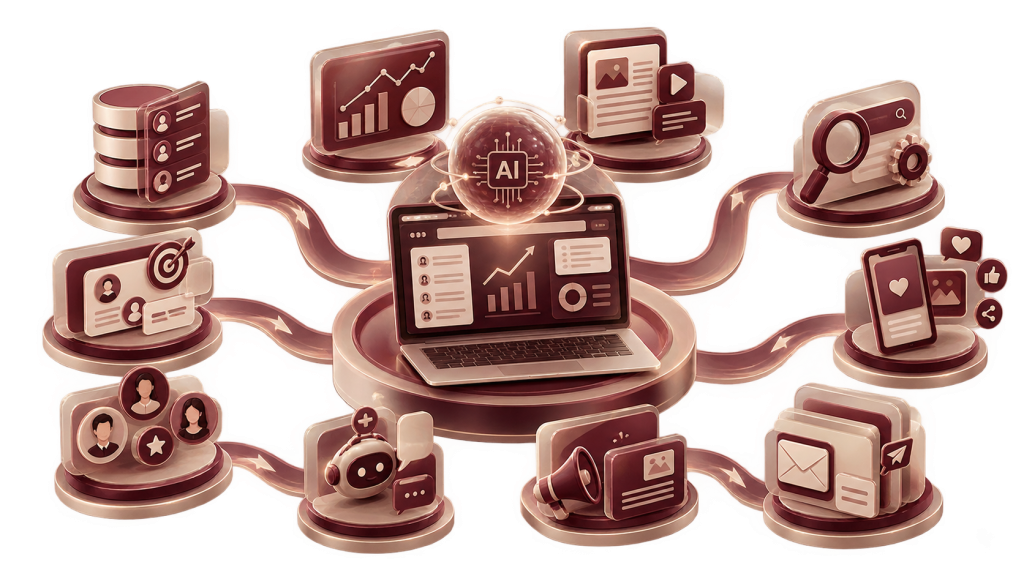
What Is AI-Powered Marketing?
AI-powered marketing involves the use of artificial intelligence—such as machine learning, predictive analytics, natural language processing, and generative AI—to analyze customer data, personalize experiences, automate routine tasks, and assist in making marketing decisions. It extends beyond simple automation by learning from patterns in the data so as to make marketing more relevant and efficient over time.
Traditional marketing automation is based on fixed rules, such as ‘if a customer abandons their cart, then send them email A three hours later’. AI-powered marketing builds on this by incorporating the elements of learning and prediction; for instance, it can determine which customers are most likely to respond to a particular offer, when they are most likely to open an email, or what product they are most likely to want next, on the basis of patterns in their past behaviour.
A simple example is an online clothing store that uses traditional automation, which means it sends the same discount email to all customers who have abandoned their carts, whereas an AI-powered system would be able to predict which customers are price-sensitive and only require a slight incentive, and which ones are unlikely to convert no matter what the discount is, and then adjust the offer or the timing as appropriate.
Firms are taking up this method since customer expectations have changed; people now expect relevant recommendations, quick responses, and content that seems tailored to them, and it’s simply impossible to provide this kind of service manually for thousands of customers.
How Does AI-Powered Marketing Work?
Most AI-powered marketing systems follow a core process:
Data → Analysis → Prediction → Personalization → Automation → Measurement → Optimization
- Data: The system gathers information from places, like website visits past purchases, email responses and customer relationship management records.
- Analysis: Artificial intelligence looks for patterns. Which items are often bought together what kind of content people engage with and which customers might stop using the service.
- Prediction: Using those patterns the system predicts what will happen next. Who’s likely to buy who might leave and what messages could work best.
- Personalization: Content, deals or product suggestions are customized for each customer or group based on those predictions.
- Automation: Repetitive tasks. Sending emails, changing ad prices starting follow-up messages. Run automatically without needing someone to do them every time.
- Measurement: Results are tracked using business goals, not just numbers generated by the AI.
- Optimization: The system and the marketing team adjust the strategy based on performance data.
- The main idea: AI does not take over this cycle completely. It makes it faster and more accurate.. Only if the data is correct and people who know the business are watching the results.
Why Is AI Becoming Important in Marketing in 2026?
Here is the input from the user:
A few real changes are happening, without needing to say much:
- AI-powered search and answer tools are changing the way people look for information making it more important for content to clearly answer questions.
- Tools that use AI have made it faster and easier for smaller teams to create content make images and come up with ideas.
- Personalization on a scale is now possible even for businesses that do not have big data science teams thanks to AI features in common marketing tools.
- Predictive analytics helps companies see what customers might need before it happens.
- Conversational experiences like chatbots and AI assistants are becoming something people expect for customer questions.
These are changes, in how marketing tools are used. Not guesses about what might happen. Companies that know how to use these tools well have an edge. Ai alone does not decide success; strategy and how things are done still matter most.
Benefits of AI-Powered Marketing
Better Customer Personalization
I observe that AI can analyze browsing behavior purchase history and preferences to deliver relevant product recommendations, content and offers rather than presenting the same experience to each visitor.
Faster Content Creation
I observe that AI tools can help generate content ideas draft versions, convert existing material into new formats and suggest on‑page optimizations. Human editing remains important for accuracy brand voice and genuine insight that AI cannot create on its own.
Improved Customer Segmentation
I observe that Improved Customer Segmentation can be achieved when AI groups customers by behavior and context—like browsing patterns or purchase timing—resulting in more relevant targeting.
Marketing Automation
Marketing Automation can run tasks such as sending follow‑up emails tagging leads or scheduling social posts automatically freeing up time for strategic work.
Better Data Analysis
Better Data Analysis is possible when AI processes larger datasets than a person can manually review, uncovering patterns that might otherwise go unnoticed—such as a subtle drop‑off point in a customer journey.
Predictive Insights
Predictive Insights allow AI to flag customers who might be at risk of leaving or products likely to trend giving marketers a head start on decisions.
Improved Customer Experience
Improved Customer Experience is enhanced by chatbots, smart recommendations, personalized content and faster response times all contributing to a journey across channels.
Efficient Advertising
More Efficient Advertising can be achieved when AI helps with audience targeting, creative testing and budget allocation across campaigns. It is worth noting that AI-assisted advertising can improve efficiency. It does not guarantee better performance—campaign strategy and creative quality still matter enormously.
Better Marketing Decision-Making
Better Marketing Decision‑Making can use AI-generated insights— as which content types perform best with a segment—to inform choices but the final decision, on strategy and messaging should remain with people who understand the brand and market.
Potential Efficiency and ROI Improvements
Potential Efficiency and ROI Improvements are possible when AI reduces time spent on tasks and surfaces insights faster. It should not be marketed or expected to guarantee financial outcomes—results vary widely by business, execution and market.
AI-Powered Marketing Use Cases
AI in SEO- AI assists with keyword research, content gap analysis and identifying search intent. Marketers use these insights to plan content. Human review ensures accuracy and originality. Example: Using AI to spot which questions a topic cluster hasn’t answered yet.
AI in Content Marketing- AI helps draft outlines generate variations. Repurpose long content into shorter formats. Human editors verify facts and align tone with the brand.
AI in Social Media Marketing- AI suggests posting times, captions and content ideas based on engagement. Humans decide what actually fits the brands voice and current context.
AI in Email Marketing- AI can personalize lines, segment audiences and predict optimal send times. Marketers still set the offer, tone and overall campaign strategy.
AI in Google Ads / Paid Advertising- AI assists with bid optimization audience targeting and creative testing. Human marketers set budgets, goals and monitor for wasted spend.
AI in Customer Segmentation- AI groups customers by behavior patterns than static categories. Marketers use these segments to build relevant campaigns.
AI in Personalization- Product recommendations and dynamic website content can be shaped by AI based on visitor behavior with marketers defining the rules and boundaries.
AI in Lead Generation- AI can score leads based on likelihood to convert helping sales teams prioritize outreach. Human judgment still matters in qualifying context- leads.
AI in Customer Service- Chatbots handle queries instantly while complex or sensitive issues are escalated to human support agents.
AI in Marketing Analytics- AI surfaces patterns across datasets. Like which channel drives the most repeat customers. That marketers then act on.
AI in E-commerce- AI powers product recommendations, inventory-based promotions and personalized browsing experiences.
AI in Local Marketing- AI can help manage and respond to reviews, optimize listings and personalize offers, for nearby customers while businesses maintain the actual customer relationships.
Challenges of AI-Powered Marketing
– Data Privacy. Businesses must take care of customer data in a way make sure people give clear permission and follow the rules that apply.
– Data Quality. Poor data produces poor insights, which produce poor marketing decisions. AI is only as reliable as the data that feeds it.
– Lack of Human Creativity. AI can make variations. Original ideas, emotional stories and brand-defining creative work still need human involvement.
– AI-Generated Content Quality. AI content can have factual mistakes, lack context or miss the brand voice. All of which need human review before publishing.
– Bias in AI Systems. If training data shows biased or incomplete patterns AI outputs can unintentionally reinforce that bias in targeting or messaging.
– Over-Automation. Automating every customer interaction can make a brand feel impersonal; some moments really need a touch.
– Brand Voice Problems. Excessive reliance on AI-generated content across channels can make a brand sound generic or indistinguishable from competitors.
– Security and Compliance. Handling of customer and business data including how it is stored and shared with AI tools needs constant attention.
– Cost and Implementation Complexity. More advanced AI systems can require investment in tools, integration work, staff training and ongoing monitoring.
– Dependence, on AI Tools. Relying entirely on one platform or vendor creates risk if that tool changes, becomes costly or underperforms.
AI-Powered Marketing Best Practices
Start with a marketing objective. Don’t use AI just because it is popular.
Use quality, clean data. Results are only as good as the data that is used.
Keep people involved at every decision especially before content is published.
Protect customer privacy by being open about how data’s used and by following rules.
Keep the brand voice by creating rules for any content that is helped by AI.
Check facts in AI-written content before it is shared. Always do this.
Test new AI-based. Ways of working before making them bigger.
Track how well things are doing regularly of thinking AI tools will work on their own.
Mix AI with creativity instead of picking one and ignoring the other.
Teach marketing teams how to use AI tools in the way and with care.
Write down AI steps so everything is done the way and can be done again.
Look at the results often to find any changes in quality or accuracy, over time.
Use AI where it really helps. Not just because it can be done.
Don’t automate interactions that really need a feeling and touch.
Keep making the plan better based on what the numbers and results say.
How to Create an AI-Powered Marketing Strategy
Step 1: Define Your Marketing Goal- Are you trying to grow leads retain customers or improve efficiency?
Step 2: Identify Repetitive Tasks- Look for time-consuming rule-based tasks that’re good automation candidates.
Step 3: Audit Your Data- Check what customer and campaign data you already have. How clean it is.
Step 4: Select AI Tools- Choose tools that solve a specific problem not the most feature-heavy option available.
Step 5: Start With One Use Case- Pilot AI in an area like email personalization before expanding.
Step 6: Create Human Review Processes- Set checkpoints for reviewing AI-generated content or decisions.
Step 7: Test and Experiment- Run experiments before committing significant budget or time.
Step 8: Measure Results- Track outcomes, against your goal, not just AI usage metrics.
Step 9: Optimize- Adjust based on what the data shows, not assumptions.
Step 10: Scale What Works- Expand pilots to other campaigns or channels gradually.
AI Marketing Strategy for Small Businesses
Small and local businesses don’t need complex AI systems to get ahead. They can start with practical steps that make a real difference.
Content creation is a place to begin. Use AI to write drafts of social media captions or blog outlines. Then tweak the words to match the brands tone. It saves time. Gets the ideas out fast.
Email campaigns can benefit from built-in AI tools. Many email platforms now offer features that help personalize lines. These small changes can boost rates and keep customers engaged.
On media AI can suggest the best times to post and even offer content ideas. That means consistent posting without the guesswork.
For customer FAQs a basic chatbot can answer questions instantly. It frees up staff to focus on complex issues.
Lead qualification gets easier with AI scoring. Of treating every inquiry the same businesses can see which ones are most likely to convert. That means spending time on the right leads first.
Website personalization is another move. Show homepage content depending on where a visitor came from or what they’ve done on the site. It feels more relevant. Can improve conversions.
Advertising doesn’t have to be expensive. Platforms like Facebook and Google have AI tools that help target the audience. Small budgets can still reach the people.
Analytics can be overwhelming. Ai-powered dashboards make it simple. Of sorting through rows of data businesses can see trends in plain language.
Review management becomes easier with AI. It can help draft responses to reviews, which can then be checked and posted. It keeps replies timely and consistent.
Customer communication gets faster with AI-assisted templates. Reply to questions with a click but still make it feel personal.
The key, for local businesses isn’t to try every AI tool. It’s to find one problem. One bottleneck.. Solve it with AI. Start small. Build from there.
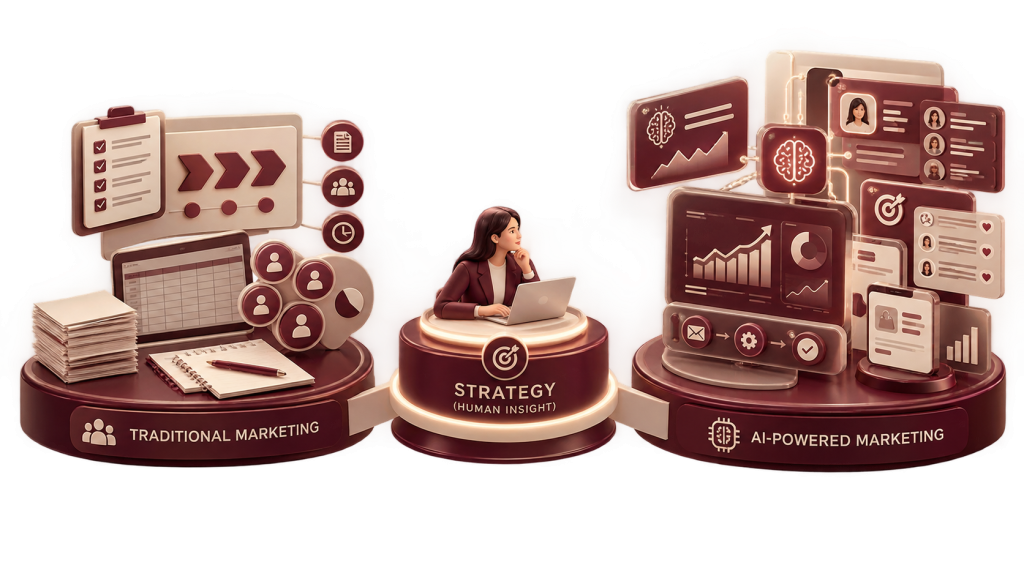
AI-Powered Marketing vs Traditional Marketing
Uses Artificial Intelligence – AI and machine learning help to look at data and help make marketing choices.
Data-driven – Uses a lot of customer and campaign data to spot patterns and find information.
Personalized – Can tailor content, offers, recommendations and messages to match how customers act.
Automation – Automates routine tasks such, as email campaigns replying to customers sorting groups and making reports.
Real-time analysis – Can look at customer behavior and campaign data fast.
Predictive insights – Can spot patterns that may help marketers guess what customers need and how they will act.
Advanced customer segmentation – Customers can be grouped using behavior signals and context clues.
Human-driven – Marketing decisions depend a lot on human experience, research and judgment.
Limited data processing – Marketers usually look at an amount of data using manual methods or simple tools.
Basic personalization – Personalization often uses information, like name, location, age group or past buying habits.
Manual work – Many campaign activities need people to plan carry out and watch over them.
Analysis – Campaign performance is often checked at set times.
Historical insights – Decisions usually come from campaign results and current customer information.
Content creation – Content planning, writing, editing and changing are mostly done by marketing teams.
AI doesn’t make traditional marketing obsolete. Strategy, brand understanding and creative judgment remain human skills. AI changes how those skills get executed, not whether they’re needed. The core of marketing still depends on people. It’s, about knowing the audience building trust and telling stories that matter. AI can help with data analysis, automation or finding patterns. It doesn’t decide what matters. Humans still have to judge what’s right what’s true and what feels real. That kind of insight? That’s human.. That’s why marketing will always need humans at its heart.
Common AI Marketing Mistakes
Using AI without a strategy. Start by defining the goal then look for the right AI application that fits.
Publishing AI content. Always review what AI produces for accuracy and tone before sharing it.
Ignoring brand voice. Set clear style guidelines so AI content matches your brand’s personality.
Feeding poor-quality data into systems. Clean and organize your data before using it to train or guide AI.
Automating everything. Don’t let automation replace judgment where it matters most.
Ignoring privacy. Be open about how data’s used and follow all privacy rules and regulations.
Not fact-checking. AI can make things sound believable. It can still get facts wrong.
Chasing every AI tool. Focus on tools that solve actual problems, not just shiny new ones.
Measuring vanity metrics only. Track progress that connects to business outcomes, not just numbers.
Not testing AI outputs. Try AI-driven campaigns on a scale before expanding them.
Ignoring customer feedback. Use AI insights. Don’t forget real customer input, from surveys or reviews.
Expecting results. Building a strong AI-assisted strategy takes time testing and repeated improvements.
Future of AI-Powered Marketing
Some paths are expected to grow while separating what is already in place from what is new:
AI tools that can manage multi-step marketing activities with less manual work (new).
Personalizing at the level, across more ways of reaching people (growing).
Predicting customer experiences that guess what people need before they ask (growing).
Talking with customers through chat and voice systems (already here getting better).
AI search changing how content needs to be organized ( here still changing).
Marketing that uses text, pictures and videos in the same process (new).
Better tools that help people work with AI marketing programs (growing).
These are trends based on what’s happening now not promises. Companies should keep learning instead of thinking something will definitely happen.
F.A.Q.
Supporting Subheading
It goes through a cycle: first it collects data. Then it looks for patterns in that data. Next it tries to predict what might happen. After that it makes content. Offers more personal, for each person. Then it does things automatically like sending emails or adjusting prices. It checks how well those actions worked. Finally it improves the process. AI helps make each step faster and more accurate.
Small businesses can start with applications such as AI-assisted email personalization, chatbots, for FAQs or AI-generated content drafts. And small businesses can expand gradually as they see results.
First define a goal. Then audit your data carefully. Pick one use case to pilot. Set up a human review process to check the results. Finally scale those aspects that prove effective.
Common effective use cases include SEO research, content drafting, email personalization, ad optimization, customer segmentation and chatbot‑based support and these use cases show how each task can be improved.
I expect growth, in AI agents, personalization, talking marketing and better tools that help people and AI work together.. The exact details will keep changing as the technology gets better.
Conclusion
AI-powered marketing isn’t about piling up tools or automating every task. It’s about using AI where it actually makes a difference. The best results come when human strategy, creativity and judgment stay in charge. Companies that truly benefit from AI aren’t the ones that jump in first. They’re the ones that use AI carefully. With data clear goals and a deep understanding of their customers.
The winning formula is simple: AI plus data plus human strategy plus creativity plus customer understanding. When you get that mix right AI stops being a trend and starts being a real advantage.
If you’re thinking about how AI-powered marketing could work for your business we’d love to talk. We’ll help you see what fits your goals and your budget. No pressure, a straight talk, about what makes sense for you.