How AI Is Changing the Customer Journey
I see a customer today discovering your brand through an Instagram reel asking a chatbot at midnight comparing your brand to a competitor using an AI search summary and finally buying from your website three days later. Without filling out a contact us form. That is not a hypothetical; that is how customers already behave.
For years marketers talked about the customer journey as a path: a person becomes aware of a brand considers it decides, buys and hopefully returns. That model still holds true in principle. The way customers move through it has changed. Customers now talk to brands across Google, social media, websites, mobile apps, chatbots, messaging platforms, AI‑powered search tools and email. Often jumping between several of these in the day.
This is why I think understanding how AI is changing the customer journey matters for every business, not just large enterprises. AI has moved from being a nice to have feature, to becoming the layer that connects data, timing and communication across every stage customers go through.
This article breaks down what an AI‑powered customer journey actually looks like how AI affects each stage from awareness to advocacy what technologies are involved and how businesses. Including growing ones. Can start using AI without losing the human side of their brand.
What Is the Customer Journey?
The customer journey is the path a person follows from the moment they first hear about a business to the point where they become a repeat customer or someone who speaks highly of that business. In its basic form it goes like this:
Awareness → Consideration → Decision → Purchase → Retention → Advocacy
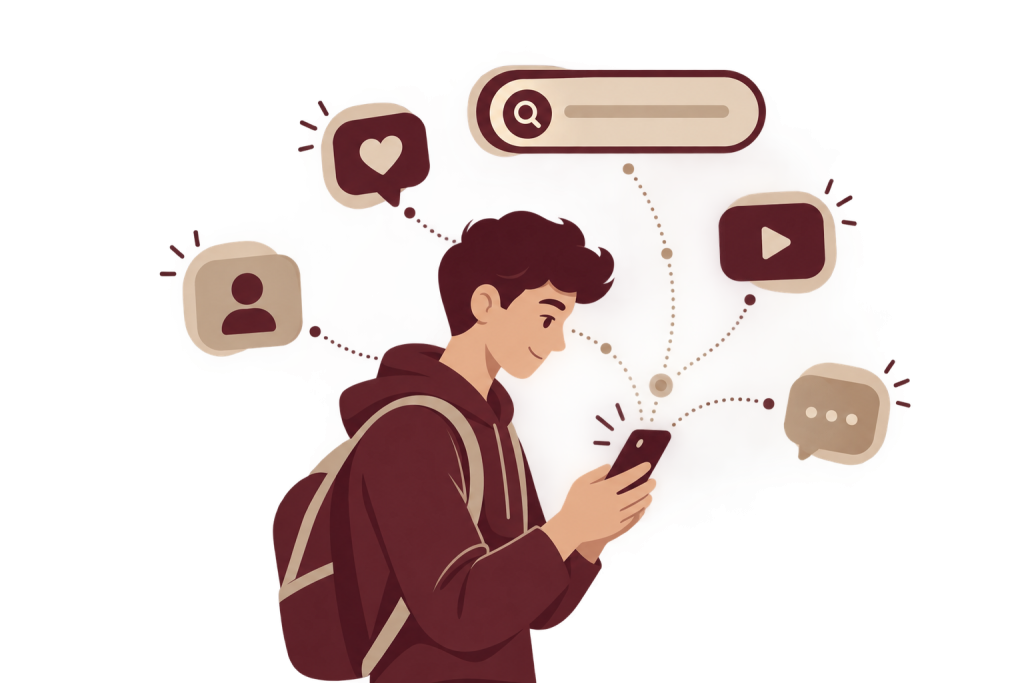
Think of a simple example: someone searches for “best dentist near me ” reads a few online reviews looks at the clinic’s Instagram page books an appointment has a positive experience and later tells a friend about the clinic. That’s the customer journey in life. And it works the same way for a software product, an online store or a local dental clinic.
In the past companies saw this journey as a line. They built marketing funnels. Expected customers to move smoothly from one step to the next.. In reality people don’t follow that path neatly. They jump back and forth between stages. They might skip a step entirely. Or they could start the journey in a different way. Maybe they see an ad on social media then later find the business through a friend’s recommendation.
This messy non-linear pattern used to be hard to track.. Now artificial intelligence is helping businesses understand and respond to the real way people move through the customer journey. AI fills the gap, between how companies thought the journey worked and how it actually works.
What Is an AI-Powered Customer Journey?
An AI powered customer journey is a customer experience where AI looks at behavior, data and context in time to tailor content, suggestions, timing and communication, at every stage. Of using fixed rules or generic messages AI does the work.
In practice AI gives life to touchpoints that used to be fixed. A product page that used to display the items to every visitor can now show different recommendations based on how the visitor browses. A support widget that used to follow a script can now grasp intent and reply in a conversational way. An email campaign that used to send to the list at nine a.m. Can now be sent at the time that each person is most likely to open it.
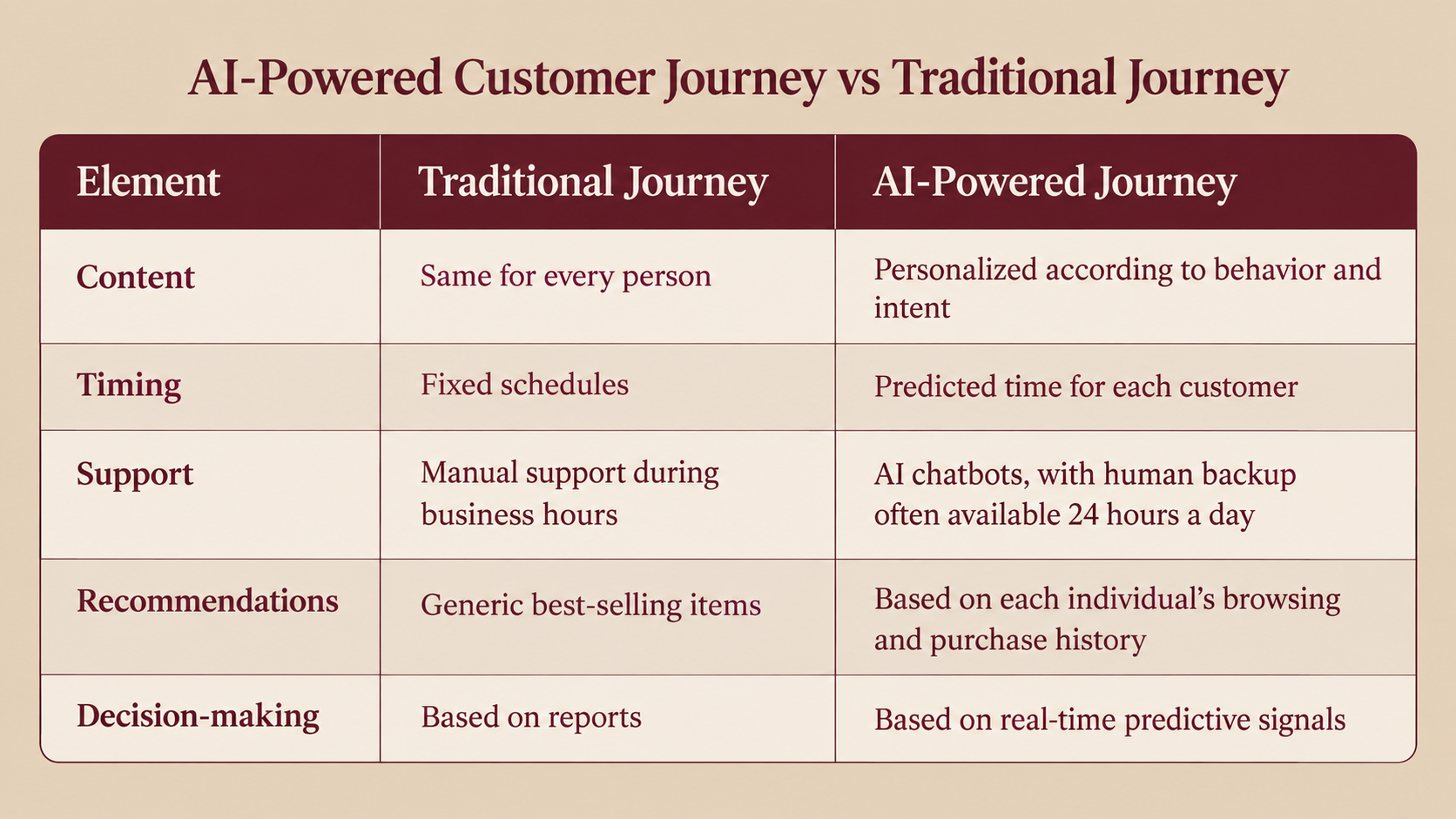
Traditional Customer Journey vs AI-Powered Customer Journey — quick comparison:
One useful way to look at it is like this: traditional customer journeys usually follow a path but AI helps companies react in real time to what customers want what they do, where they are and what they have done before. The journey doesn’t really change its shape much as it becomes flexible. It shifts, on its own depending on what a particular person actually does.
How AI Is Changing Every Stage of the Customer Journey
Stage 1: Awareness
This is where AI influence begins, often before a customer even knows a brand exists. AI helps businesses:
- Identify audiences by looking at patterns among customers not only by demographics
- Analyze signals of behavior such as browsing, engagement and past purchases to predict who might be interested
- Optimize ad spend automatically by moving budget toward audiences and placements that perform best
- Personalize creative and messaging according to audience segments
- Predict interests using historical and behavioral data instead of guesswork
Platforms such as Google Ads and Meta Ads already use machine learning to decide who sees which ad and when. This is one of the most mature examples of AI inside the awareness stage.
Stage 2: Discovery
Discovery has changed the most in the two years. People no longer only search; they ask.
- AI search and conversational search:- Tools such as Google’s AI Overviews and AI chat assistants now summarise answers directly. This means brands must be understandable to AI not visible in rankings. [Internal Link: SEO Services]
- recommendations:- Social platforms and marketplaces show content and products based on individual behaviour not only popularity.
- Discovery:- Short‑form video platforms use AI to match content to viewers likely to engage with it. [Internal Link: Social Media Marketing]
- Content recommendations:- Blogs YouTube and news feeds increasingly rely on relevance scoring.
For businesses discoverability now depends on being structured and genuinely useful, to both people and AI systems that read your content.
Stage 3: Consideration
Once a customer learns a few options AI helps narrow the decision:
- AI‑powered product recommendations that look at what similar customers have bought
- Personalized content such as comparison guides or use‑case pages that show up after a visitor has looked at certain items
- Chatbots that answer specific questions right away instead of asking customers to wait for an email reply
- Virtual assistants that help compare features or plans side by side
- Predictive insights that signal which leads are close to deciding so sales teams can focus on the most promising follow‑ups
Stage 4: Interaction
This is where conversational AI has changed how we talk with customers.
- AI chatbots answer common questions instantly any time of day or night
- AI assistants on websites guide visitors straight to the right product or service page
- WhatsApp automation is especially useful, for Indian businesses because WhatsApp is the main channel many customers already use to talk to brands
- Website chat tools qualify visitors before a human ever joins the conversation
- Personalized communication. Messages that mention a customer’s real browsing or purchase history instead of generic templates
When done right this approach does not replace human interaction; it simply removes repetitive questions so human teams can focus on conversations that really need a person.
Stage 5: Conversion
Conversion is where AI’s impact on revenue becomes most measurable:
- Identifying purchase intent through signals like time on page repeat visits and cart activity
- Recommending the most relevant product or service instead of a generic “you might also like”
- Personalizing offers based on what is likely to actually move a specific customer
- Optimizing landing pages through automated testing
- Improving lead qualification so sales teams spend time on the right prospects
- Automating follow‑ups for abandoned carts or incomplete inquiries
Stage 6: Purchase
Even after a customer decides to buy AI continues working in the background:
- Streamlining checkout by reducing friction with autofill and saved preferences
- Suggesting add‑ons at the right moment without being pushy
- Detecting fraud patterns that would be nearly impossible to catch manually at scale
- Powering post‑purchase support through chatbots
- Sending order and shipping updates that feel timely rather, than generic
Traditional Customer Journey vs AI-Powered Customer Journey
To sum up the changes across the customer journey:
- Personalization has moved from broad groups to individual-level relevance.
- Decision-making has shifted from reports, to real-time signals.
- Communication has changed from scheduled campaigns to behavior-triggered messages.
- Customer data has gone from spreadsheets to connected platforms.
- Automation has evolved from follow-ups to smart automated sequences.
- Recommendations have transitioned from bestsellers to personalized suggestions.
- Response time has improved from hours or days to seconds for common queries.
- Customer support has expanded from business-hour- to always-available first responses.
- Predictive capability has moved from looking at past data to forecasting future trends.
AI Technologies Transforming the Customer Journey
Machine Learning- This is a type of technology that looks at information to find patterns and get better at making predictions as time goes on. Impact on customers: the more they spend time with a brand the better the suggestions become. Example: a shop that makes the “recommended for you” part better based on what people look at.
Generative AI- This is a kind of technology that makes things like text, answers or summaries when given a prompt and data. Impact on customers: the responses are quicker. Sound more real. Example: an AI that helps write product descriptions that fit groups of people.
Conversational AI- This is the technology that runs chat and voice conversations. It understands what someone wants not the words they use. Impact on customers: they get answers faster without having to go through menus. Example: a bank chatbot that solves a question about account balance away.
Predictive Analytics- This uses data to guess what might happen in the future like if someone might stop using a service or if they might buy something. Impact on customers: they get unneeded offers and more helpful ones at the right time. Example: a service that guesses who might leave this month and acts before it happens.
Recommendation Engines- These are systems that link products or content to what people like. Impact on customers: the experience of looking is more personal. Example: a store that shows extra items that go with what someone has in their shopping cart.
AI Chatbots- These handle questions and pass the hard ones to real people. Impact on customers: they get an answer right away. Example: a travel site chatbot that deals with questions about booking status.
Marketing Automation- This is a system that starts actions like sending an email showing an ad or sending a message based on what a customer does. Impact on customers: they get messages that fit their needs of the same message for everyone. Example: an email sent quickly when someone leaves something in their cart not after a time.
Customer Data Platforms (CDPs)- These bring together information about customers from places into one complete record. Impact, on customers: the experience is the same no matter where they go. Example: a customer who talks on WhatsApp gets the details when they later call support.
The AI Customer Journey Framework
To make this practical here’s an original framework worth applying to your business:
DISCOVER → UNDERSTAND → PERSONALIZE → ENGAGE → CONVERT → RETAIN → ADVOCATE
DISCOVER: Find out where and how new customers are most likely to see your brand and do this with data instead of guessing.
UNDERSTAND: Look at past and current behavior data to get an idea of what each group of customers really needs.
PERSONALIZE: Customize your messages, offers and content, for each customer but do not overdo it.
ENGAGE: Use chat tools and messages that come at the time to keep the conversation relevant and quick.
CONVERT: Use predictions to choose the leads and show them the right offer at the best time.
RETAIN: Spot early signs that a customer might leave and act before they fully disengage.
ADVOCATE: Spot loyal. Give them real reasons, plus simple tools to bring in new customers.
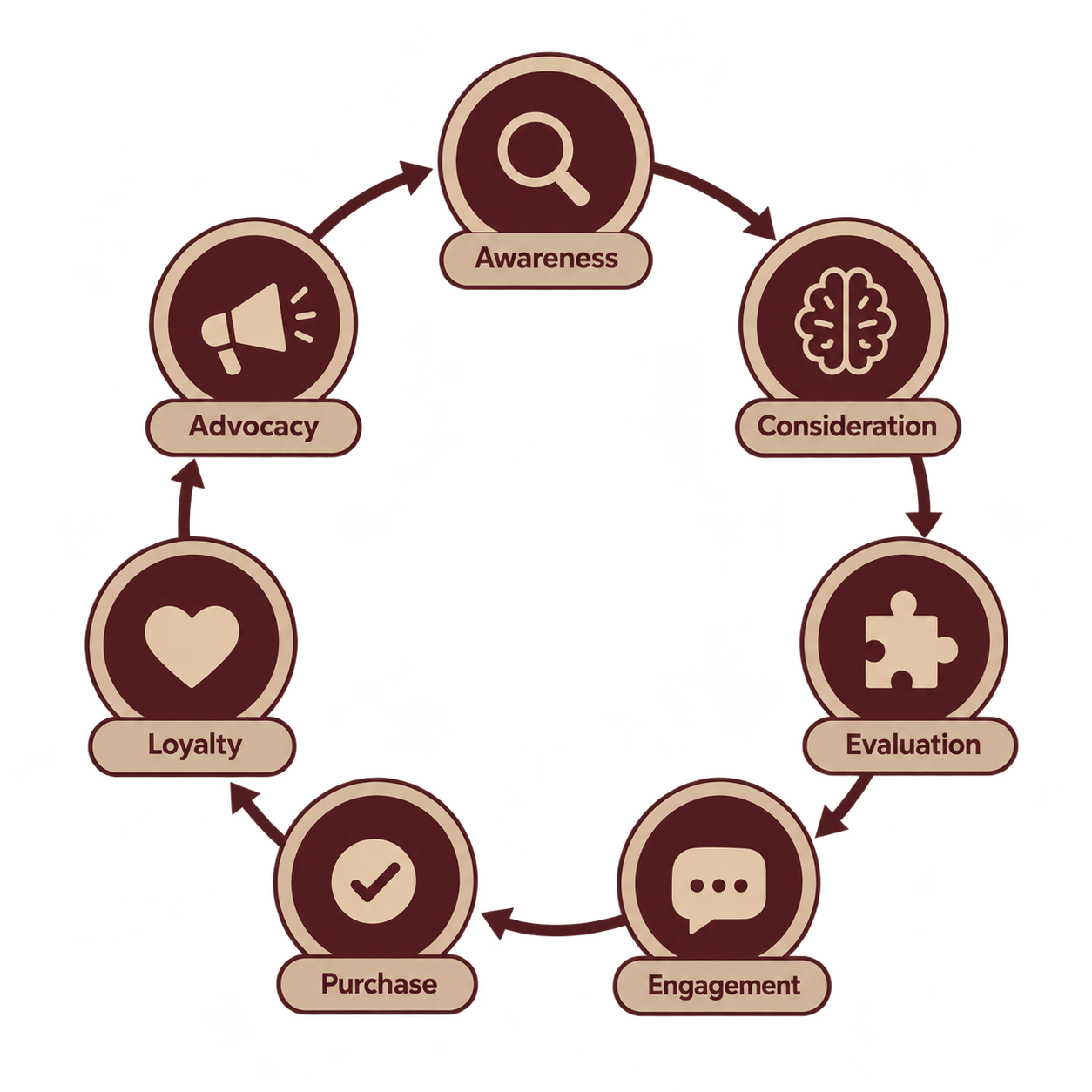
This framework works because it uses AI to connect every step of the journey of adding it to just one part.
Future of the AI-Powered Customer Journey
Some changes are already starting to appear even though how much they are used varies a lot depending on the type of business and how big it is:
- AI agents and agentic workflows:- Tools that can do tasks that take steps (like looking up information writing something and setting up a meeting) with much less work from people
- Conversational commerce:- Shopping that happens right inside a conversation instead of going to a different page to pay
- AI search:- More and more summaries made by AI that give answers as people look for things along, with regular search results
- Real-time personalization:- Experiences that change while someone is using a service not just when they come back later
- Multimodal AI:- Systems that can understand text, pictures and sounds all at the same time to make interactions better
- Autonomous customer support:- More complicated questions that are answered without needing a human but for serious problems people are still needed
- AI-powered CRM systems:- Customer relationship tools that suggest what to do next automatically instead of just keeping track of information
F.A.Q.
AI makes every step more responsive. Of using a set plan companies can change what they show when they show it and what deals they offer based on what a particular customer is doing right now. This makes the whole experience feel more personal and not so same, for everyone.
I notice that AI looks at my browsing history my purchase habits and how I interact with sites. AI then uses that information to give me recommendations, emails, special offers and website content. This means AI does not show me the generic experience that everyone else gets. visitor.
Common technologies include machine learning, generative AI, conversational AI such as chatbots, predictive analytics, recommendation engines, marketing automation and customer data platforms. These tools help unify information, across channels.
Start by looking at the way your customers currently move through your service. Find the parts that happen over and again. Then pick one place to start, like customer support. Sending messages after a sale. Try to make that one part easier, with automation. Check how it works and see what happens. Once its working well move on to the part.
I expect conversational commerce to keep growing. AI-powered search will become a discovery channel. Customer support for issues will become more autonomous. Complex sensitive interactions will still need oversight, for the foreseeable future.
Conclusion
AI does not do simple marketing tasks such as sending an email or replying to a chat. AI is changing how businesses understand customers how they communicate and how they respond, all the way from the search, to the moment a loyal customer refers a friend.
The businesses that benefit most will not be those that automate everything. They will be those that use AI to understand customers and reply to them more thoughtfully while keeping a human hand on the parts that need judgment, empathy and accountability.
If your business wants to know where AI can improve its customer journey Futurixmedia can help you find the opportunities and build a practical digital marketing strategy around them.
