
What Are AI Agents for Customer Support?
An AI customer support agent is an AI-powered system designed to assist service teams by understanding customer inquiries, retrieving verified information from approved knowledge repositories, executing permitted support tasks, and escalating complex issues to human agents.
Of making customers go through long phone trees or endless FAQ pages today’s support agents manage tasks throughout the entire service journey.
- Direct Inquiry Handling:- They understand questions written in everyday language and give clear answers using trusted company documents.
- Customer Verification & Data Retrieval:- They check if a customer has a subscription or get real-time updates on delivery status by using secure API connections.
- Ticket. Smart Routing:- They examine tickets to mark how urgent they are what the customer feels and what the issue is about. Then they send cases straight to the right team.
- Basic Troubleshooting:- They walk customers through step-by-step fixes for things, like software setup or restarting devices.
- Proactive Follow-Ups:- After suggesting a fix they reach out again to make sure the problem is really solved before closing the ticket.
What Are AI Sales Agents?
An AI sales agent is a computer-based system that helps with the sales process by talking to people who might want to buy a product answering questions about the product checking if potential customers fit business rules updating customer records and setting up meetings, for real sales people.
In sales work real sales people spend about two-thirds of their time doing tasks like entering information looking up leads writing emails and trying to get meeting confirmations. An AI sales agent helps the team by taking care of first-step tasks:
Real-Time Conversations
Engage visitors when their buying interest is highest, 24 hours a day.
Automated Lead Qualification
Collecting budget, timeline and company size naturally, without annoying forms.
Calendar Coordination
I check the calendar in time and book discovery sessions so you do not need to send many emails back and forth.
Clean CRM Hygiene
Clean CRM Hygiene means you enter contact details, pain points and the current pipeline stages directly into tools such, as HubSpot or Salesforce.
How AI Agents Work in Customer Support and Sales
Deploying an AI agent is not about turning on an API. A strong agent works through a ten-step process that is built for safety, accuracy and matching business goals:
1. Receive Inbound Request:- Gets the question or message from website chat, email, helpdesk or other messaging tools.
2. Understand Intent & Tone:- Looks at what the user’s trying to say what information they need how urgent it is and how they are feeling.
3. Assemble Context & History:- Gets past information like purchases what level of service the user has or any tickets that are still open.
4. Access Authorized Knowledge:- Checks trusted files, product information and knowledge sources.
5. Formulate Multi-Step Plan:- Figures out the order of steps to solve the problem or pass it on to a person.
6. Invoke Permitted Tools & APIs:- Uses software like calendar apps, CRM systems or shipping trackers in a safe way.
7. Execute Guard railed Action:- Does the allowed task but only within the rules that limit what can be done.
8. Evaluate Outcome:- Makes sure the action worked didn’t work or needs details.
9. Deliver Resolution OR Escalate:- Gives the answer. Sends the conversation to a real person if needed.
10. Record Audit Trail, in CRM:- Saves the conversation, tags and what happened into the database.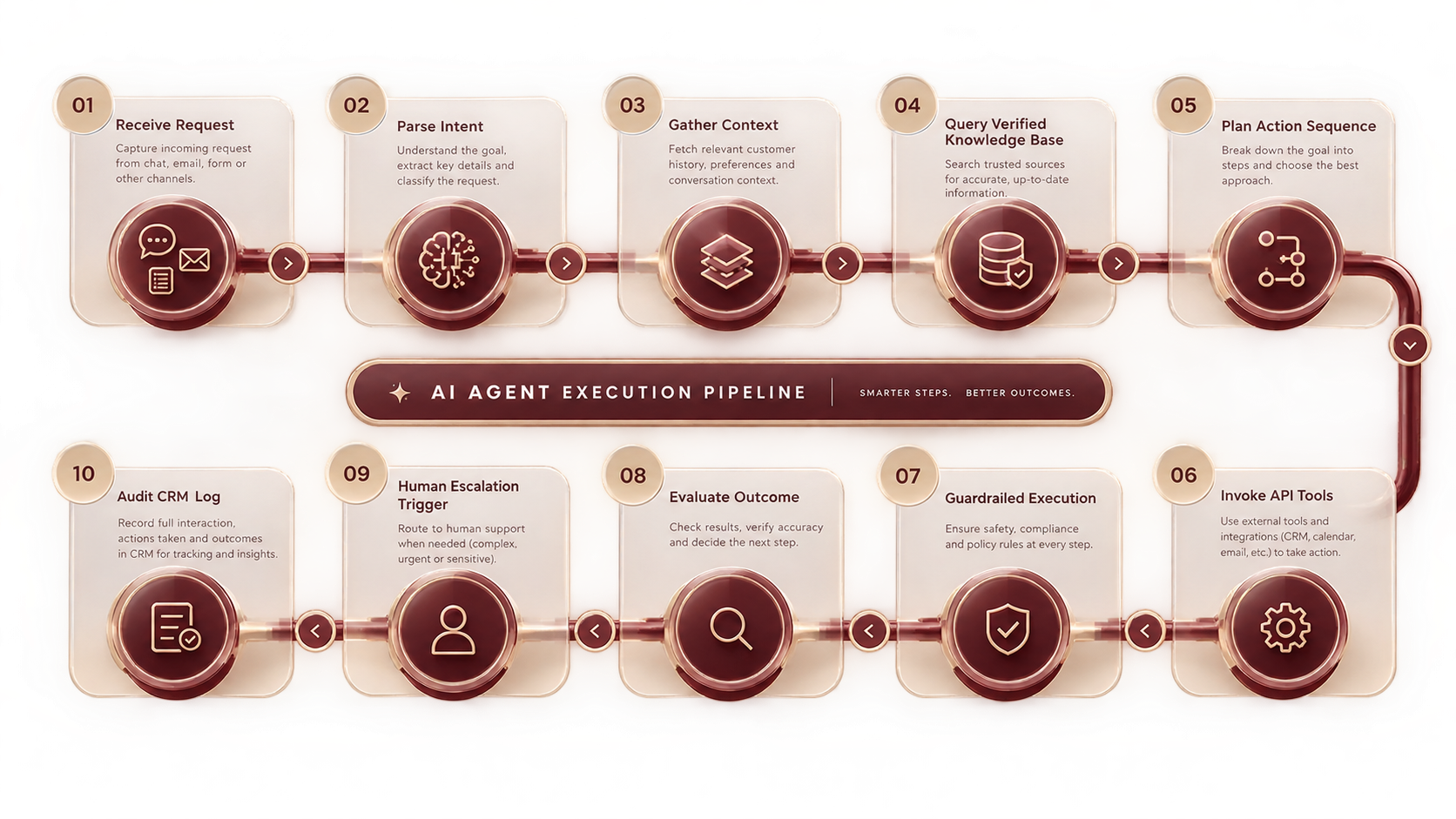
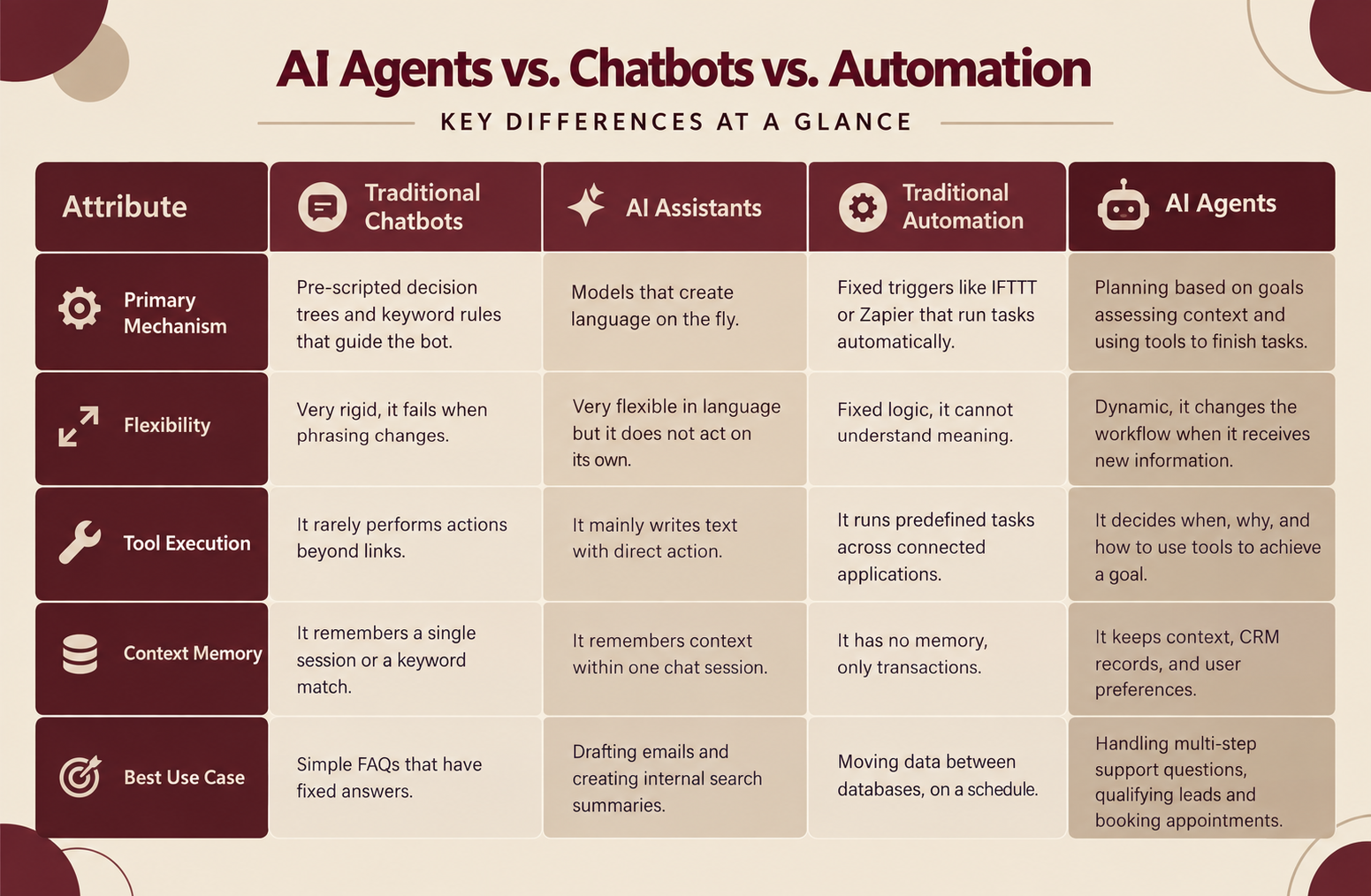
AI Agents vs Chatbots vs Traditional Automation
How AI Agents Are Changing Customer Support
1. 24/7 Customer Assistance
Customer problems do not follow a workday. AI customer support agents are available around the clock—midnight, weekends and across time zones—without needing staff to handle simple repeat questions.
2. Faster Responses
When a customer faces a service outage or account issue, quick feedback and fast fixes matter. AI agents read messages instantly reducing response times from hours to seconds for questions.
3. Personalized Support
By connecting to verified customer data AI agents can offer answers that fit the individual. Of giving a general reply they can use the customers name mention their plan and include recent activity.
4. Automated Ticket Routing
Some issues need an expert. AI agents review tickets judge how technical or urgent they are check the customer’s importance and send the ticket to the right person with a short summary.
5. Knowledge Retrieval
Help documents can be long and scattered—across help centers, release notes and forums. AI agents use search to find correct trusted answers from official sources so customers don’t have to read through unrelated content.
6. Proactive Customer Support
AI can spot problems before customers report them. For example if someone keeps failing to check out or has repeated onboarding errors the system can offer help away keeping frustration from building.
7. Human Escalation
Good support systems know when to involve humans. AI agents are set to hand off conversations, in situations:
- When a customer is very upset or asks directly for a human manager.
- When there is a billing problem a cancellation threat or a legal message.
- When technical setups are sensitive. Mistakes could cause big issues.
- When a customer is a high-value VIP. Needs special attention.
- When the AI is unsure of the answer and confidence is low.
How AI Agents Are Changing Sales
- Instant Lead Response
Contacting leads within the first five minutes greatly improves the chances of making a sale. AI sales agents reply in seconds connecting with customers when they are most interested.
2. Lead Qualification
of making visitors fill out strict forms with eight required fields an AI sales agent has a natural flexible conversation to collect important details like budget, project schedule and decision-making power.
3. Lead Research
Before a prospect talks to an account executive an AI agent can gather information about the company, size of the business recent news and industry focus from sources making a complete preparation file for the human sales person.
4. Personalized Sales Conversations
Unlike fixed email messages an AI sales agent adjusts its message based on the problem the customer mentions. If a buyer talks about security the agent focuses on compliance features. If they talk about speed it talks about how the product can be set up.
5. Follow-Up Automation
Leads often get lost because human workers don’t have time to manage repeated follow-ups. AI agents track what the prospect has done remember chats and send helpful messages that bring the buyer back.
6. Appointment Scheduling
Scheduling can be a problem. AI agents check team calendars handle time zones offer online booking options and send calendar invites without needing many emails back and forth.
7. CRM Updates
Sales people often hate doing data entry. AI sales agents automatically record what happened in meetings pick out parts of the conversation fill in custom CRM fields and make sure the sales pipeline is always updated.
8. Sales Handoff
When a lead is ready and a meeting is set the agent gives all the information, recorded preferences and notes, to the human sales person. The buyer never has to start over.
AI Agents vs Human Customer Support and Sales Teams
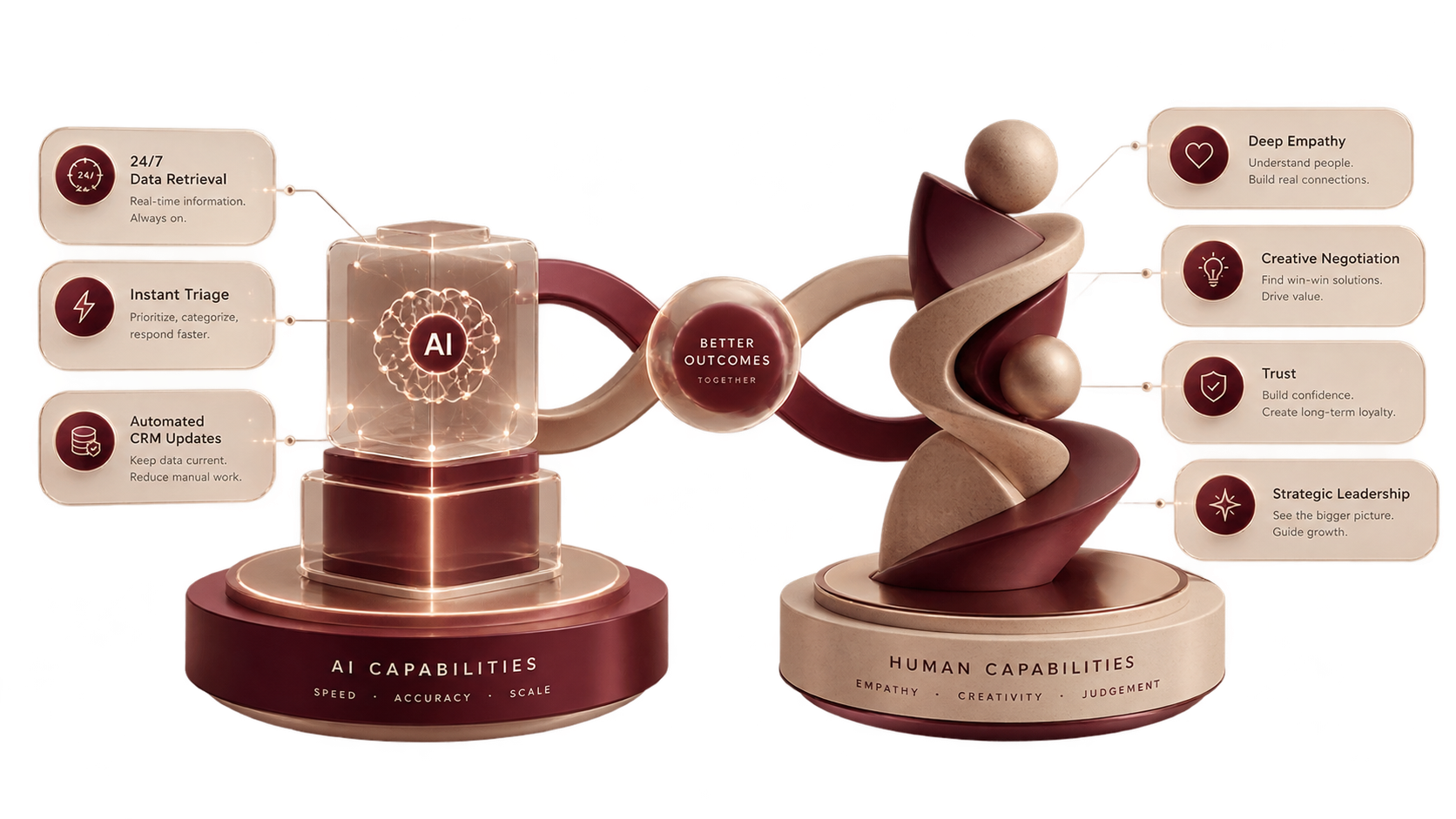
What AI Agents Excel At
- Fast replies anytime, day or night handling thousands of chats at once
- Finding information in amounts of documents and logs in just milliseconds
- Checking basic requirements saving records and scheduling appointments
- Watching systems constantly and entering data in time with clear structure
What Human Teams Excel At
- Deep empathy, de-escalation conflict resolution and personal care
- Reading between the lines of unspoken buyer anxieties
- Navigating dynamics, in B2B buying committees
- Creative deal-structuring, bespoke contracts and relationship building
- Ultimate ethical judgment, brand stewardship and strategy
How to Implement AI Agents for Customer Support and Sales
Rolling out an AI agent needs a careful plan. Follow this 10-step roadmap to do it right:
- Define Clear Business Objectives- Be specific. For example reduce first-response time by 60% or double discovery bookings. Know what success looks like.
- Map the Existing Workflow- Write down every step that support and sales reps take today. See how things are done now.
- Isolate Repetitive Tasks- Look for tasks that happen over and over. These are usually complexity but take up a lot of time. That’s where AI can help.
- Choose the Right Technical Approach- Decide if you need an embedded CRM bot, a no-code agent or a custom API framework. Pick what fits your tech stack.
- Curate Verified Knowledge Sources- Check your knowledge bases. Clean out pricing, outdated info or broken links. Only use data.
- Configure Secure Integrations- Connect to CRM, calendars and helpdesk systems. Make sure all connections are encrypted and safe.
- Establish Strict Guardrails & Permissions. Set rules- No AI agent should give discounts or change data without approval.
- Build Clear Human Escalation Triggers- When a chat gets too complicated, emotional or high-value the system should hand it off to a person.
- Run Controlled Sandbox Testing- Test, with users first. Try edge cases, angry customers and tough questions. See how the agent handles them.
- Monitor, Audit and Iterate- Look at conversation logs every week. Learn from mistakes. Update the system and documentation regularly.
How to Measure AI Agent Performance
Support KPIs
- First Response Time (FRT)
- First Contact Resolution (FCR)
- Escalation / Handoff Rate
- Customer Satisfaction (CSAT)
- Repeat Contact Rate
Sales KPIs
- Inbound Lead Response Time
- Lead Qualification Rate
- Discovery Booking Rate
- Meeting Show-Up Rate
- Pipeline Contribution ($)
Technical KPIs
- Percentage of Multi Step Task Completion
- Rate of API Errors and Exceptions
- Accuracy of Answer Verification
- Cost Per Interaction
- Latency and Token Efficiency
Common Mistakes Businesses Make With AI Agents
1. Automating much too early instead of proving a single flow can cause problems.
2. Choosing tools because of hype than measurable bottlenecks can mislead the team.
3. Giving permission to write or delete important database information.
4. Giving the agent old unreviewed company papers to use.
5. I notice that skipping review and lacking audit logs can lead to serious mistakes.
6. I find that ignoring consumer data privacy and compliance standards is a breach of trust.
7. I see that trapping users in loops without a clear way to get help is a problem.
8. I feel that expecting return on investment, without continuous improvement of prompts is unrealistic.
9. Not teaching the people who work here how the automated handoffs function.
10. Looking at agent deployment as something that is done once and then forgotten.
F.A.Q.
What are AI agents for customer support? An AI agent for customer support is a software system that understands customer questions pulls verified information from approved knowledge bases executes permitted actions like checking an order or updating account details and seamlessly escalates complex problems, to human specialists.
AI agents help sales teams by responding to website leads in just a few seconds checking out potential customers through natural talks making it easier to set up meetings updating customer relationship management records on its own and giving sales people clear lead summaries before they have their first call.
AI agents generate leads by engaging website visitors in helpful real‑time conversations. AI agents generate leads by answering questions. AI agents generate leads by collecting contact information with user permission. AI agents generate leads, by giving resources or offering a talk while the visitor is still interested.
Companies usually handle between 30% and 70% of repeated first-level questions, with AI tools. The exact amount varies a lot based on how complicated the industry’s how good the documentation is, how well the software works together and how much the company wants to keep people checking the work.
I think the future will bring AI agents working together smooth interaction across all channels fixing problems before they arise tighter links with customer records and easy handoffs, between AI agents and people where software does the data work and people focus on building relationships.