
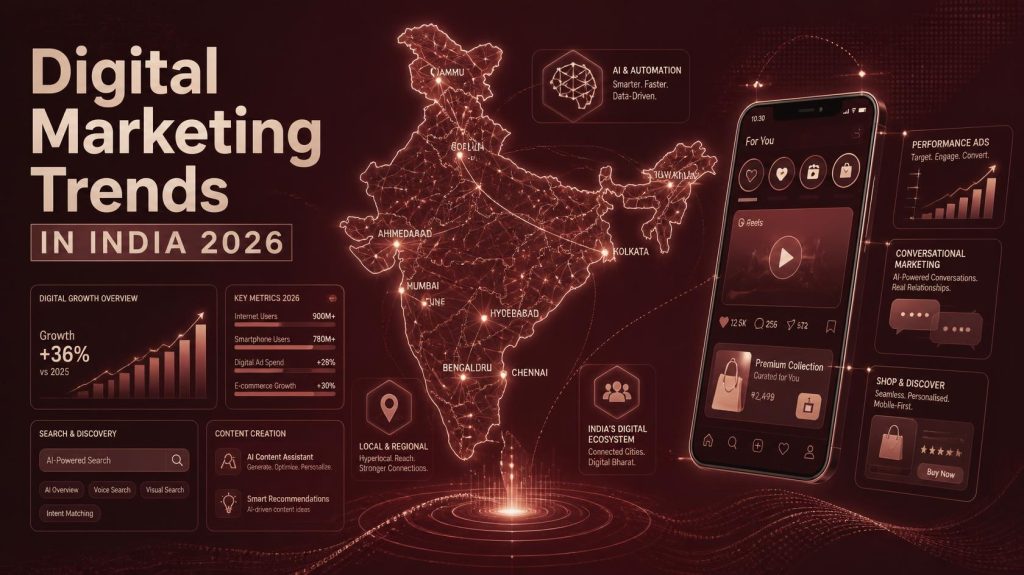
Digital Marketing Trends in India 2026:
DIGITAL MARKETING TRENDS IN INDIA 2026 A shop owner in Indore now runs Instagram ads that are targeted by an algorithm that he has never seen before. He receives order confirmations on WhatsApp from a chatbot that he did not build and sometimes his name appears inside an answer on Google that never sends the customer to his website. None of this existed as “normal” five years ago. In 2026 it is Tuesday. That is really what is different about this year. It is not that digital marketing has gone online. That happened a decade ago. It is that the machinery underneath marketing has changed hands. Search results are increasingly written by AI than linked one by one. Discovery happens much on Instagram and YouTube as on Google.. A huge share of India’s next wave of digital buyers. From Tier 2 and Tier 3 towns on a phone in a regional language. Does not behave like the urban, English‑speaking desktop‑first audience that most marketing playbooks were built for. This guide is not another list of twenty predictions. It is a working explanation of what’s actually changing in Indian digital marketing in 2026, why it is happening and. More importantly. What a business, with limited time and budget should do about it. Quick Answer: Key Takeaways I see that AI has moved from experiment to infrastructure. I see that Googles and Metas ad platforms now handle much of the targeting, bidding and creative testing automatically. I see that Search is no longer a list of blue links. I see that Googles AI Overviews already appear on a share of Indian searches and AI Mode. Including a real-time “Search Live” feature. Launched in India before most other countries. I see that SEO is not dying. It is expanding to include AEO (being the direct answer) and GEO (being cited inside AI-generated responses). I see that Short-form video remains the default discovery format. But raw useful imperfect content is increasingly outperforming heavily produced ads. I see that language and hyperlocal content is not optional anymore as internet growth shifts toward Tier 2 and Tier 3 India. I see that WhatsApp has quietly become a sales and support channel, especially with UPI-based in-chat payments. I see that Indias privacy landscape has shifted from theoretical to real. The DPDP Act and its Rules are rolling out in phases through 2027. I see that Micro and nano-influencers, regional creators often outperform big-name endorsements for trust and conversion. I see that Quick-commerce apps have become advertising channels, particularly, for FMCG, food and D2C brands. I see that the businesses that win in 2026 will not chase every trend. They will pick two or three that actually fit their customers. The Digital Marketing Landscape in India in 2026 Indias story of growth hasn’t slowed. It has changed where it is happening. The languages it is using. More people who are new to the internet buying things and even creating content are coming from cities that’re not the biggest. These people are using phones first often using their third phone. They have internet and lower costs than the earlier generation had. A company that only speaks in English only focuses on computers. Only looks at the big cities is choosing to make its market smaller on purpose. At the time more companies are trying to get attention. Every business from a brand with two people to a big store that covers the whole country is trying to get noticed in the same news feeds the same search results and the same short videos that last ten seconds. On top of all that there is a change because of intelligence. Googles AI summaries are already appearing for a quarter of the searches in India. Google has said that most of the searches around the world end without anyone clicking on a website. This one fact should make every business in India think differently about the content it creates. Being found is now just as important, as being clicked on. None of this means that the basic ideas have gone away. What has changed is where those basic ideas need to be and how they need to change to fit new ways people find things. Top Digital Marketing Trends in India 2026 1. AI-Powered Marketing Becomes the Default, Not the Add-On AI tools are now embedded directly inside the platforms marketers already use — automated bidding, automated ad creative, and writing, design and analytics tools that plug into everyday workflows. For most Indian SMEs without large teams, this is a force multiplier: work that used to need eight people can now be handled by two or three. How to adapt Use AI for the repetitive 80% — first drafts, variations, reporting — and keep a human in charge of the 20% that decides brand voice and what gets published. Common mistake Publishing AI-written content without a human review pass. It’s usually detectable and can quietly damage trust. Action to take Pick two or three recurring tasks and build a simple AI-assisted workflow for just those, with a mandatory edit step. 2. AI Search, AEO and GEO Change How Things Are Seen Search is breaking into three parts. Organic results, AI summaries that appear in search and separate helpers like ChatGPT, Gemini and Perplexity. India was one of the places outside the United States to get Googles new, real-time, voice and camera based “Search Live” feature, before many Western places. Ranking number one does not always mean people will see your content if an AI Summary answers the question before the listing. But being mentioned inside that summary can really help. How to Change Arrange content so a machine can take out an correct answer. A direct answer at the start then more details and real experience. Common Mistake Thinking about GEO as a way to trick the system. Writing “for the AI” of for the person reading. AI systems are made to remove that. Action to Take Rewrite