
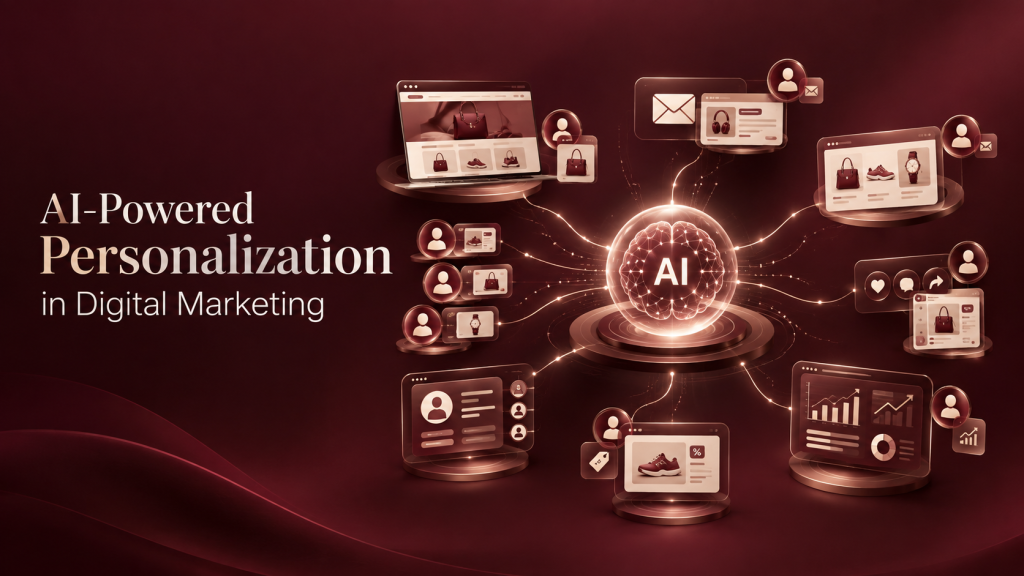
AI-Powered Personalization in Digital Marketing:
“AI-Powered Personalization in Digital Marketing” AI‑powered personalization in marketing is the use of artificial intelligence to analyze customer data—such as behavior, preferences and purchase history—and automatically deliver tailored content, offers and experiences to each individual at scale. Of manually creating segments AI‑powered personalization does this analysis continuously and in real time. To understand AI‑powered personalization properly it helps to break the term into its parts. AI (Artificial Intelligence) refers to systems that can analyze data identify patterns and make decisions or predictions— faster and at a larger scale than a human team could manage. Personalization in a marketing context means adjusting content, messaging or offers based on who the customer’s what they are likely to want. AI‑powered personalization combines the two: AI‑powered personalization systems process customer signals (browsing history past purchases, location, device, time of day and more) and use that data to tailor what each visitor or subscriber sees. A simple example: Picture two shoppers visiting the clothing website. One has browsed running shoes three times this week. The other has been looking at wear. With AI‑powered personalization both shoppers see homepage banners, different product recommendations and possibly different email follow‑ups—, without any marketer manually setting this up for each person. How Does AI-Powered Personalization Work? 1. Data Collection:- AI personalization gathers information from websites, apps, CRM systems, email interactions and ad platforms— as pages visited, time spent products viewed and past purchases. 2. Customer Behavior Analysis:- AI personalization studies this information to discover patterns: what a customer tends to browse how often they return and which actions usually lead to a purchase. 3. Audience Segmentation:- Of broad groups like “all subscribers ” AI personalization can create dynamic micro‑segments based on shared behaviors or interests and these segments update automatically as new information arrives. 4. Pattern Recognition:- AI personalization models detect recurring patterns across thousands of customer journeys—for example noticing that customers who watch a product video are more likely to buy within forty‑eight hours. 5. Predictive Analytics:- Based on these patterns AI personalization can predict behavior, such as which customers are likely to churn or which products a person might purchase next. 6. Customer Intent Detection:- AI personalization examines real‑time signals—like search terms or cart activity—to estimate what a customer is trying to do now rather than only what they did in the past. 7. Content and Product Recommendations:- Using this intent and behavior data AI personalization suggests products, articles or offers that are most relevant to that individual. 8. Automated Personalization:- Then AI personalization automatically delivers this experience—such as a personalized email, a customized homepage or a targeted ad—without manual intervention for each user. 9. Continuous Learning:- AI personalization models refine themselves over time as they receive data and feedback on what worked and what did not. 10. Performance Optimization:- Marketers can review results. Adjust strategy while AI personalization continues to optimize personalization rules, in the background. Why Is Personalization Important in Digital Marketing? Customers today want brands to know whats going on. A message that doesn’t take into account what a person already knows what they want or what they have done feels old-fashioned.. Usually gets ignored. Personalization is important because it directly impacts: Customer experience- Messages that match real interests feel useful instead of annoying. Higher engagement- Content that is relevant is more likely to be opened, read and clicked on. Better conversion rates- Offers that fit what someone is looking for are easier to accept. Retention- Customers stay longer when a brand keeps feeling important over time. Customer relationships- Personalization shows that a business is paying attention, which helps build trust. Marketing efficiency- Money is spent on messages that people care about, not on broad messages. Irrelevant advertising- Customers see fewer ads for things they already bought or don’t care about. Higher customer lifetime value- Experiences that’re relevant encourage people to come back and stay loyal. None of this needs claims. It just shows that people respond better to things that matter than, to things that don’t. AI Personalization vs Traditional Personalization AI Personalization Artificial Intelligence and Machine Learning are used to personalize customer experiences. Large amounts of customer data are analyzed quickly. Real‑time customer behavior including clicks, searches, purchases and browsing can be understood. Dynamic recommendations are created based on interests. Predicts what a customer may want next. Personalization can happen automatically at scale. Personalization adapts continuously as customer behavior changes. Personalization can be applied to websites, emails, ads, product recommendations and content. Supports individualized customer journeys. Traditional Personalization This system mainly relies on customer information and predefined rules. It often uses information such as name, age, location or past purchases. Customer groups are usually created through segmentation. Personalization is often based on fixed conditions. It requires marketers to create different campaigns or experiences. It has limited ability to predict customer behavior. Changes usually require updates, to campaigns or rules. It works well for predictable customer segments. It provides a generalized form of personalization. Types of AI-Powered Personalization 1. Content Personalization What it means: Content Personalization means showing articles, videos or messages that match a visitors interests. How AI helps: AI helps by finding which topics a visitor reads or watches the most. Example: For example a blog homepage can reorder featured articles to match a visitors reading history. Business benefit: Content Personalization can increase the amount of time a visitor spends on the site and encourage repeat visits. 2. Product Recommendations What it means: Product Recommendations means suggesting products based on what a visitor is looking at or has bought before. How AI helps: AI helps by studying patterns among customers who’re similar. Example: For example a website might show a section that says “Customers who viewed this also liked…” Business benefit: Product Recommendations can lead to an average amount spent on each order. 3. Email Personalization What it means: Email Personalization means customizing lines, contents and offers for each subscriber. How AI helps: AI helps by predicting the time to send a message and choosing the most relevant content blocks.