
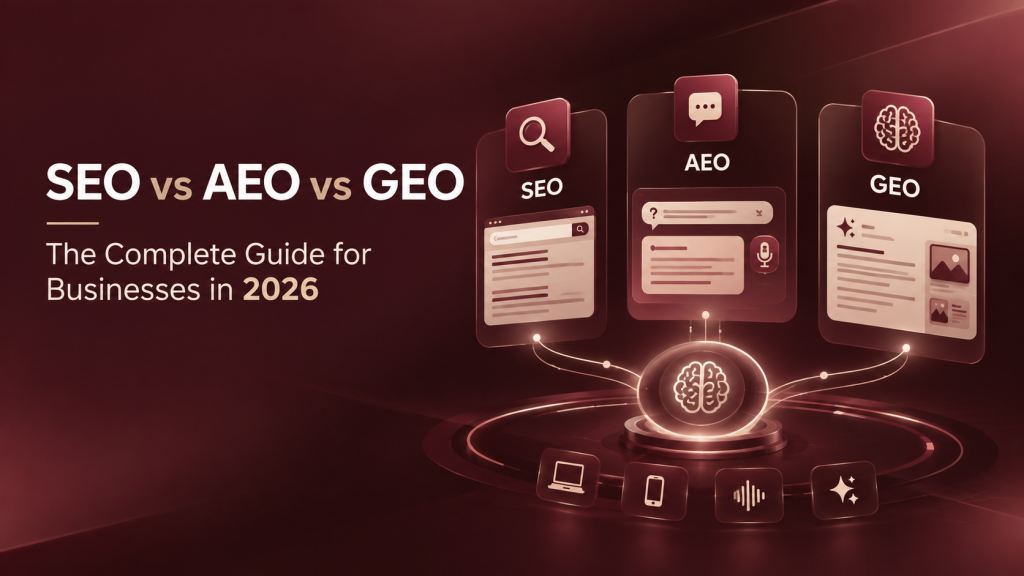
SEO vs AEO vs GEO: The Complete Guide for Businesses in 2026
SEO vs AEO vs GEO: The Complete Guide for Businesses in 2026 Search doesn’t look like it did five years ago. It doesn’t work the way it worked when most small business owners first heard the word “SEO.” Today a customer might type a question into Google. They could get an AI-generated summary before they even see a blue link. Then they might open ChatGPT on their phone to ask a follow-up question. After all that do they land on a website. If they land at all. That change is why three acronyms now appear in the conversation: SEO, AEO and GEO. Each one reflects a way people find information.. Each one needs a slightly different kind of content and optimization strategy. This guide explains what SEO, AEO and GEO actually mean. It shows how they differ. It points out where they overlap. But most important it tells you what your business should actually do about them in 2026. There’s no hype. No promises that can’t be kept. Clear practical advice you can use right away. What Is SEO? SEO has existed for long as search engines have been around and SEO remains the base upon which every other part of this guide is built. When a person types a query such as ” accounting software for freelancers” or “plumber near me ” search engines crawl, index and rank billions of pages to find the ones that best fit that query. SEO success depends on connected parts: Keywords and search intent- Use the words and phrases that your audience really types matched to the goal they have in mind (learn, compare or buy). On‑page SEO- Title tags, headings, meta descriptions, internal links and how the content is arranged all of which tell search engines what the page is about. Technical SEO. How fast the site loads, how well it works on phones how easy it is for search engines to crawl whether it uses secure connections and how clean the site structure is. Off‑page SEO- Links, from other trustworthy sites mentions of the brand and the overall authority of the domain. Content quality- Fresh well‑researched truly useful content that solves the person’s problem not just content that satisfies the algorithm. User experience- How easily visitors can move around the site and find exactly what they need after arriving. If you keep all of these points straight a business will appear whenever its perfect customers are actively searching for what it offers. What Is AEO? Answer Engine Optimization, which I call AEO is the way I shape content so it can be pulled out and shown as a clear stand‑alone answer. AEO shows up in featured snippets People Also Ask boxes, voice assistants and other answer‑focused formats. AEO appeared because how people search has shifted. People no longer just type phrases like “weather Mumbai.” Instead they ask questions such as “what is the weather going to be like in Mumbai this weekend?” Voice search made this shift faster because no one talks to a speaker in broken keyword fragments. Search engines answered by creating features that give answers without needing a click: Featured snippets that show a short answer at the top of results People Also Ask boxes that let you expand related questions Voice search results that the assistant reads aloud Direct answer boxes that give facts, definitions and comparisons AEO is about writing content so that these systems can easily pull out a clean accurate answer. That usually means: Using question‑based headings that mimic how people actually ask Answering the question in the one or two sentences then adding detail Adding FAQ sections numbered steps and short definitions Building content that can stand alone without the rest of the page The main difference, from ordinary SEO is that SEO mainly aims to rank a page. AEO on the hand aims to win the specific spot where an answer is shown or spoken sometimes even without the user clicking at all. What Is GEO? Generative Engine Optimization or GEO is about making sure your content and brand are clear and easy for generative AI tools to understand. Tools like ChatGPT Google’s AI Overviews and Perplexity use this information to build answers summarize ideas or even quote sources when someone asks them a question. More and more people are finding answers through AI conversations not by clicking through a list of search results. For example if someone asks an AI “what’s the best CRM for an agency ” the AI doesn’t show ten links. Instead it creates an answer sometimes pulling in and naming a few sources it used. GEO focuses on key things: How generative AI systems discover and make sense of information about your brand or topic Whether AI tools actually mention or cite your content when they answer a question Brand and entity recognition. Does the AI know who you are and what you do and does it remember that consistently? Topical authority. Do you have deep meaningful coverage on a subject or just one thin page? Trust signals. Is your content clear, about who wrote it is it accurate and does it feel credible? Semantic and structured clarity. Is your content organized so the AI can easily see how ideas connect? It’s important to be honest GEO is still a new field. How each AI platform picks sources is not always clear. It can change over time. Different tools also work in ways. So GEO helps make it more likely that your business will be understood and possibly cited by AI systems.. It doesn’t promise that any specific tool will mention your website. SEO vs AEO vs GEO in Simple Terms If the table above feels like a lot here’s the short version: SEO → Helps search engines find and rank your content. Example: A bakery optimizes its website so it appears when someone in their city searches “custom birthday cakes near me.” AEO → Helps answer engines understand and present your answers. Example: The same