
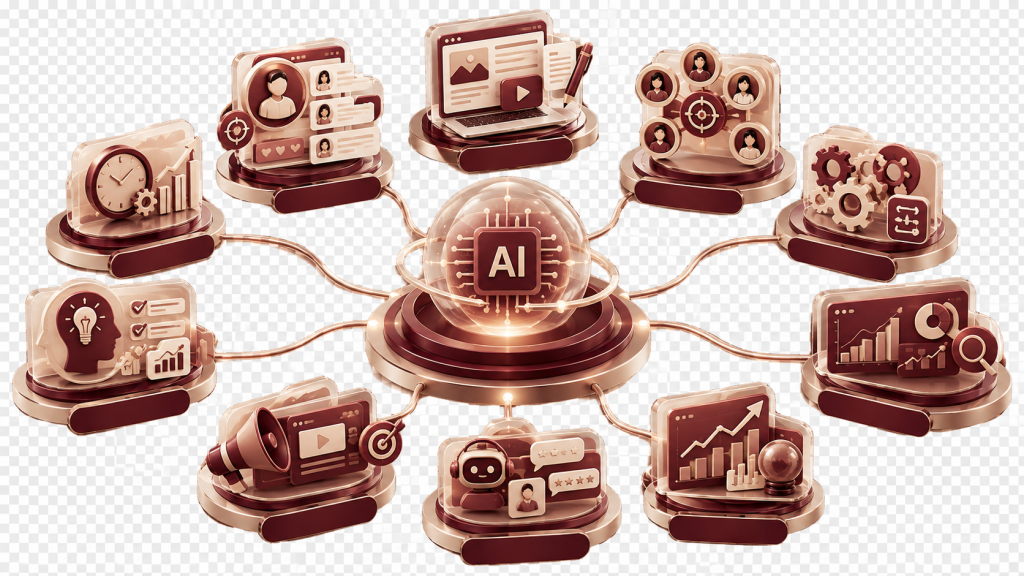
AI-Powered Marketing: Benefits, Challenges and Best Practices for Businesses in 2026
AI-Powered Marketing: Benefits, Challenges and Best Practices for Businesses in 2026 A few years ago, the idea of using data in marketing involved just checking a spreadsheet once a month; nowadays, companies are expected to understand their customers in real time, produce content faster than ever, and personalize each and every interaction—whether it’s a visit to a website or the subject line of an email. That change wasn’t the result of marketers suddenly becoming faster; it was due to AI taking on the heavy work behind the scenes. It isn’t the case that AI-powered marketing consists of one particular tool or represents a single trend; rather, it involves a wide-scale change in the way that businesses understand their customers, produce content, manage campaigns, personalize experiences, analyze data, and automate the more repetitive aspects of marketing so that people can concentrate on strategy and creativity. This change is particularly important for a small business owner in Mumbai who is running advertisements on a limited budget or for a SaaS founder who needs to nurture hundreds of leads without having a large team. The guide explains what it actually means to have AI in marketing, how it works in practice, the areas in which it is useful, the areas in which it fails, and how both large and small businesses can develop a strategy based on it responsibly. What Is AI-Powered Marketing? AI-powered marketing involves the use of artificial intelligence—such as machine learning, predictive analytics, natural language processing, and generative AI—to analyze customer data, personalize experiences, automate routine tasks, and assist in making marketing decisions. It extends beyond simple automation by learning from patterns in the data so as to make marketing more relevant and efficient over time. Traditional marketing automation is based on fixed rules, such as ‘if a customer abandons their cart, then send them email A three hours later’. AI-powered marketing builds on this by incorporating the elements of learning and prediction; for instance, it can determine which customers are most likely to respond to a particular offer, when they are most likely to open an email, or what product they are most likely to want next, on the basis of patterns in their past behaviour. A simple example is an online clothing store that uses traditional automation, which means it sends the same discount email to all customers who have abandoned their carts, whereas an AI-powered system would be able to predict which customers are price-sensitive and only require a slight incentive, and which ones are unlikely to convert no matter what the discount is, and then adjust the offer or the timing as appropriate. Firms are taking up this method since customer expectations have changed; people now expect relevant recommendations, quick responses, and content that seems tailored to them, and it’s simply impossible to provide this kind of service manually for thousands of customers. How Does AI-Powered Marketing Work? Most AI-powered marketing systems follow a core process: Data → Analysis → Prediction → Personalization → Automation → Measurement → Optimization Data: The system gathers information from places, like website visits past purchases, email responses and customer relationship management records. Analysis: Artificial intelligence looks for patterns. Which items are often bought together what kind of content people engage with and which customers might stop using the service. Prediction: Using those patterns the system predicts what will happen next. Who’s likely to buy who might leave and what messages could work best. Personalization: Content, deals or product suggestions are customized for each customer or group based on those predictions. Automation: Repetitive tasks. Sending emails, changing ad prices starting follow-up messages. Run automatically without needing someone to do them every time. Measurement: Results are tracked using business goals, not just numbers generated by the AI. Optimization: The system and the marketing team adjust the strategy based on performance data. The main idea: AI does not take over this cycle completely. It makes it faster and more accurate.. Only if the data is correct and people who know the business are watching the results. Why Is AI Becoming Important in Marketing in 2026? Here is the input from the user: A few real changes are happening, without needing to say much: AI-powered search and answer tools are changing the way people look for information making it more important for content to clearly answer questions. Tools that use AI have made it faster and easier for smaller teams to create content make images and come up with ideas. Personalization on a scale is now possible even for businesses that do not have big data science teams thanks to AI features in common marketing tools. Predictive analytics helps companies see what customers might need before it happens. Conversational experiences like chatbots and AI assistants are becoming something people expect for customer questions. These are changes, in how marketing tools are used. Not guesses about what might happen. Companies that know how to use these tools well have an edge. Ai alone does not decide success; strategy and how things are done still matter most. Benefits of AI-Powered Marketing Better Customer Personalization I observe that AI can analyze browsing behavior purchase history and preferences to deliver relevant product recommendations, content and offers rather than presenting the same experience to each visitor. Faster Content Creation I observe that AI tools can help generate content ideas draft versions, convert existing material into new formats and suggest on‑page optimizations. Human editing remains important for accuracy brand voice and genuine insight that AI cannot create on its own. Improved Customer Segmentation I observe that Improved Customer Segmentation can be achieved when AI groups customers by behavior and context—like browsing patterns or purchase timing—resulting in more relevant targeting. Marketing Automation Marketing Automation can run tasks such as sending follow‑up emails tagging leads or scheduling social posts automatically freeing up time for strategic work. Better Data Analysis Better Data Analysis is possible when AI processes larger datasets than a person can manually review, uncovering patterns that might otherwise go