
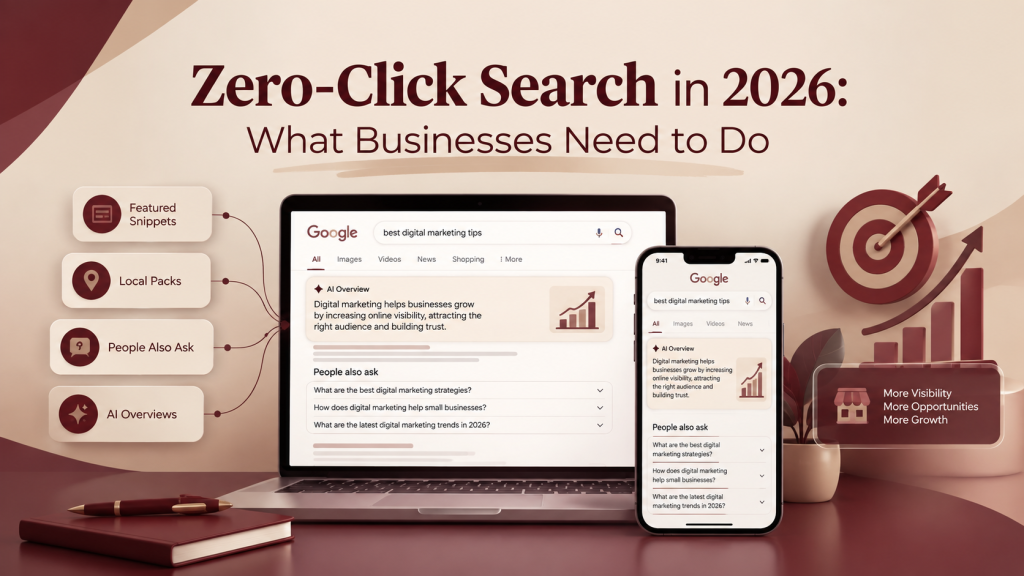
Zero-Click Search in 2026: What Businesses Need to Do
Zero-Click Search in 2026: What Businesses Need to Do Someone types a question into Google. A years ago that meant looking at a list of blue links and choosing one to open. In 2026 it often means something the answer shows up. In a snippet a box, a local listing or a short summary made by an AI. And the person moves on without opening any website. This is zero-click search. It is no longer a small thing. Research from SparkToro using Similarweb data found that 68% of Google searches in the U.S. In early 2026 ended without any click up from about 60% in 2024. That is a change, in just two years and it is happening as AI-powered search experiences grow fast. Google said at I/O 2026 that its AI Mode had already reached 1 billion monthly users with the number of questions asked doubling every quarter. None of this means search is going away. It does not mean your website is not important. It means the work of appearing in search has gotten bigger. This guide explains what zero-click search really is, why 2026 is the year it needs your focus and. Importantly. Exactly what your business needs to do about it. What Is Zero-Click Search? Zero‑click search occurs when a person finds the answer they need directly on the search results page. Through a featured snippet, knowledge panel, local pack or AI‑generated summary. Without clicking into any website. Zero‑click search does not mean the search failed; zero‑click search means the answer has moved onto the results page itself. For example if someone searches “what is a domain name ” Google shows a definition at the top of the page. The searcher receives the answer closes the tab and moves on. From Google’s perspective that is a search. From a business’s perspective that is an impression that did not convert into a visit. Unless that business’s content was the source of the answer. Zero‑click search results exist because search engines have become better, at understanding intent not just matching keywords. When a question has one factual answer there is often no need to send someone to a full page to find it. How Does Zero-Click Search Work? User Query → Search Engines Understanding of Intent → SERP Feature or Direct Answer → User Gets Information → Click Becomes Optional The exact experience that the user sees depends on factors: the type of query the device of the user the location of the user the platform such as Google Search, Google AI Mode, Bing or an AI assistant and even the time of day for things like local business hours. The search engine must interpret the query. A “what is” question behaves differently from a “best plumber near me” search, which behaves very differently again from a complex multi-part research question typed into an AI chat interface. This point is worth repeating because it is easy to oversimplify: not every query produces a zero-click result and not every SERP feature behaves, in the same way. Some searches still send plenty of traffic. Transactional comparison-heavy or highly specific queries. Types of Zero-Click Search Results Featured Snippets Featured Snippets are answers that come straight from a webpage. They can be a paragraph, a list or a table. They appear at the very top of the search results. The page that supplied the answer is shown with a link yet many people do not click through the link. Knowledge Panels Knowledge Panels are information boxes that usually sit on the side of desktop results. They give a summary of facts about a business, a person, a place or an organization. The data in these panels often comes from data and trusted sources. Local Packs / Local Results Local Packs or Local Results help people who search for “near me” or other location‑based queries. Google shows a map with business names, ratings, hours and directions. A user can call, get directions or check hours without opening the website. People Also Ask (PAA) People Also Ask sections are question‑and‑answer boxes that answer related questions right inside the results page. Definitions and Direct Answers Definitions and Direct Answers give factual responses to queries such as “what is SEO” or “what is a backlink.” These answers are short and to the point. Calculator, Conversion and Utility Results Calculator, Conversion and Utility Results include things, like currency conversion, unit conversion, simple math and other quick tools. The search engine provides the answer instantly. AI‑Powered Search Experiences AI‑Powered Search Experiences include AI Overviews and conversational AI search modes. They combine information from sources into a single narrative answer sometimes with citations sometimes without a click‑worthy link at all. Why Is Zero-Click Search Important in 2026? A few converging trends make this the year businesses cannot ignore. AI Overviews are showing up on more queries. Similarwebs 2026 analysis found AI Overviews now appear on than one in five Google searches and that number is still climbing. AI-native search interfaces are growing quickly. Googles AI Mode had over 1 billion users by mid-2026 and usage keeps growing each quarter. Search behavior is becoming more conversational. People are asking questions more often expecting a clear answer instead of a list of links. Local, mobile and voice search all want answers. A person asking “is this store open now” wants a fact, not a webpage. The strategic shift for businesses is simple to say although it needs work to do: stop treating every search as a race, for a click and start treating it as a chance to build visibility, authority and trust. Some of which gives results right away and some of which pays off later. Zero-Click Search: Threat or Opportunity? Potential Challenges Content that is about explaining what X is might get less clicks even if it appears high in search results. More companies are fighting for space in the search results pages through features like snippets, panels and people also ask boxes. Certain types of website traffic