October 4, 2026

Uncategorized

How to Create Helpful Content in the AI Era

How to Create Helpful Content in the AI Era A years ago publishing one good article a week felt like a strong content plan. Now one person using an AI tool can write ten articles before lunch. But here’s the problem: readers can find ten articles on any topic just as fast.. Most of them say the same thing. Search results are full. Social media feeds are full. Inboxes are full. The real question, for any business is no longer “Can we publish more?” It’s “Why would someone choose to read ours?” The goal isn’t to create content. The goal is to create content that actually helps people. This guide shows you how to do that. You’ll learn what it means to write content, how to use AI without losing your own voice and how to structure your articles so they work for Google, answer engines and AI-powered search. All of this is practical. You can use it in your article. What Is Helpful Content? Helpful content is content that solves a problem for a real person. It gives information offers original insight and is clear enough that the reader can take action. Google calls this kind of content “people- content.” That means its made first to help people not to get search traffic. This should be the goal no matter what tool you use to write. Helpful content usually has these traits: Relevance: It answers the question the reader actually wants to know. Accuracy: All facts, dates and claims are. Correct. Originality: It brings something to the table not just repeats what others have said. Depth: It goes enough so the reader doesn’t need to open five more pages. Clarity: A busy person can read it quickly. Understand it without effort. Experience: It shows the writer has actually done the thing they’re writing about. Trustworthiness: Every claim is backed up. Opinions are clearly labeled as opinions. Practical value: The reader knows what to do after reading. Here’s a simple example. Imagine two articles on “how to choose a CRM for a business.” The first one lists ten popular CRMs and copies feature descriptions directly from their websites. It’s generic. Doesn’t help much. The second article starts by asking who the buyer is—like is this a team of three salespeople or a group of 40? It then explains which features matter at each size. It shares three mistakes the writer has seen during setup.. It ends with a one-page decision checklist. Both articles are, about the topic.. Only the second one helps someone make a real choice. Why Helpful Content Matters More in the AI Era AI did not change what readers want. AI changed how competition there is for readers attention. 1. Content is now abundant- Publishing used to take time, skill or a budget. Now it takes a prompt. Barriers to entry have. The average quality of what is published has dropped too. 2. Generic content is cheap to produce- If your article can be fully reproduced by typing your headline into an AI tool it has no advantage. Readers and search systems can find that information in places. 3. Differentiation matters more- When everyone can write a summary the winners are those who add something others cannot easily copy: first‑hand experience original examples, real data and clear opinions. 4. Search itself is changing- People now get answers from AI overviews, chat assistants and answer engines without clicking a link. Zero‑click experiences mean your content may be read, summarised or quoted before anyone visits your site. That makes clear well‑structured trustworthy writing important not less. 5. User expectations have risen-  Readers have seen thousands of articles. Readers notice padding, advice and repeated information much faster than before. This is why smart businesses focus on value, than volume A smaller number of useful pages usually does more for trust rankings and leads than a large library of thin ones. The 10 Principles of Helpful Content in the AI Era Here is the rewritten version of the input: 1. Start with the people who will read it. Before you begin writing think about who the writing’s for and what they hope to achieve. Saying “small business owners” is not specific enough. Instead think about “a restaurant owner who wants to get local orders but doesn’t have a big budget for ads.” That is something you can write for. 2. Know why people are looking for something. Someone who searches “how to create content” is looking for a way to do it. Someone who searches “content marketing agency” is looking to compare companies. The same topic may need pages for different reasons. 3. Fix an issue. Each article should help the reader move from a problem to a solution. If you cannot explain the problem in one sentence the article is not ready to be written. 4. Share something Ask yourself: what can we say that the top five articles do not? A way to do something, a mistake, a small test, a tool to use. One new idea in an article can make it stand out. 5. Show experience. “Rewriting 30 product pages led us to add a size guide, which helped reduce customer questions” is much better than “product pages should be detailed.” Only share what you have actually done. 6. Use reliable facts. Check every number, date and statement. If you cannot find a trusted source leave it out. 7. Make it simple to read. Short paragraphs, words, clear headings. If a reader has to read a sentence rewrite it. 8. Use AI as a helper not as a substitute. Let AI help with the tasks that take time. Keep the thinking the opinions and the checking for facts in your hands. 9. Write for people and, for machines. Start by writing for the reader. Then organize the page so search engines and answer machines can understand and use the information. 10. Keep making it better after it is out. Look at how it’s doing update old
Uncategorized

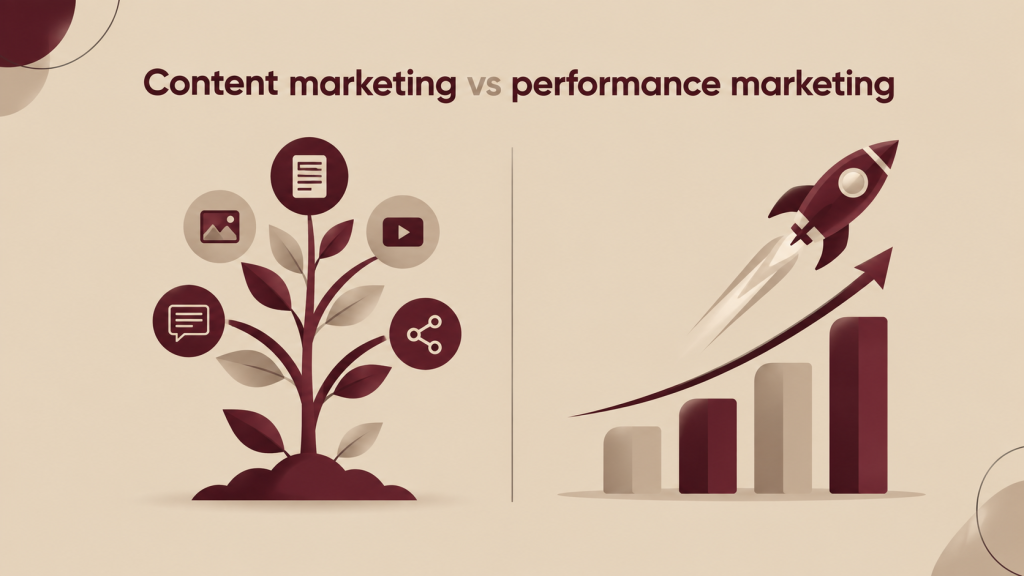
Content marketing vs performance marketing

Content marketing vs performance marketing Every business eventually faces the fork in the road. One path is to build long‑term reach with blogs, videos, guides and search rankings that keep drawing people in. The other path is to run paid advertising that puts your offer in front of customers this week and tells you how much each lead costs. So the real question behind content marketing versus performance marketing is this: should your business invest in content marketing in performance marketing or in both? In this guide you will learn what each strategy really means how they differ in cost, speed return on investment and measurement which businesses should lean on which how they work together and how to build a combined plan step, by step. No confusing words. Every technical term is explained when it first appears. I hope this guide helps you. What Is Content Marketing? Content marketing is a strategy that focuses on creating and sharing relevant content to attract and engage a specific audience. Of pushing sales messages directly this approach builds relationships by offering value. The content earns attention by answering questions solving problems and building trust—often before the buyer is even ready to talk to sales. How it works- Imagine someone searches for “how to choose accounting software for a business.” Your blog post appears in the search results offers an answer and gently shows how your product helps. The person reads it finds value and comes later. They sign up for your email list continue learning from your content and eventually reach out to ask about your solution. You didn’t pay for that click. You invested time or money to create content that keeps working over time—like an asset that keeps generating leads. Common content marketing formats  Blog posts and how-to guides  Case studies and customer stories  Videos and YouTube tutorials  Social media content  Email newsletters and email sequences  Whitepapers and e-books Webinars, templates, calculators and other educational tools Where it sits in the marketing funnel The marketing funnel shows the journey a buyer takes—from hearing about your brand to becoming a customer. Content marketing plays a role at every stage. It’s most powerful at the top and middle. At the top of the funnel content helps people recognize a problem—like “What’s wrong with my bookkeeping?” In the middle it supports decision-making—like “Which software fits my needs?” Benefits and limitations- Benefits:  It drives compounding traffic over time.  It builds brand authority and trust.  It lowers the cost, per lead in the run.  It supports customer retention by continuing to provide value after the sale. Limitations:  It’s slow. Building rankings and results takes months.  It’s hard to track exactly which content leads to a sale.  Generic or low-quality content produces no results all. So content marketing works best when you’re patient, consistent and focused on value. What Is Performance Marketing? I notice that Performance marketing is a paid results-focused method where you pay for measurable actions such, as clicks, leads, sales, app installs or calls. Every campaign is linked to a goal. Spend is judged by the results it creates. Main channels Paid search / Google Ads: your ad shows up when someone searches a keyword. Social media advertising: Meta (Facebook, Instagram) LinkedIn, YouTube. Display advertising: banner and visual ads spread across websites and apps. Retargeting: ads displayed to people who already visited your site. Affiliate marketing: partners are paid only when they bring a sale or lead. The actions and numbers that matter Performance marketing relies on actions: clicks, leads, purchases, registrations, calls and conversions (any desired action a visitor takes). Content Marketing vs Performance Marketing: Quick Comparison What Is the Difference Between Content Marketing and Performance Marketing? Content marketing builds attention slowly by sharing content that people want to read. It grows visibility naturally over time. Performance marketing gets attention quickly by using paid ads. It focuses on results, like getting leads or sales. One creates something the other pays for short-term access. 1. Short-Term vs Long-Term Results A bakery that starts a festive hamper can use Instagram and Google ads right now and begin receiving orders this week. A B2B accounting firm that writes a GST compliance guide may not see the benefit for four to six months yet that guide can continue to bring in enquiries for many years. 2. Organic vs Paid Traffic Organic traffic comes from sources such as search results and shares. Paid traffic comes from advertisements. Organic traffic costs less per visit over time. Grows more slowly. Paid traffic is instant. Stops once the budget ends. 3. Brand Building vs Direct Response Content tells people who you’re and why you know what you do. Performance ads are made to trigger an action such as a call, a purchase or a sign up. Strong brands usually do both because people are more likely to act on names they already recognize. 4. Investment Model Content requires an investment: you pay writers, designers and strategy upfront then benefit many times. Performance marketing is pay‑as‑you‑go: you keep funding the engine. Content behaves like a long‑term resource while ads behave like costs. 5. Audience Targeting Content targets by search intent, which is what the person is trying to find or solve. Paid campaigns can also target by demographics, location, interests, behavior and past site visits. A local clinic can show ads within five kilometres of its location something content alone cannot control so tightly. 6. Measurement Paid campaigns show numbers: spend, clicks, leads, cost per action. Content impact spreads across points of contact. A reader might find a blog via Google return via email and convert after a follow‑up ad. Deciding which point of contact gets credit is therefore messier for content. 7. Scalability Performance marketing scales quickly when you raise budgets until the audience becomes full or costs rise. Content scales through output, topical authority and better distribution which takes longer but has a lower ceiling on cost. 8. Customer Journey Content is strongest early, when buyers are researching.

Scroll to Top