Author name: @Shubhi

Uncategorized

How to Generate More Leads Through Digital Marketing

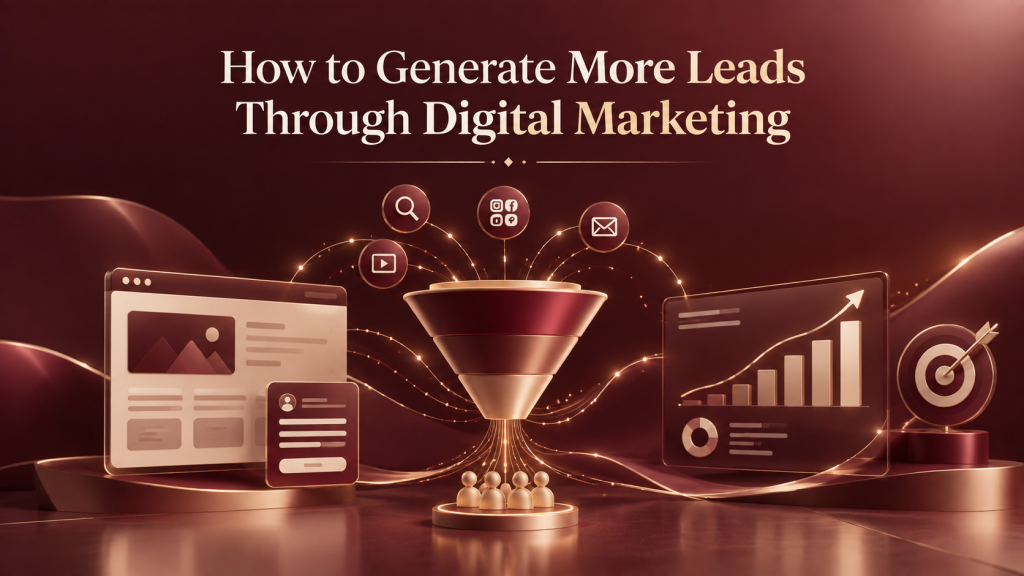
How to Generate More Leads Through Digital Marketing A business can have a website, a busy Instagram account and a Google Ads campaign that runs every single day. And still see the contact form stay empty week after week. This is one of the common problems that small business owners talk about when they go to a marketing company: there is traffic but no leads. People come in look around a bit and then go away without calling or filling out a form. The issue is usually not because there is not digital marketing happening. The issue is that the different parts are not working as one system. Getting leads on a basis is not about doing more of everything. It is about getting the right people to come building their trust quickly giving them an easy way to reach out and following up before they forget about you. This guide explains how to get leads using digital marketing in a clear and helpful way. Covering strategy, the different channels, the steps, in the process budgets, typical mistakes and a 30-day plan that you can really use whether you are running a local service business in Pune or a SaaS company that sells all over the country. What Is Lead Generation in Digital Marketing? Lead generation is the process of attracting people who’re truly interested in what you offer and collecting their contact details so your business can reach out to them. A lead is a person who has shown interest. By filling out a form calling, sending a message on WhatsApp downloading something or scheduling a meeting. They are not yet a customer. They have moved from being unknown to being someone you can speak with directly. It helps to understand a terms that are often used in a confusing way: Traffic is the number of people who come to your website or page. Traffic by itself does not have any value until it turns into something A lead is a visitor who has given you a way to get in touch with them. A customer is a lead who has actually made a purchase. Not all leads are the same. A qualified lead fits your customer profile. Right budget right need, right time. An unqualified lead might have filled out a form out of curiosity or they might not have the money or the power to make a purchase. Example: A digital marketing agency runs a Google Ads campaign for “SEO services for clinics.” Someone who searches for that phrase lands on a relevant page and asks for a free audit is a qualified lead. Someone who clicks on an Instagram ad and fills out a form just to “see what it’s, about” is a much weaker lead. Even though both are technically leads. How Digital Marketing Generates Leads Lead generation is not something that happens at once. It is a process. A good way to understand it is: Awareness → Interest → Consideration → Lead Capture → Nurturing → Conversion Every part of this process needs tools working together: Awareness: Search engine optimization, social media and content help people learn about your brand for the first time. Interest: Blog posts, videos and social media updates answer questions and create excitement. Consideration: Examples of work comparison guides and service details help the person decide if you are right for them. Lead Capture: Web pages, forms, free resources and calls to action turn interest into contact details. Nurturing: Emails and ads keep the conversation going until the person is ready to take action. Conversion: A phone call, a demonstration, a meeting or a purchase finishes the process. No one method can do everything. Search engine optimization might bring someone in through a blog post; a clear call, to action turns them into a lead; emails keep them engaged for three weeks;. A sales call makes the final move. If any one of these steps is missing people stop moving through the process. Why Digital Marketing Is Important for Lead Generation I have seen digital marketing become the way to get new customers because digital marketing lets businesses reach and measure their audience in ways that regular marketing cannot.  Wider reach- A local bakery and a national SaaS company can both reach their exact audience but at very different scales.  Exact targeting- By location interest, behavior, device and search intent.  Results you can measure- Every click, form fill and call can be tracked.  Lower barriers to start- A small business can start with a modest budget.  24/7 visibility- A website or Google listing works even outside business hours.  Different messages for each group- Messages tailored to each audience group.  Target again- A second (or third) chance with people who already showed interest.  Decisions based on data- Campaigns can be adjusted based on real performance, not guesswork.  Growth that can expand- Budgets and campaigns can grow as the business grows. It is honest to say that digital marketing does not promise a fixed number of leads. Digital marketing builds a system where the right mix of channels, offers and follow-up consistently creates results, over time. How to Generate More Leads Through Digital Marketing This is the heart of the strategy. Thirteen approaches that when used together create a full lead-generation system. Strategy 1: Build a High-Converting Website Your website is where everything begins. It’s the place all your efforts. SEO, ads, social media. Are meant to go. If your site is slow hard to use or looks outdated then every rupee you spend on driving traffic will be wasted. A website built to convert should include: A clear value proposition at the top of the page Simple and easy navigation A strong visible call-to-action Full responsiveness on mobile devices Fast loading times Trust signals like certifications, client logos or years in business Contact details that are easy to find Service or product pages that’re well-organized Testimonials and case studies to build credibility Short and simple lead forms Live chat or

Uncategorized

How to Get Your Business Featured in AI Search Results:

How to Get Your Business Featured in AI Search Results: Search behavior is changing faster than most businesses understand. People aren’t typing queries into Google. Scrolling through ten blue links like they used to. Instead they’re turning to AI tools like ChatGPT, Perplexity, Gemini and Google’s AI Overviews. They want answers. And often they want business recommendations right there in the response. This shift brings up a question for every business owner: when someone asks an AI tool to suggest a business like yours will your brand come up? For most businesses today the truth is, we don’t know.. That’s the real issue. This guide is here to fix that. Two new fields have emerged to help brands stay visible in this world: Answer Engine Optimization (AEO) and Generative Engine Optimization (GEO). These don’t replace SEO. They build on it. In this guide you’ll get a picture of what AI search really means. You’ll learn how AEO and GEO work together how AI systems find and judge businesses and a practical step-by-step plan you can start using this week. Whether you operate a clinic in Lucknow, a tech startup in Bengaluru or an e-commerce store shipping all, across India. What Is AI Search? AI search means using language models and generative AI tools to answer a user’s question right away. It usually pulls together facts from places instead of merely giving a list of links. Tools such as Google AI Overviews, ChatGPT Search, Perplexity and Microsoft Copilot scan the web pick out the facts and give a chat‑style reply—sometimes with citations sometimes with brand or product names tucked into the answer. Traditional search engines rank pages. Let the user click through to decide what is useful. AI search skips that step. The system reads the content for you. Decides what to show, quote or suggest. Why should businesses care? Because when an AI system answers a question in your field—like ” accounting software for small business ” “top salons near Connaught Place ” or “most reliable CRM, for startups”—and your business is not mentioned you do not just lose a click. You lose the chance to be considered all. Businesses should notice that missing out on AI search answers means missing out on customers. What Are AEO and GEO? What Is AEO? Answer Engine Optimization or AEO is the method of arranging content so that it can be pulled out easily and used as an answer by search features, voice assistants and AI-generated results. AEO focuses a lot on clarity. AEO aims to answer the question that a user is asking. AEO does this in a form that a machine can pick up cleanly. Such forms include a definition, a paragraph, a numbered list or a table. What Is GEO? Generative Engine Optimization or GEO is a method of improving how a brand is understood, referenced and cited within generative AI experiences such as ChatGPT, Claude, Gemini and Perplexity. GEO goes beyond formatting. GEO is about clarity of the entity authority on the topic mentions across the web and the overall citability of your content and brand. AEO, vs GEO AEO and GEO are not rigidly disciplines. Think of them as overlapping layers that share the goal. AEO is more tactical and focused on content format. AEO works to make individual answers extractable. GEO is more strategic and brand-focused. GEO works to make your business as an entity trustworthy enough to be summarized recommended or cited across AI systems and contexts. In practice most businesses need both AEO and GEO. AEO helps a specific page get noticed for a question. GEO builds authority that makes an AI system comfortable mentioning your brand at all.. Beneath both AEO and GEO lies traditional SEO. This foundation still decides whether your site gets crawled, indexed and understood first. How AI Search Finds and Understands Businesses AI systems do not use a ranking formula and no person outside the companies that build these tools knows the exact mechanics. But based on how these systemsre built and documented several signals consistently matter:  Website content- Clear, well‑organized pages that answer real questions  Search engine indexes-  Most AI systems rely on underlying web indexes (often Google’s or Bing’s) to find candidate sources  Structured data- Schema markup that explicitly labels who you are what you offer and where you operate  Reviews and ratings- Especially for local and commercial queries  Brand mentions- Appearances on third‑party sites even without a link  Authoritative publications- Industry sites, news coverage and respected directories  Local listings- Google Business Profile and consistent local citations  Consistency of business information- Matching name, address, phone number and descriptions across the web Topical relevance and depth- How comprehensively your site covers a subject  Overall content quality- Accuracy, usefulness and freshness The takeaway: AI systems triangulate. AI systems cross‑reference your own website against what the rest of the internet says about you. That is why isolated tricks rarely work. Visibility comes from signals, across many sources. Why AI Search Visibility Matters for Businesses Appearing in AI-generated answers can bring advantages though none of them are guaranteed: Brand visibility rises when someone is deciding what to buy or where to go New audiences discover you audiences who could not find you through a normal search Brand authority grows when you are mentioned next to established names, which builds implicit trust Referral traffic comes from AI tools that link back to your sources Trust increases because users treat AI-generated answers as a shortlist of vetted options Competitive advantage appears while many businesses, in your space still have not adapted Better visibility shows up across new search experiences not just Google These are potential benefits, not guarantees. AI search visibility changes with shifting factors and no valid strategy can guarantee that you will appear in AI-generated answers. How to Get Your Business Featured in AI Search Results This is the structure. Go through it step by step. Each part depends on the one before it. Step 1: Create a Solid, Easy to

Artificial Intelligence (AI)

AI Content vs Human Content: Which Performs Better?

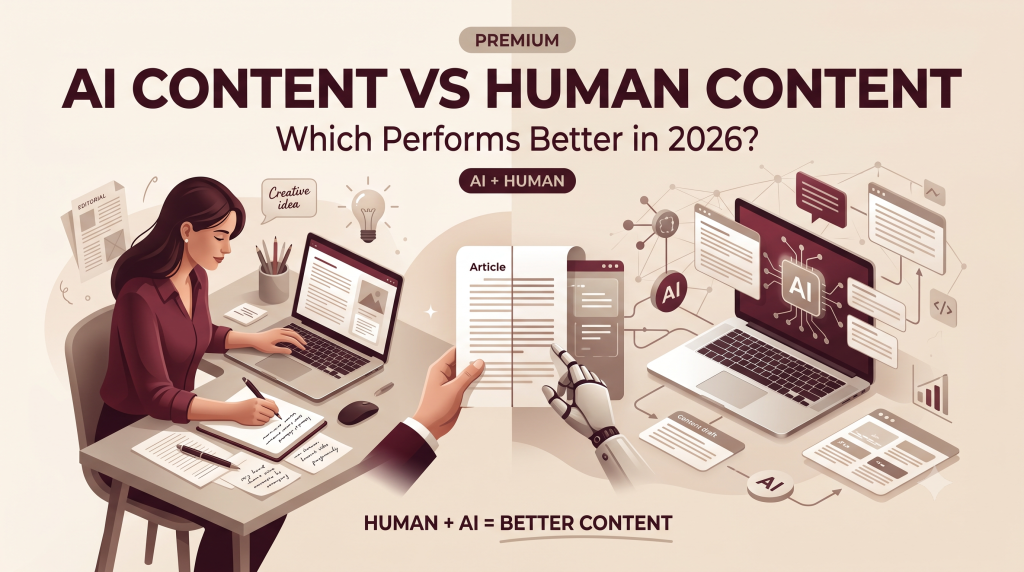
AI Content vs Human Content: Which Performs Better? Introduction Two years ago many businesses were still unsure if content written by AI could actually work. Today AI tools are part of every content process. Helping with outlines drafting first versions creating product descriptions and answering customer questions before a person even starts writing. This change has led to a question for anyone who publishes online: should you use AI-generated content, human writers or a mix of both? The real answer isn’t about choosing one over the other. AI content and human content don’t compete in the way. Their strengths depend on what you care about. Like search rankings trust from readers how much people engage or whether they turn into sales. A post that ranks high might not lead to conversions. A written article might never be found by anyone. This article looks at where each method works and where it struggles. It also shares what the data and official rules say about quality and rankings. By the end you’ll have a way to decide what fits your strategy. And why the choice is usually not “either AI or humans ” but something in, between. What Is AI-Generated Content? AI-generated content is text or other types of media created by a machine learning system. This usually involves a language model like the ones used by ChatGPT, Gemini or Claude. The system follows a prompt that a person writes. These models are trained on amounts of text and they learn how language works. This helps them create writing that makes sense and is related to the topic they are given. It can be done quickly. In life AI content means different things to different people. At one end someone might type an instruction and then share the result without changing anything. At the end a writer might use AI to help start a piece of writing. Then they check the facts change the words and organize the content in a way. This difference is more important than many people think. It affects the quality how correct the content. How well it works. People use AI-generated content in ways today. Some examples are: Drafts and outlines for blog posts Descriptions for products when many are needed Captions for social media Copy for email marketing versions of ad text for testing Briefs for writers to use Answers to frequently asked questions Meta descriptions and titles for SEO For companies that need to create a lot of content like online stores, with thousands of products AI is no longer something new. It has become a part of the work that needs to be done. What Is Human-Written Content? Human writing is the result of an effort to communicate. Human writing comes from thought, human work and human feelings. While software writes by guessing what words are most likely a human writer starts a page with something that machines do not have. A human writer has a point of view that comes from life experiences. When an experienced marketing strategist, software engineer or clinical doctor writes an article, a human writer does more than just repeat what the ten Google results say. A human writer uses years of trial and error customer talks, surprising project failures, private case studies and quiet cultural instincts. A human writer knows when a strange metaphor will help explain an idea or when a true admission of vulnerability will calm a doubtful buyer. Human writing has clear mental qualities: Lived practitioner experience: Real insights that come from hands‑on work from making executive decisions and from real field tests. Original investigative research: Doing surveys talking to industry experts and finding new data. Emotional. Empathy: Adjusting tone, pace and style to meet the fears and hopes of the reader. Narrative storytelling: Weaving stories and dramatic tension, into lessons or business talk. Nuanced critical reasoning: Arguing bold ideas that go against common opinion. AI Content vs Human Content: Key Differences:- AI CONTENT AI-generated content is made using intelligence tools that can quickly create articles, captions, product descriptions and other marketing materials. It is helpful when you need a lot of content and want to save time. However AI content can sometimes sound the same feel ordinary or miss the touch and emotional feelings that people have. It also needs a person to check the facts make sure it is original check the tone and ensure it fits the brand. HUMAN CONTENT Human-written content is created by people using their imagination and knowledge. It is based on experiences. Thinking carefully about things. Human writers can understand emotions. They can sense what people want to express. They also understand cultures and how to share a story. This helps them make content that feels real and easy to relate to. It usually makes people believe in the content more. Does Google Penalize AI-Generated Content? No Google does not penalise content simply because it was created using AI. Google’s long‑standing position, first set out in guidance published in 2023 and reaffirmed since is that Google evaluates content based on quality and helpfulness not on the production method. What Google does penalise is the misuse of automation including AI to mass‑produce content whose primary purpose’s to manipulate search rankings rather than to help users. This falls under Google’s spam policies about scaled content abuse. The distinction is really about intent and outcome, not the tool: Allowed: Using AI to help draft, outline or scale content that’s genuinely useful, accurate and reviewed for quality. Not allowed: Publishing volumes of thin, unoriginal or unreviewed AI output purely to capture search traffic. Google’s quality systems evaluate content against the E‑E‑A‑T framework. Experience, Expertise, Authoritativeness and Trustworthiness. Regardless of who or what wrote the draft. In practice that means a well‑researched fact‑checked useful article produced with AI assistance can perform just as well as an article written entirely by hand while an unedited generic AI dump published at scale is exactly the type of low‑value content that Google’s spam systems are

Uncategorized

Social Media Marketing Trends in India 2026:

Social Media Marketing Trends in India 2026 Social media in India has stopped being a place where brands simply “post and hope.” Over the two years it has quietly turned into the countrys biggest discovery engine, its busiest customer-service desk and. For a growing number of D2C and local brands. Its most reliable sales channel. Three forces are driving this shift in 2026. First Indias internet base has crossed 950 million users with rural India now accounting for 57% of that base and growing nearly four times faster than urban India according to the IAMAI-Kantar Internet in India Report 2025. Second short-form video has become the default way Indians consume the internet. 588 Million users or 61% of the population watched short video in 2025. Third AI has moved from a marketing buzzword to habit: the same report found 44% of Indian internet users have already engaged with AI-enabled features like voice search, chatbots and AI filters. Put together this means media marketing in India in 2026 is no longer just, about likes and followers. It has become the layer across: Discovery- How people find brands, products and services Search- How people ask questions and get answers Conversation- How people talk to brands mostly on WhatsApp Community- Where people build trust with brands and each other Commerce- Where the actual buying decision now happens The journey has shifted from Posting → Discovery → Conversation → Community → Commerce and businesses that still treat social media as a broadcast channel are going to fall behind those treating it as a full-funnel growth engine. Quick Answer: Biggest Social Media Marketing Trends in India 2026 Short-form video (Reels, YouTube Shorts) remains the primary discovery format AI-assisted content creation and campaign management is now mainstream, not experimental Social search — using Instagram, YouTube, and Google’s AI Overviews to find answers — is growing fast Regional and vernacular content is expanding well beyond metro India Influencer marketing is shifting from celebrity reach to micro- and nano-creator performance WhatsApp is becoming India’s default conversational commerce channel Authentic, unpolished UGC is outperforming heavily produced brand content in many categories Social commerce is growing alongside quick commerce as a shopping habit Community-led marketing (WhatsApp groups, private communities) is gaining strategic importance Brands are being pushed toward measurable ROI, not vanity metrics like follower count Why Social Media Marketing Is Changing in India in 2026 A few changes in structure explain why 2026 feels different from two years ago. Rural India is now the engine of growth. Rural internet users, 548 million are slightly more than urban users when it comes to watching short videos according to IAMAI. Brands that thought social media marketing was for big cities now miss more than half of the people they could reach. Using a phone first and watching videos first is the way people act. With than a billion mobile connections active in India as DataReportals Digital 2026: India report says, short videos grab most attention. Static image posts are having a time being found by the algorithm and even harder for people to see. AI is being used by everyone. Customers already use AI to search and filter. Marketers use AI for everything from writing captions to testing ad designs. Businesses that ignore this change are stuck. The creator economy has grown. In India influencer marketing is expected to reach about ₹4,500–5,000 crore in 2026 Kofluences Decoding Influence 2026 report says, up from ₹3,000–3,500 crore in 2025. This is no longer a trend; it is a real industry with clear return on investment goals. WhatsApp is the link in digital life. In a country where people chat more than they browse apps, WhatsApp Business, catalogues and click‑to‑WhatsApp ads are the link between seeing something on Instagram and actually buying it. Shopping habits are moving beyond marketplaces. IAMAIs report says that out of internet users 230 million people or 56% shopped online in the last year. Quick commerce and social commerce are gaining share along with e‑commerce marketplaces. None of this means old channels are dying. Facebook still has about 700 million users, in India according to NapoleonCat/Meta data. It means the way people use these platforms and what they expect from brands has changed. Top Social Media Marketing Trends in India 2026 Trend 1: Short‑Form Video Becomes the Core Discovery Format What is happening? Instagram Reels and YouTube Shorts have become the way that Indian users find new brands, products and creators. They are used more than posts, image carousels or even searching in some categories. Why is it important in India? Because 61% of India’s internet users watch video and more people in rural areas are joining the web quickly. Short‑form video can reach people that many brands have not been able to reach with advertising. What does it mean for businesses? If your brand does not put out videos regularly it will be invisible to the algorithm that most customers use every day to discover new things. How can brands use it? Restaurants: short recipe previews, behind‑the‑counter clips, dish reveal moments D2C brands: unboxing videos, before‑and‑after shows founder explainer Reels Education businesses: 30‑ to 60‑second concept explainers estate: walkthrough Reels that show local landmarks and price highlights Beauty/fashion: get‑ready‑with‑me videos and styling Reels Service businesses: client testimonial snippets and a day‑in‑the‑life clips Best suited for: Almost every business, but especially D2C, hospitality, education, beauty and local services. Key takeaway: Treat short‑form video as your discovery engine, not just a vanity post. Every Reel must have a next step, such, as follow, DM, link or WhatsApp. Trend 2: AI‑Powered Social Media Marketing:- What is happening? AI now sits inside every step of the marketing workflow. From brainstorming ideas and writing captions to editing videos translating text creating ad variations and analysing audiences. Why is this important in India? Marketing teams in India at small businesses and startups are often small. AI tools let a two‑person team create work that used to need five people. They also help localise content into

Uncategorized

Digital Marketing Trends in India 2026:

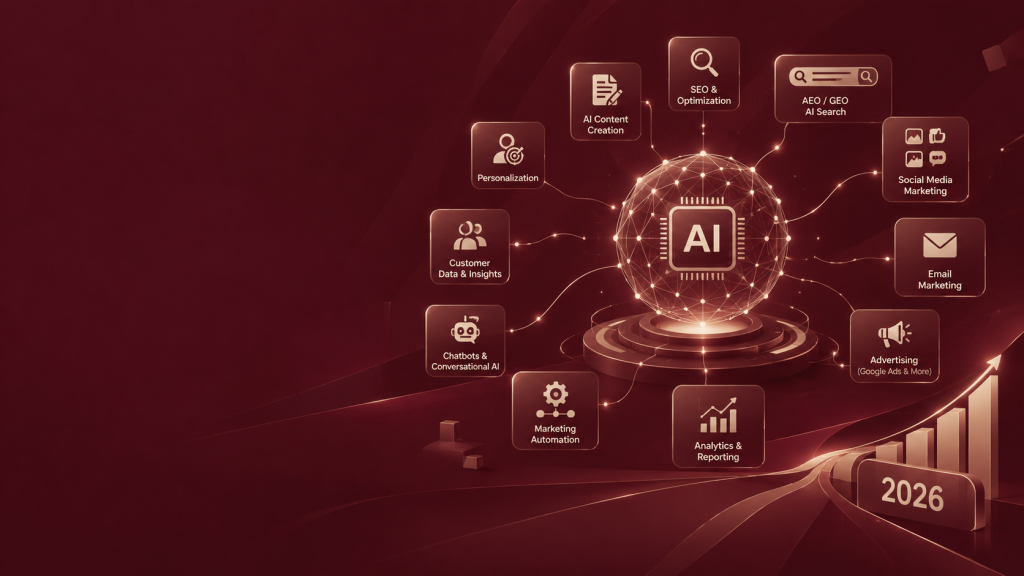
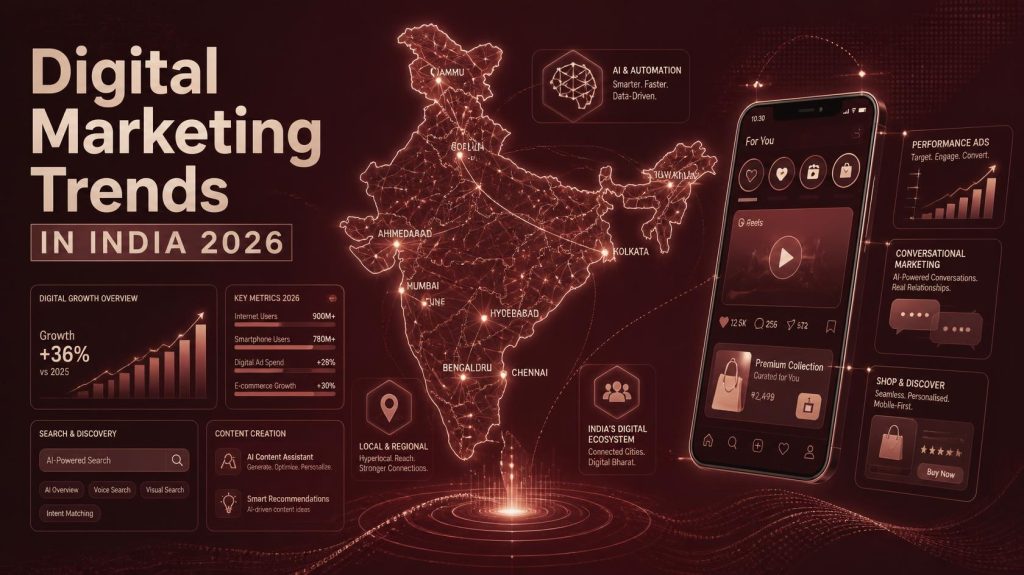
DIGITAL MARKETING TRENDS IN INDIA 2026 A shop owner in Indore now runs Instagram ads that are targeted by an algorithm that he has never seen before. He receives order confirmations on WhatsApp from a chatbot that he did not build and sometimes his name appears inside an answer on Google that never sends the customer to his website. None of this existed as “normal” five years ago. In 2026 it is Tuesday. That is really what is different about this year. It is not that digital marketing has gone online. That happened a decade ago. It is that the machinery underneath marketing has changed hands. Search results are increasingly written by AI than linked one by one. Discovery happens much on Instagram and YouTube as on Google.. A huge share of India’s next wave of digital buyers. From Tier 2 and Tier 3 towns on a phone in a regional language. Does not behave like the urban, English‑speaking desktop‑first audience that most marketing playbooks were built for. This guide is not another list of twenty predictions. It is a working explanation of what’s actually changing in Indian digital marketing in 2026, why it is happening and. More importantly. What a business, with limited time and budget should do about it. Quick Answer: Key Takeaways I see that AI has moved from experiment to infrastructure. I see that Googles and Metas ad platforms now handle much of the targeting, bidding and creative testing automatically. I see that Search is no longer a list of blue links. I see that Googles AI Overviews already appear on a share of Indian searches and AI Mode. Including a real-time “Search Live” feature. Launched in India before most other countries. I see that SEO is not dying. It is expanding to include AEO (being the direct answer) and GEO (being cited inside AI-generated responses). I see that Short-form video remains the default discovery format. But raw useful imperfect content is increasingly outperforming heavily produced ads. I see that language and hyperlocal content is not optional anymore as internet growth shifts toward Tier 2 and Tier 3 India. I see that WhatsApp has quietly become a sales and support channel, especially with UPI-based in-chat payments. I see that Indias privacy landscape has shifted from theoretical to real. The DPDP Act and its Rules are rolling out in phases through 2027. I see that Micro and nano-influencers, regional creators often outperform big-name endorsements for trust and conversion. I see that Quick-commerce apps have become advertising channels, particularly, for FMCG, food and D2C brands. I see that the businesses that win in 2026 will not chase every trend. They will pick two or three that actually fit their customers. The Digital Marketing Landscape in India in 2026 Indias story of growth hasn’t slowed. It has changed where it is happening. The languages it is using. More people who are new to the internet buying things and even creating content are coming from cities that’re not the biggest. These people are using phones first often using their third phone. They have internet and lower costs than the earlier generation had. A company that only speaks in English only focuses on computers. Only looks at the big cities is choosing to make its market smaller on purpose. At the time more companies are trying to get attention. Every business from a brand with two people to a big store that covers the whole country is trying to get noticed in the same news feeds the same search results and the same short videos that last ten seconds. On top of all that there is a change because of intelligence. Googles AI summaries are already appearing for a quarter of the searches in India. Google has said that most of the searches around the world end without anyone clicking on a website. This one fact should make every business in India think differently about the content it creates. Being found is now just as important, as being clicked on. None of this means that the basic ideas have gone away. What has changed is where those basic ideas need to be and how they need to change to fit new ways people find things. Top Digital Marketing Trends in India 2026 1. AI-Powered Marketing Becomes the Default, Not the  Add-On AI tools are now embedded directly inside the platforms marketers already use — automated bidding, automated ad creative, and writing, design and analytics tools that plug into everyday workflows. For most Indian SMEs without large teams, this is a force multiplier: work that used to need eight people can now be handled by two or three. How to adapt Use AI for the repetitive 80% — first drafts, variations, reporting — and keep a human in charge of the 20% that decides brand voice and what gets published. Common mistake Publishing AI-written content without a human review pass. It’s usually detectable and can quietly damage trust. Action to take Pick two or three recurring tasks and build a simple AI-assisted workflow for just those, with a mandatory edit step. 2.   AI Search, AEO and GEO Change How Things Are       Seen Search is breaking into three parts. Organic results, AI summaries that appear in search and separate helpers like ChatGPT, Gemini and Perplexity. India was one of the places outside the United States to get Googles new, real-time, voice and camera based “Search Live” feature, before many Western places. Ranking number one does not always mean people will see your content if an AI Summary answers the question before the listing. But being mentioned inside that summary can really help. How to Change Arrange content so a machine can take out an correct answer. A direct answer at the start then more details and real experience. Common Mistake Thinking about GEO as a way to trick the system. Writing “for the AI” of for the person reading. AI systems are made to remove that. Action to Take Rewrite

Scroll to Top